American mosaic: A photo essay
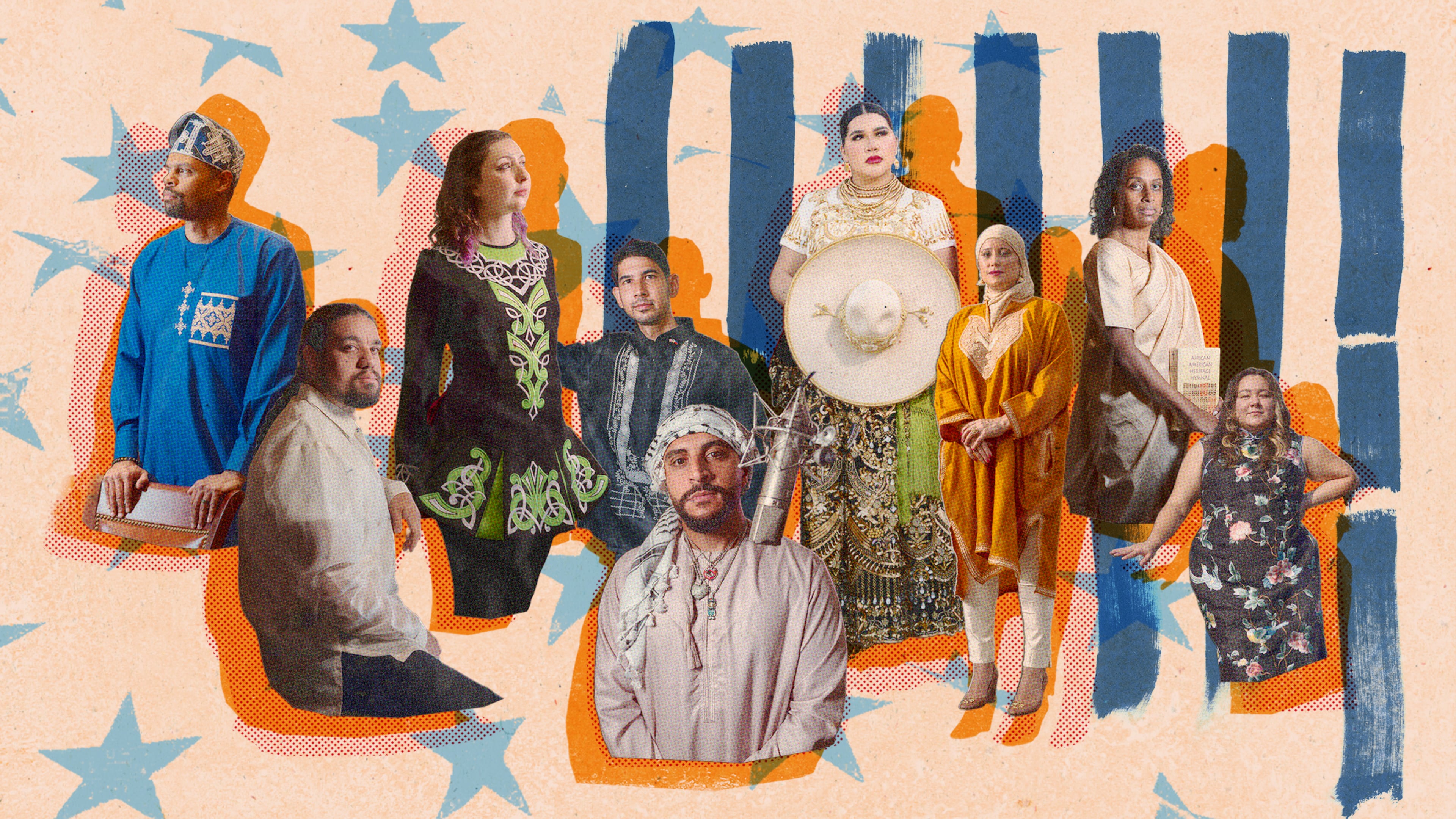
From the pilgrims and Puritans to the Irish and Indonesians, we are a nation of people who have made long, often difficult, journeys to reach our shores. America is built from the contributions and cultures of people the world over.
One common metaphor for the country is the mosaic. Like a work of art assembled tile by tile, we are made up of many cultures, ethnicities and ideas. In metro Atlanta, you can see this rich variety in the city’s Black cultural influence, the immigrant enclaves of Clarkston and Buford Highway and the long-standing customs that shape the South.
For the country’s 250th anniversary, I photographed eight first-generation Americans — those with at least one immigrant parent — to honor and celebrate our multicultural heritage.
First-generation Americans are uniquely positioned to illustrate the American mosaic. They are the connective pieces in this country because they are born in the U.S., but also carry some of their parents’ customs. I have a personal connection to this because I, too, am first-generation American. My mother is from the Philippines, and my father is from India.
For this project, each person is dressed in traditional attire from their heritage while posing in an Atlanta location that is meaningful to them. I talked to each participant about their experiences as first-generation Americans and what they hope readers take away after seeing their pictures.

Maya Prabhu
It wasn’t until Maya Prabhu got to Spelman College, a historically Black college, that she was able to embrace her Indian heritage.
When she was growing up, Prabhu’s Black relatives sometimes made jokes about her being Indian, or teasingly called her an “immigrant.” It made her feel confused and ashamed. “It hurt my feelings because they were basically saying ‘You’re not one of us,’” said Prabhu, whose mother is Black and from New York and whose father is from India.
When she got to Spelman, she met other Black students who also had multiple identities. Conversations with these friends helped her come to terms with her own mixed lineage. “I identify culturally as Black … but I don’t shun the fact that I am Indian anymore, like I did when I was a kid,” she said.
She hopes that readers viewing her portrait, in which she wore an Indian sari, will understand that Americans come in all forms. “Just because someone might have a different background than what you’re used to seeing, it doesn’t make them any less American or any less part of Atlanta.”

Jocelyn Correa
Sometimes when Jocelyn Correa drives with her father in Douglasville, he points out the car window: “I made this house,” he says proudly.
For her portrait, Correa posed in a china poblana, a ceremonial outfit she sometimes wears for the Mexican equestrian sport charrería. Jocelyn rides solo and on an escaramuza team, where women perform synchronized routines on horseback.
She chose a construction site as a tribute to her father, a carpenter from Mexico who owns a construction company.
For Correa the site represents the fact that much of America was built by immigrants. She said her parents, both from Mexico, taught her to honor her roots, and she is passing that forward as a charrería rider who teaches children and competes across the country: “I am proud to share our culture with others.”

Aisling Mahony
Aisling Mahony wants you to know there’s more to Irish culture than wearing green and heading to your local Irish watering hole on St. Patrick’s Day (although that’s great, too).
Mahony, whose father is from Ireland, spent her childhood competing in Irish dance and now teaches elementary school students the discipline at St. Thomas More Catholic School in Decatur. Through dance, she said, she can share Irish history and culture with Americans who haven’t dug below the surface.
Mahony chose to wear a team dance dress, used for céilí dances performed by groups, to have her portrait taken at Georgia Tech College of Design, where she is a student. She was inspired to go to Tech by her father, who studied engineering.
“I think Irish dancing is beautiful in that it is so old, and I know so many people did it before me,” she said. “There is something so wonderful about being here and living a very different story than my ancestors, but still doing something very similar to what they once did.”

Faris Mousa (aka Phay)
In Faris Mousa’s song “US,” he tells his father’s story as a Palestinian refugee ending up in Chicago and later Atlanta. “They came to the U.S. … so they can be proud of us, us, us,” he proclaims of his immigrant parents in the song’s hook.
The rapper, whose artist name is Phay, channels his identity and personal history into his music.
When he was younger, he was ashamed of his roots — particularly after the Sept. 11 terrorist attacks created a wave of Islamophobia in the United States. But as he grew older, he came to appreciate his parents’ struggles and sacrifices to make a life in the U.S, and the history that brought them to the place they thought of as the “promised land.”
He was photographed at Tree Sound Studio in Norcross, where he has performed, wearing a thobe — a robe he wears for religious practice — and a keffiyeh — a headdress historically worn by nomadic communities in historic Palestine. “Americans come in all kinds of colors, creeds, the way they dress, the way they talk,” he said. “I think that’s the beauty of America.”

Sameera Fazili
For Sameera Fazili, the lessons from the National Center for Civil and Human Rights in Atlanta are personal.
Fazili’s parents left Kashmir, a region in the northern part of the Indian subcontinent, to escape a history of war and political disenfranchisement.
When they came to the U.S. in the early 1970s, the Civil Rights Movement had newly committed the country to equal protection under the law, said Fazili, an attorney and economic policy consultant. “My parents taught us to cherish the freedoms that America offered since they grew up knowing what life was like without these freedoms of speech, assembly, or voting rights,” she said in a statement.
Posing at the National Center for Civil and Human Rights, Fazili wears a cloak called a pheran, made of pashmina wool and embroidered with metallic threads in the tilla style. She calls the museum “a space of inspiration,” where visitors can celebrate the everyday people who are fighting for freedom and a better future.

David Samonte
The unofficial greeting for Filipinos is “have you eaten yet?” joked David Samonte, whose mother is from the Philippines. It’s a testament to Filipinos’ culture of hospitality.
That’s part of the reason Samonte chose the Atlanta pub Manuel’s Tavern as the setting of his portrait. He is friends with the bar’s staff and owners and spends holidays there when he isn’t able to see his family in Maryland. The conviviality feels Filipino. “It’s got similar vibes, despite it being basically on the other side of the world of the culture I was raised by,” Samonte said.
He wore a barong, which was handmade for him in the Philippines and brought to him by an aunt. He likes to wear it to formal gatherings, because it’s a conversation piece: “The barong is a nice connection to my culture, and it makes a statement about that.”

Emily Wu Pearson
Waffle House has a special place in the love story between Emily Wu Pearson and her husband, Matt. When they were long-distance dating between Georgia and Florida, they’d often meet at a Waffle House to share breakfast and conversation. When they eloped, they had their photos taken at one. And for their two-year anniversary, they had a photoshoot at the Waffle House Museum (home to the original restaurant) in Avondale Estates.
Getting photographed again at the Waffle House Museum in her Chinese qipao felt natural — almost. Pearson, who is white and Taiwanese, said that she has long felt uncomfortable wearing the outfit because she hasn’t seen many mixed-race people wearing it. She harbored guilt that she might not be authentic enough to don one, even though she speaks Mandarin and has lived in Taiwan, which is self-governed by also claimed by China. But she took this AJC photoshoot as an opportunity to prove to herself and others that she can take pride in this part of her heritage.
“I still haven’t decided how I feel about being mixed race, and I don’t know if I will,” she said. But “this was a really nice and comfortable way to practice being ‘both-and’ instead of one or another.”

Phil Olaleye
As executive director of the mentorship nonprofit Next Generation Men & Women, Phil Olaleye noticed the struggles of high school students he works with mirror those his own family faced.
Even though his parents came to the United States for educational opportunities and met in college, they still faced economic hardships in their new home. Olaleye worked as a teenager at Waffle House and Best Buy to help support his Colombian mother when his parents divorced. “The journey over to America is only half the battle,” he said. “There’s still so much work and struggle and sacrifice just to make ends meet and raise a family.”
That’s what motivated Olaleye to run for the state Legislature. Being photographed in Georgia’s House of Representatives is a “rags to riches” story for the state representative. Just one generation earlier, his father, who is from Nigeria, was sleeping over in a community college lecture hall after arriving in the U.S., he said. Now Olaleye is helping shape the lives of millions of Georgians.
He wears a buba, a traditional outfit of the Yoruba people, brought to him by his father. Having immigrant parents from two different countries was wonderful, he said: “It only served to enrich my upbringing.”

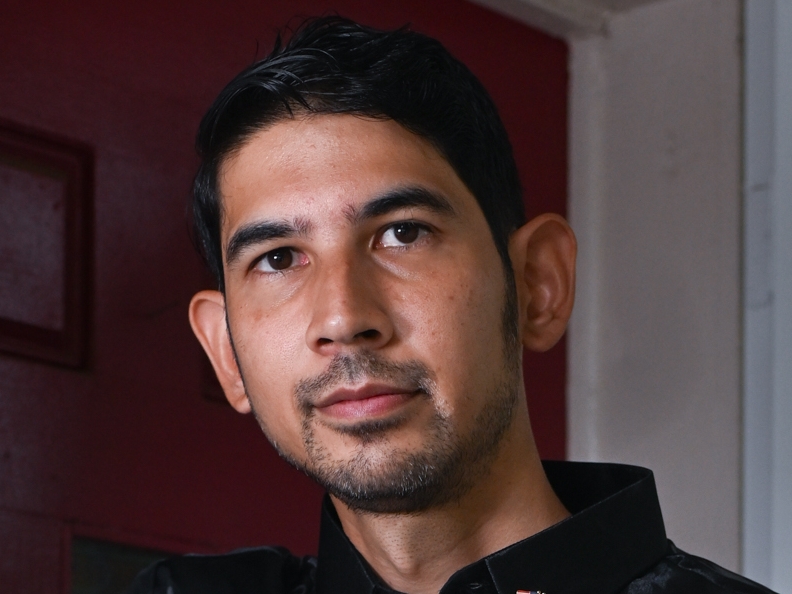
And the author — Arvin Temkar
Home has always been a tricky concept for me. I have lived in five states, three countries and one U.S. territory. Atlanta, where I’ve been for the past seven years, is the longest I’ve stayed put anywhere.
I was photographed by photographer Natrice Miller outside my apartment wearing a Filipino barong. In an opinion essay, I wrote about my complicated identity as a half-Filipino, half-Indian American who grew up on a U.S. Army base in Japan.
Ultimately home, to me, is America: as a place and as a concept. “Our history is complicated and sometimes tragic, but at its best, it is a testament to the qualities that inspired my parents and other immigrants to leave their homes to make a new one.”