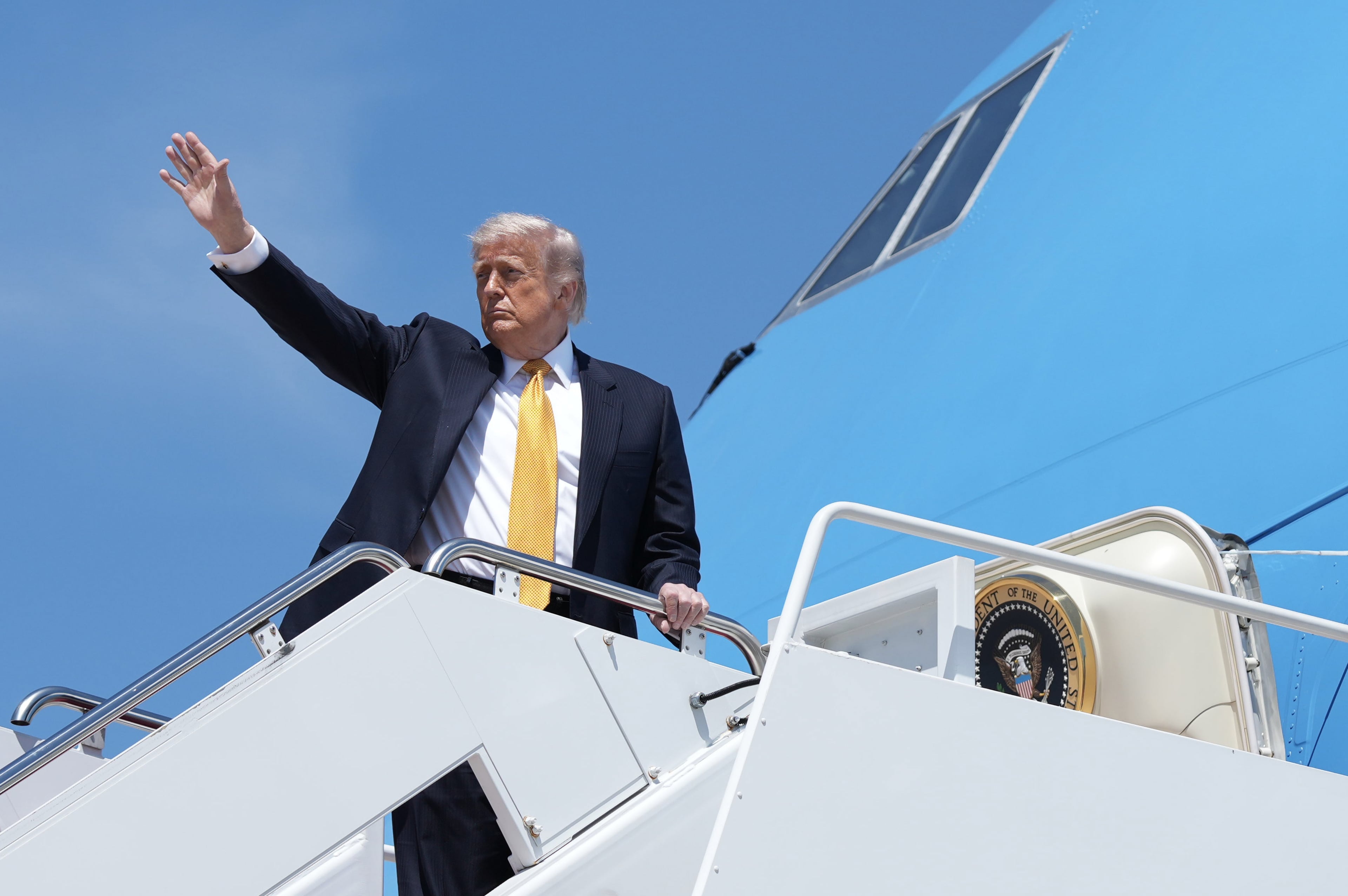
The Latest: Trump departs for China as Iran war
President Donald Trump departed Tuesday afternoon for Beijing to meet with China's President Xi Jinping. The high-stakes visit comes after Trump spent weeks trying, and failing, to persuade China to influence Iran to meet U.S. terms to end the war — or at the very least, reopen the Strait of Hormuz.
U.S. consumer prices climbed sharply again last month as the 10-week war with Iran delivered higher gasoline prices and more pain for Americans, according to data released Tuesday.
Senators from both parties grilled Defense Secretary Pete Hegseth about the Iran war ’s unclear endgame and spiraling costs, as he defended the Pentagon’s historic $1.5 trillion budget request for 2027.
Meanwhile, the Congressional Budget Office reports that Trump’s “Golden Dome” missile defense program could cost $1.2 trillion over 20 years, far more than he initially said.
Also Tuesday, a White House official said the head of Trump's Food and Drug Administration is resigning after a rocky tenure. Dr. Marty Makary drew months of complaints from health industry executives, anti-abortion activists, vaping lobbyists and other allies of the president.
Here's the latest:
Trump says trade will be focus of Beijing visit, plays down discussions on Iran
The president said he would have a “long talk” about Iran with Chinese leader Xi Jinping but added that trade would be the central issue.
“We have a lot of things to discuss. I wouldn’t say Iran is one of them, to be honest with you, because we have Iran very much under control,” Trump said as he departed the White House for Beijing on Tuesday.
Trump said he spoke with Xi and both are looking forward to the visit.
“He’s been a friend of mine. He’s been somebody that we get along with. And, I think you’re going to see that good things are going to happen.”
Trump’s proposed ‘Golden Dome’ is estimated to cost $1.2 trillion for 20 years, far more than he initially said
A new Congressional Budget Office analysis released Tuesday suggests a far heftier sum than the initial $175 billion price tag Trump gave last year for his plan to put weapons in space, called the “Golden Dome for America” missile defense program.
The system, inspired by Israel’s “Iron Dome,” aims to detect and intercept missiles at all stages of an attack. Congress has already approved about $24 billion for the initiative.
Trump ordered the system during his first week in office, expecting it to be operational before his term ends in January 2029.
With Makary’s departure from the FDA, the fate of many fledgling initiatives is uncertain
Most of the programs Makary introduced have not gone through federal rulemaking required to enshrine them in U.S. regulations and could easily be overturned by his successors.
Democrats in Congress have questioned the legality of some of those efforts, including a program that offers drugmakers expedited reviews for innovative medicines.
Marty Makary is out as Trump’s Food and Drug Administration head
That’s according to a White House official who was not authorized to speak ahead of an official announcement and spoke on condition of anonymity Tuesday.
Makary, a surgeon and health researcher, had drawn complaints from health industry executives, anti-abortion activists and other Trump allies.
He came to the attention of Republican operatives as an outspoken critic of COVID-19 health measures during the pandemic when he appeared frequently on Fox News Channel.
But at the FDA, Makary failed to win the staff’s confidence after mass layoffs, leadership changes and a series of controversies in which the agency’s scientific principles appeared to be overridden by political interests.
— By Matthew Perrone and Seung Min Kim
Hegseth hearing concludes with questions on long-term strategy in Iran war
The defense secretary’s hearing for a subcommittee of the Senate Appropriations Committee has concluded with Democratic senators repeatedly asking the defense secretary for clarity on what the plan is to reopen the Strait of Hormuz.
Hegseth was defensive and countered that the questions were ignoring the U.S. military’s successes in the war.
Sen. John Kennedy offers encouragement and warning to Hegseth
The Republican from Louisiana did not echo the administration’s claims of victory in Iran, noting the Strait of Hormuz remains closed.
But Kennedy agreed with Trump that the U.S. has long-term leverage with its blockade of Iranian ships and those aligned with Tehran. And Kennedy pushed back at Democrats that he accused of suggesting the U.S. already has lost.
“You’re not going to win over my Democratic friends,” Kennedy told Hegseth. “It’s not worth getting your blood pressure up. Focus on other things.”
Kennedy added a muted endorsement of international alliances. He wasn’t as direct as McConnell, but he concluded with advice:
“America First does not have to mean America alone,” he said. “We need all the friends we can get. They need to carry their own weight. They need to pay their bills. But the more the better.”
Democratic senator closely questions Hegseth on strategy to reopen Strait of Hormuz
Sen. Chris Coons had some intense questions for the defense secretary after he claimed that the U.S. essentially controls the Strait of Hormuz.
Coons repeatedly asked what the Trump administration’s strategy is for reopening the waterway to commercial shipping.
“If we control it, how do we reopen it? And your average American is seeing this at the gas pump every single day as the cost of gas continues to rise,” Coons told Hegseth.
Hegseth responded defensively, saying the senator was being disingenuous and ignoring the U.S.’s “incredible battlefield successes.”
Still, Coons said he was worried that “you’ve achieved a series of tactical successes but are on the verge of a strategic loss.”
Hegseth suggests Iran is accessing old drone supplies, not replenishing
Some Democrats pushed back against Trump’s claims of victory and Hegseth’s assertions that Iran’s military has been obliterated.
Sen. Jeanne Shaheen, a Democrat from New Hampshire, noted Iran’s continued use of drones, which are inexpensive assets compared to what the U.S. has used to prosecute the war.
Hegseth retorted that “pulling a drone out of a cave that’s been collapsed” is not the same as “producing more drones.”
Shaheen was unmoved, joining colleagues who have put Hegseth on the defensive deep into his testimony.
“But if Iran still has almost 50% of their capacity and the ability to pull drones out of caves and still injure our allies and U.S. service members, then we have not won the war,” she said.
Defense secretary tells senators Trump has authority to resume war
That posture has resulted in some tension between the Republican-controlled Congress and White House.
Presidents are required by law to gain authorization from Congress after 60 days of starting a war. However, the White House has argued that the 60-day deadline no longer applies because the war is currently in a ceasefire.
Republican Sen. Lisa Murkowski voiced some skepticism to that argument. Pointing to the troops and warships deployed to the region, she said, “It doesn’t appear that that hostilities have ended.”
Murkowski has hinted she may bring legislation that would authorize the use of military force against Iran.
Hegseth claims the US controls the Strait of Hormuz
He claimed to senators that “ultimately we control the Strait, because nothing’s going in that we don’t allow to go in.”
It was a striking statement from the defense secretary at a time when Iran has seized control of the waterway, causing a global spike in fuel prices that’s rippled through other economic sectors. In response, the U.S. has tried to cut off all Iranian traffic through the strait as well.
Hegseth claimed “the economic pressure that creates on them greatly outstrips the pressure on us.”
Cuban diplomat slams Hegseth’s testimony that Havana poses a threat to the US
Ernesto Soberón Guzmán, the Cuban ambassador to the U.N., said Tuesday that it is the U.S., not the small island country, that poses “an unusual and extraordinary threat” to the world and international law.
“Its acts of aggression and threats against Venezuela, Iran, Greenland, Canada, His Holiness the Pope, Palestine, Mexico, Cuba — and an endless list of others — demonstrate this to be true,” Guzman said in a statement.
His comments came hours after Rep. Mario Díaz-Balart, a Florida Republican, asked Hegseth in a congressional hearing whether he believed the Cuban government poses a national security threat to the U.S. The Pentagon chief responded, “I do.”
GOP senator pushes for the military to take a harder line on Iran
There are plenty of lawmakers, including Republicans, who are uneasy with President Donald Trump’s war with Iran. GOP Sen. Lindsey Graham isn’t one of them.
He drew a tough line as he questioned the Trump administration’s efforts to draw down the conflict and questioned the decision to use China and Pakistan as intermediaries in peace negotiations with Iran.
Graham’s ire was mostly aimed at efforts by previous Democratic presidents to prevent Iran from developing nuclear weapons. He said those efforts had “failed.”
Graham praised the current war with Iran as “spectacular” and said there should be “more to come.”
White House holds off on beef executive orders
The president on Monday had planned to sign two directives meant to address short-term supply issues in the U.S. beef market.
But the White House is saying it’s reworking the orders a bit.
A White House official, noting that Trump is “committed” to lowering the cost of beef and other groceries, said Tuesday the administration is “accordingly finetuning potential executive actions.” The official spoke on condition of anonymity to discuss private deliberations.
The two executive orders that had been on tap were meant to expand beef imports and support the renewal of America’s domestic cattle herd.
— Seung Min Kim
Hegseth offers no timeline on details for how Ukraine aid funds will be spent
The defense secretary wouldn’t offer lawmakers a timeline on delivering a plan for what the military will buy with the $400 million that was set aside for Ukraine aid by Congress at the start of the year.
Hegseth said he wanted to make sure U.S. European Command, which has been tasked with determining what the money will be spent on, “is fully informed in how they want to spend this.”
However, Democratic Sen. Chris Coons noted that “it’s May and this has been the law since January, and you or your representatives have been asked this repeatedly on a bipartisan basis by members of this committee.”
Hegseth has only publicly confirmed that he’ll spend the money about two weeks ago when he last appeared before Congress and just a day after Republican Sen. Mitch McConnell called out the Pentagon for withholding the funds in an editorial in The Washington Post.
Sen. Susan Collins critiques Trump administration’s shifting strategy on the Strait of Hormuz
The Republican, who’s in the midst of a reelection campaign for her Maine Senate seat, questioned whether the military anticipated Iran could take actions to blockade the Strait of Hormuz.
The chairman of the Joint Chiefs of Staff, Gen. Dan Caine, told her the military’s briefings to the Trump administration “cover and consider the full range of things all the time in our careful consideration of military actions.”
But Collins, the chair of the Senate Appropriations Committee, responded with criticism for the Trump administration’s current strategy.
“It seems there has been a different plan almost daily with dealing with this problem,” she said.
Collins late last month also joined Democrats to vote for failed legislation that would have forced Trump to halt the war with Iran.
Hegseth treads carefully on China but says the US works with regional partners
When pressed by Sen. McConnell about U.S.-China relations, the defense secretary said he wouldn’t speak for the president ahead of his Beijing summit with Chinese President Xi Jinping.
But Hegseth said the U.S. has “worked very hard in that region, in the Indo-Pacific, with Japan, with the Philippines and others” to prioritize U.S. security and security for its allies around China.
Hegseth said U.S. interests are “amplified by burden sharing of partners who recognize the shared threats that we face and are willing to invest alongside us.”
He insisted that “every aspect” Trump does regarding China “is to ensure that American interests are advanced.”
McConnell had asked explicitly whether Trump is trying “to preserve American primacy or simply to accommodate China’s rise?”
The senator also asked about Trump’s commitment to navigational freedom in the South China Sea. Hegseth said, “Americans ships should — should sail freely. So should others.”
McConnell warns against the administration’s budget approach
The Kentucky Republican got into the weeds on the president’s budget request, noting it’s not a $1.5 trillion annual baseline. Instead, he noted it’s a roughly $1.1 trillion request plus a supplemental bill.
The latter can be passed by “reconciliation,” a process that allows the Republican majority the easiest way to bypass Democrats’ objections. But McConnell suggested the White House think about future years when Republicans may not have the Senate majority.
He said the Pentagon’s approach means it’s putting necessary ongoing funding requests in the supplemental, one-time measure.
McConnell alluded to “continuing resolutions” that have become a common budget device for a divided Congress to extend agencies’ funding even without a larger budget deal. But one-time funding, McConnell noted, cannot be included in those CRs.
“I’m confused by the administration’s failure to prioritize” ongoing funding, the senator said.
Anti-war protester interrupts Hegseth’s opening statement
As Hegseth started his opening statement, a woman stood up and pronounced, “I am an Iranian American and against this war of aggression.”
Within moments, she was removed from the hearing room by Capitol police officers , but she continued to tell the hearing room she was opposed to the war with Iran.
There are a handful more anti-war protesters wearing pink shirts sitting in the back row of the Senate hearing room, but they remained silent. Several of them stood and walked out while Hegseth was talking.
Senate Democrat overseeing defense spending says administration ‘distracted’ from military priorities
Democratic Sen. Chris Coons launched into a wide-ranging critique of how Defense Secretary Pete Hegseth is leading the military and raised concerns that his decisions are undermining U.S. military priorities.
“I am concerned that we have a distracted administration and a distracted department,” Coons said, adding that “We have a president who seems more focused on a $1 billion ballroom and a victory arch, rather than achieving actual victory.”
Coons also questioned why the administration has withdrawn support from allies in Europe, including Ukraine, at a time when their drone defenses could aid U.S. efforts to counteract drone attacks from Iran.
Sen. Mitch McConnell emphasizes the need for US alliances in a rebuke of Trump’s approach
Without naming Trump, McConnell sternly critiqued the president’s belligerent approach to traditional U.S. allies and he advocated for NATO and defending Ukraine.
The former Republican Senate leader now chairs the Senate’s Appropriations subcommittee. McConnell told Hegseth that strained relationships with democratic allies “only serves our adversaries’ interests and limits our capacity and deterrent power globally.”
McConnell, who voted against Hegseth’s confirmation in 2025, said he wanted to see U.S. assistance previously approved for Ukraine “reach their destination without further delay.”
The senator said such aid is not “charity,” but part of cultivating relationships that can benefit the U.S. in the future.
“I want to hear about the future of capacity building with committed allies and partners,” he said.
“We have things to learn from our friends,” McConnell added, alluding to Ukraine’s success in drone warfare.
Hegseth’s Senate hearing gets underway
The defense secretary has started his hearing before a Senate appropriations panel after spending several hours Tuesday morning testifying before House lawmakers.
The hearing room is packed and there are a handful of anti-war protesters in the audience as well.
Republican Sen. John Kennedy greeted Hegseth with some friendly advice before the hearing got underway. “Don’t let them get you down,” Kennedy told Hegseth.
House panel adjourns with a final push for more information from the Pentagon
The budget subcommittee adjourned with a final bipartisan push for the Pentagon to provide more details about its $1.5 trillion budget request for the coming year.
The leading Democrat and Republican also noted the more professional tenor of the hearing, which did not feature the name-calling and other tense exchanges that have defined Hegseth’s previous Hill appearances.
“This is the way these hearings should be conducted, especially when it’s dealing with national defense,” said McCollum, the ranking Democrat, after urging Hegseth to answer the panel’s questions by the end of next week.
“I thank everyone for a respectful hearing, but we need the information, Mr. Secretary,” she added.
Rep. Ken Calvert, the Republican chair, clarified that the committee wants details both for the Pentagon’s more immediate supplemental funding request and the larger proposal for fiscal 2027.
The subcommittee plans to more formally consider the administration’s requests on June 11.
Hegseth says ceasefire with Iran remains in effect despite exchange of fire
He said “it’s evident” the ceasefire remains in effect in response to questions from lawmakers Tuesday.
“Cease fire means the fire is ceasing and we know that has occurred while negotiations occur,” Hegseth said even as the U.S. military said it intercepted Iranian attacks on three Navy ships in the Strait of Hormuz last week.
Hegseth also said restarting military escorts of merchant shipping known as Project Freedom “could always recommence should the commander in chief want us to.”
As Trump heads to Beijing, Caine and lawmakers make clear China is a main focus
Caine told the panel the Pentagon wants “a range and mix of capabilities that create outsized dilemmas for XI Jinping and others that are out there, to ensure that we maintain and sustain deterrence.”
He added that it’s “our primary focus” to assess the risks and ensure that Trump and Hegseth can always consider “a range of military options across the world.”
Caine’s statement comes hours before Trump departs for a summit with Xi.
The Joint Chiefs chair was responding to Rep. Hal Rogers. The Kentucky Republican is among several lawmakers raising concerns about China.
Earlier, the chairman of the full Appropriations Committee, Tom Cole, said “China is modernizing its military at a pace and scale that is alarming.”
Rogers, in his questioning of Caine, said he appreciated the administration’s push for more money to bolster U.S. manufacturing for weaponry but cautioned that “we’re competing against the speed” at which China can build up its military.
The cost of the Iran War climbs to nearly $29 billion
The Pentagon’s top budget official told Congress the Defense Department now believes the cost of Operation Epic Fury is “closer to $29 (billion).”
Jules Hurst, the Pentagon comptroller, told Congress in testimony Tuesday that the estimate has climbed from the $25 billion he provided lawmakers nearly two weeks ago “because of updated repair and replacement of equipment ... and also just general operational costs.”
Hegseth claims reports of munition shortages are ‘overstated’
In response to lawmakers arguing the U.S. military is facing issues in replenishing the bombs and missiles it has expended in the war with Iran, Hegseth said the Pentagon is “well aware of all those dynamics.”
“The munitions issue has been foolishly and unhelpfully overstated,” Hegseth claimed before adding “we know exactly what we have, we have plenty of what we need.”
The comments come just days after Democratic Sen. Mark Kelly told “Face the Nation” on Sunday that it’s “shocking how deep we have gone into these magazines.”
Hegseth fired back on social media saying Kelly was “blabbing on TV (falsely & dumbly) about a (asterisk)CLASSIFIED(asterisk) Pentagon briefing he received.”
Hegseth sidesteps question about scaling back the Iran war
The defense secretary wouldn’t say anything specific about the next steps in Iran.
“We have a plan to escalate if necessary. We have a plan to retrograde if necessary. We have a plan to shift assets,” Hegseth told the subcommittee.
He was responding to Rep. Betty McCollum, the panel’s ranking Democrat, asking whether the administration has a “Plan B” to scale back operations.
US consumer prices rise 3.8% as Iran war sends energy prices higher
The Labor Department reported Tuesday that its consumer price index rose 3.8% from April 2025. On a month-to-month basis, April prices rose 0.6% from March as gasoline prices rose 5.4%.
Excluding volatile food and energy costs, so-called consumer core prices rose 0.4% last month from March and 2.8% from April 2025, relatively modest readings that suggest the energy price burst isn’t spilling over much yet into other prices.
Inflation had been dropping more or less steadily since peaking with a 9.1% year-over-year spike in prices in June 2022, a surge caused by supply chain bottlenecks at the end of COVID-19 lockdowns and an energy price shock following the Russian invasion of Ukraine. But inflation remained above the Federal Reserve’s 2% target.
Then, the United States and Israel attacked Iran on Feb. 28, and Tehran responded by shutting off access to the Strait of Hormuz, through which a fifth of the world’s oil and liquefied natural gas passes. Energy prices rocketed in response.
Defense Secretary Hegseth defends ‘historic’ budget request
Hegseth said the “admittedly a historic budget” the Pentagon is requesting from Congress is “a fiscally responsible budget, and it is a warfighting budget.”
Hegseth argued that the Trump administration inherited a defense industrial base that had been “hollowed out by years of America last policies, resulting in a diminished capability and capacity to project strength.”
However, in contrast with his Congressional testimony two weeks ago, Hegseth struck a much softer tone and did not personally criticize lawmakers in his initial remarks.
Rep. Betty McCollum, a Democrat from Minnesota, specifically noted that “it was disappointing that you referred to members of both parties as defeatist” in previous testimony.
“I will not question your patriotism, nor will you question mine,” she added.
The defense secretary said the $1.5 trillion request also includes a large troop pay increase and “eliminates all poor or failing barracks” while investing heavily in projects championed by President Trump such as the Golden Dome and Golden Fleet.
House Appropriations Committee chair subtly pushes against Trump approach
Rep. Tom Cole, the top Republican on the powerful House money committee, added his concerns about Trump’s approach on the world stage, saying “America First has never meant American alone.”
“American power is most effective when it’s exercised in concert with like minded nations who share our interests and our values,” the chairman said in his opening remarks.
He added an endorsement of NATO as a “critical pillar of collective defense” in the world.
“American strength is not diminished when allies shoulder their share,” he said. “It’s multiplied, and we must continue to sharpen our strategic advantages.”
Cole, an Oklahoma Republican, did not explicitly mention the president or his criticism of NATO and traditional U.S. allies. But his remarks stood as a clear contrast to Trump’s statements and approach.
Top Republican and Democrat open with concerns about Pentagon strategy
Subcommittee Chairman Ken Calvert, a California Republican, and Ranking Member Betty McCollum, a Democrat from Minnesota, opened the hearing expressing bipartisan worry over the Pentagon’s budget requests, especially to fund the Iran war.
They repeated their request that the Trump administration offer a more detailed breakout of what the war costs and how the Pentagon would spend any budget increase.
“The subcommittee needs to understand how the resources requested in this budget translates into real, measurable improvements in warfighting capability,” Calvert said, adding that he has “serious concerns” about the request.
“Questions persist about whether we are building the depth and reliance required for a high-end conflict,” he said.
McCollum noted that lawmakers have “asked several times for a complete update on ammunition levels, and it has not been provided.”
Lawmakers begin hearing with Defense Secretary Pete Hegseth and Joint Chiefs Chairman Dan Caine
The House Appropriations’ defense subcommittee has opened its Tuesday session to hear from President Trump’s top advisers on the Iran war.
The hearing is part of a series of congressional budget deliberations. The Pentagon is asking for $1.5 trillion for fiscal 2027, a roughly 44% increase from the current U.S. defense budget.
Hegseth has had contentious exchanges with Democrats in recent appearances on the Hill. But he’s been a staunch defender of the Iran war even as public opinion sours on the conflict.
More Stories
The Latest