Foul calls are up in the NBA playoffs. History says that's to be expected
CHICAGO (AP) — NBA referees are calling about 11% more personal fouls per game so far in these playoffs than they did during the regular season, a differential that's on pace to be one of the largest in NBA history.
And in the league's eyes, that's to be expected.
Mindful of criticism from players and coaches that seems like a constant in any postseason, the NBA's senior vice president of referee development and training freely acknowledges that there is a difference between regular-season basketball and playoff basketball — a point that nobody within the league likely would largue.
But refereeing, Monty McCutchen insists, doesn't fundamentally change at playoff time.
“It would be very difficult on our players, on our coaches, most certainly on our referees, if the intensity of a seven-game series that we see in the playoffs exhibited itself over 82 games," McCutchen said at the NBA draft combine. “NBA playoff basketball is one of the great spectacles of all sport in my opinion. You get the combination of the passion and strength of our players and coaching staffs in tight spaces over seven-game series. And I think that that absolutely makes for a different game.”
Given the stakes of the postseason, it's only natural for every play to come under more scrutiny and for emotions to run hotter.
— San Antonio star Victor Wembanyama was ejected from a playoff game this week for elbowing Minnesota's Naz Reid, a play that led to Spurs coach Mitch Johnson saying his team's 7-foot-4 star is constantly dealing with some sort of physicality that goes over the line and inevitably will force him to react. “At some level, you have to protect yourself,” Johnson said. “Every single play on every single part of the floor, people are trying to impose their physicality on him. I get it. We get it. That’s part of the game."
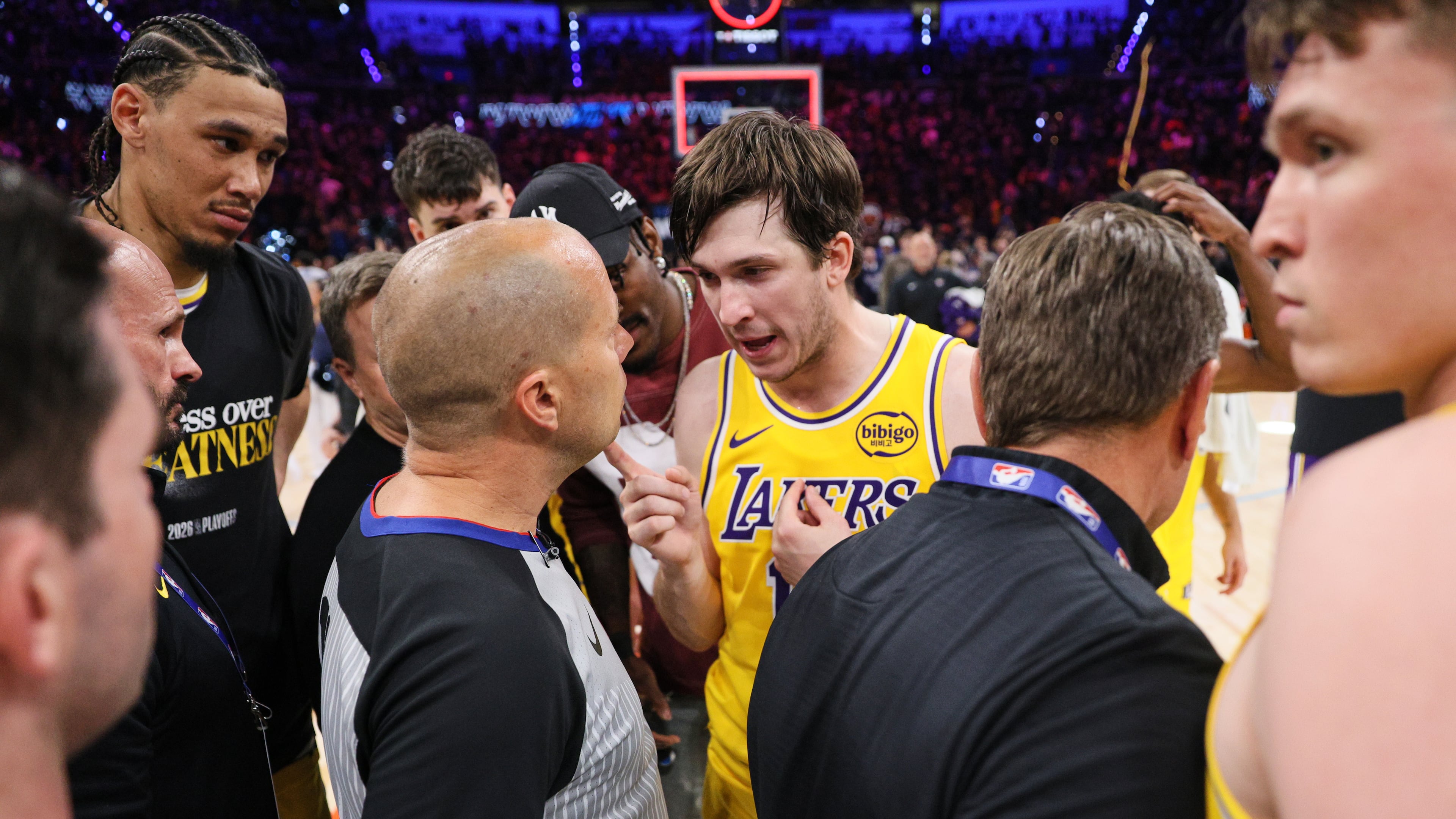
— Austin Reaves and the Los Angeles Lakers held an impromptu meeting at midcourt with referees after a playoff loss in Oklahoma City to voice concerns.
— Cleveland coach Kenny Atkinson pointed out that Cavs star guard Donovan Mitchell wasn't getting to the line very often in Games 1 and 2 of the series with Detroit; Mitchell got there 11 times, total, in those games (both Cleveland losses) and got there 11.5 times on average in the next two games (both Cleveland wins). That, in turn, led to Pistons coach J.B. Bickerstaff to comment after Game 4.
And those are just some examples.
“Standing up for your team is a job descriptor of an NBA head coach and most certainly I don’t begrudge a head coach the desire to represent for himself, his team, most certainly his players," McCutchen said. "That’s part of the voice of an NBA head coach that I have an understanding of. My job is to take those commentaries and decide or see what is true and what is avocation. And now, even if it is true, it’s very important that I’m not putting my foot on the scale of a series.”
Playoff referees — not all referees get playoff assignments, and the roster of officials gets pared down after each round based on performance — study tape after games, just as they do in the regular season. Every call is evaluated, and McCutchen has said several times in recent years that the league's referee corps is constantly striving to do better.
“We’re not putting our whistles in our pocket,” McCutchen said. “That being said, I think it’s fair to debate, talk about passionately, like many of our fans and people in the media do, about whether that’s the appropriate enough of whistles to blow. But we are trying to meet the moments of the passion of the playoffs in a way that upholds our standards.”
That tends to come with more calls. The NBA is seeing an increase in foul calls from the regular season to the playoffs for the 66th time in its 80-year history. This season is seeing a differential of higher than 10% in that regard for only the sixth time in the last 60 years. (The five biggest increases in that differential, ranging from 13% to 17%, all took place between 1949 and 1955.)
McCutchen looks at the playoffs this way: Aggression is good, rough is not.
“We don’t like to see ejections," McCutchen said. "Our goal would be to get through all these games where we meet this right up to the edge of rough and you have this really aggressive, passionate game that is adjudicated and an environment is created in which that environment of aggressiveness is rewarded — because we have the best players in any sport, in my opinion — but that it doesn’t creep over to rough. That’s the goal.”
___
AP NBA: https://apnews.com/hub/NBA