Drones, bullets and cartel warfare fuel an invisible displacement crisis in Mexico
TULA, Mexico (AP) — When bombs fell from the sky and bullets ricocheted off her concrete floors, 74-year-old María Cabrera and her family fled into the night-cloaked mountains of central Mexico with only the clothes on their backs.
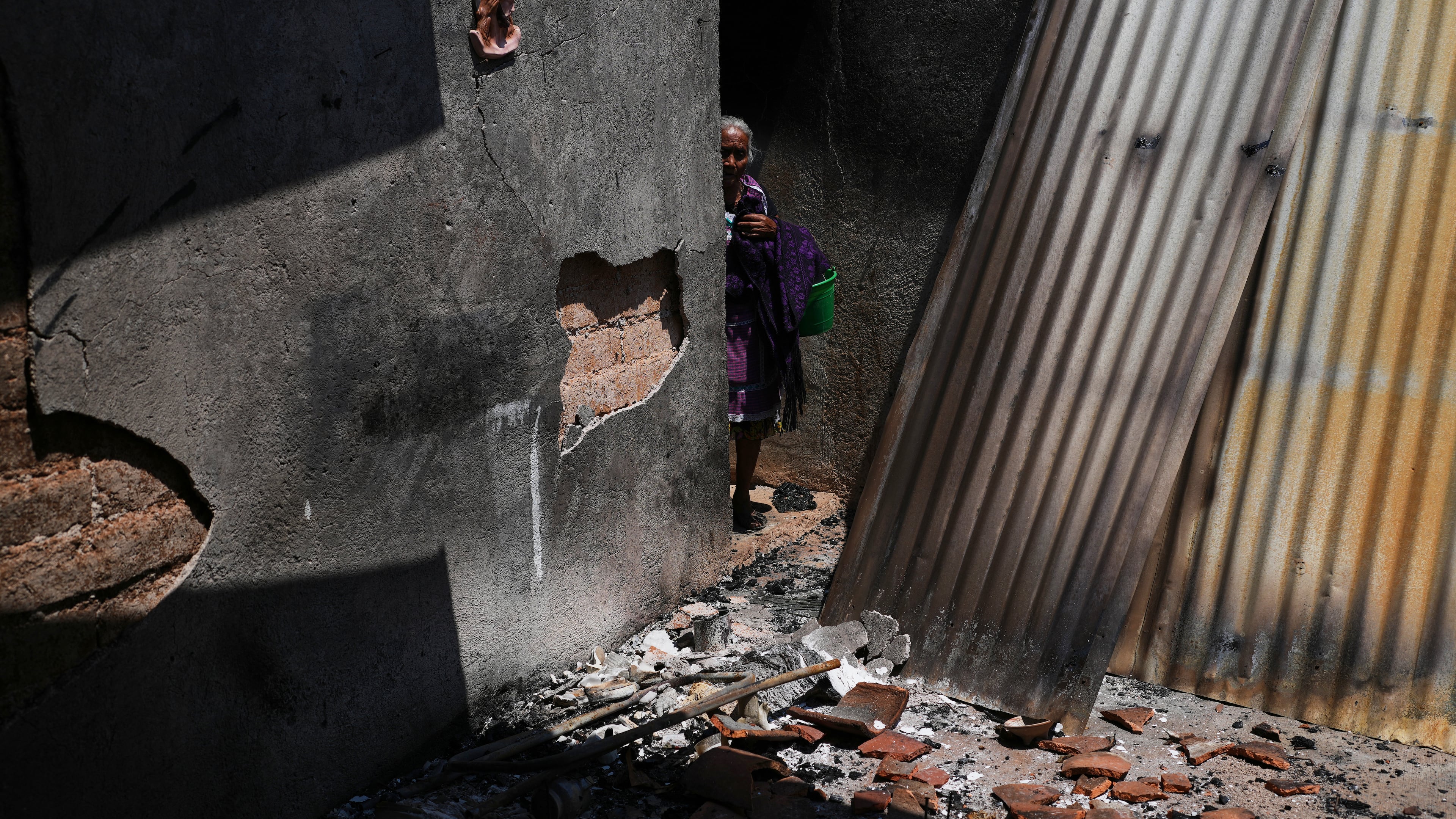
A week later, Cabrera picks through the charred scraps of her life, salvaging pots, woven cloths and a small wooden cross. She knows that it's the last time she'll return to her home of 60 years.
“Oh God, why have you abandoned me,” she said through heartbroken sobs, wandering past burned ashes of what was once her mattress in a small room with a collapsed roof and a melted refrigerator just through the door. “How are we going to rebuild? We don’t have money, we don’t have anything.”
She joined a growing number of people displaced in conflict-torn regions of Mexico forced to flee their homes. Experts have described the phenomenon as an invisible crisis with long-term humanitarian consequences — there are few official figures on the number of displaced people, who have almost no resources to turn to once violence forces them to leave.
‘We can’t live here anymore’
Cabrera fled her small town Friday after years of mounting cartel violence in Tula. This town of around 200 native Náhuatl people is among many in the central state of Guerrero ravaged by decades of fracturing rival criminal groups warring for territorial control.
Last week, a group known as Los Ardillos attacked her town and a handful of others with drone-fired explosives, opened fire on local community police forces, killed livestock and burned homes like Cabrera’s to an undistinguishable crisp.
Cabrera carefully handed bags of belongings to soldiers escorting a small group of families returning home to gather their things. She prayed as armed men in camouflage loaded her possessions into the back of a truck. As she wandered through her garden for the last time, she begged forgiveness from the dogs and chickens she was forced to leave behind.
“We don’t want to abandon them,” she said. “But we suffered through everything. We can’t live here anymore.”
Scattering across Mexico
A local human rights group, Indigenous and People’s Council of Guerrero-Emiliano Zapata, or CIPOG-EZ, estimated that at least 800 people, including children and the elderly, were forcibly displaced along with Cabrera, and three community police officers — groups often formed to protect themselves in the wake of state absence — fighting back against the mafia were killed.
The official numbers are far lower: Mexico’s government said Tuesday that only 120 people were forced to flee and confirmed no deaths. One community leader sleeping at the basketball court on Friday told a local government official that in their town alone they estimated around 280 people had been forced to flee.
Some families ran into the mountains, not looking back. Hundreds sought shelter under a local basketball court, hoping that it might be safe to eventually return home. Others — some wounded by gunfire — boarded cars, buses and trucks, scattering to different regions of Mexico.
Videos published on social media this week show groups of crying women and children pleading for help.
The images pushed the government to deploy 1,200 military and police officers to the region. Officials say they have provided aid to those displaced, largely contained the violence, established a “safe corridor” for humanitarian aid to enter and paved the way toward defusing the region’s convoluted conflict.
“What we do not want is a confrontation that would affect the civilian population. Above all, we must preserve people’s lives,” Mexican President Claudia Sheinbaum said at a news conference last week.
An invisible crisis
Critics say that it was the latest example of government inaction and efforts to downplay the depth of the displacement crisis in Mexico. Unlike Colombia, Mexico doesn’t have a comprehensive registry of displaced people. Government figures are often cited as being insufficient by entities like the U.N. refugee agency, human rights groups and researchers documenting the crisis.
A 2025 government National Survey of Victimization and Public Security Perception estimated that nearly 250,000 households were forced to flee their homes in 2024 alone to protect themselves from crime.
Between 2024 and 2025, the Ibero-American University documented at least 44,695 people who had fled their homes to other parts of Mexico. Many more migrate to the U.S.
In a May report, the university noted that forced displacements are on the rise in Mexico at a time when Sheinbaum’s government has sought to highlight security gains — like sharp dips in homicides — in an effort to offset threats by the Trump administration to take military action on Mexican cartels.
“There’s no more life in these communities,” said Prisco Rodríguez, a local representative for CIPOG-EZ. “The government says people have already returned to their houses, but there’s no one here. People don’t say where they’re going out of fear ... and the majority never appear.”
Cabrera and her husband, 75-year-old Alejandro Venancio Bruno, were scrambling to figure out where they would go. Cabrera said that her children plead with her to come live with them in Mexico City, around 350 kilometers (220 miles) from their home, or the state of Queretaro, and rebuild their lives elsewhere.
But Venancio said that he’s spent his life working his land, and without money, a home or his most valuable possessions — his goats — any other life outside of Tula seems unfathomable.
“It’s like starting from zero,” he said.
More Stories
Keep Reading