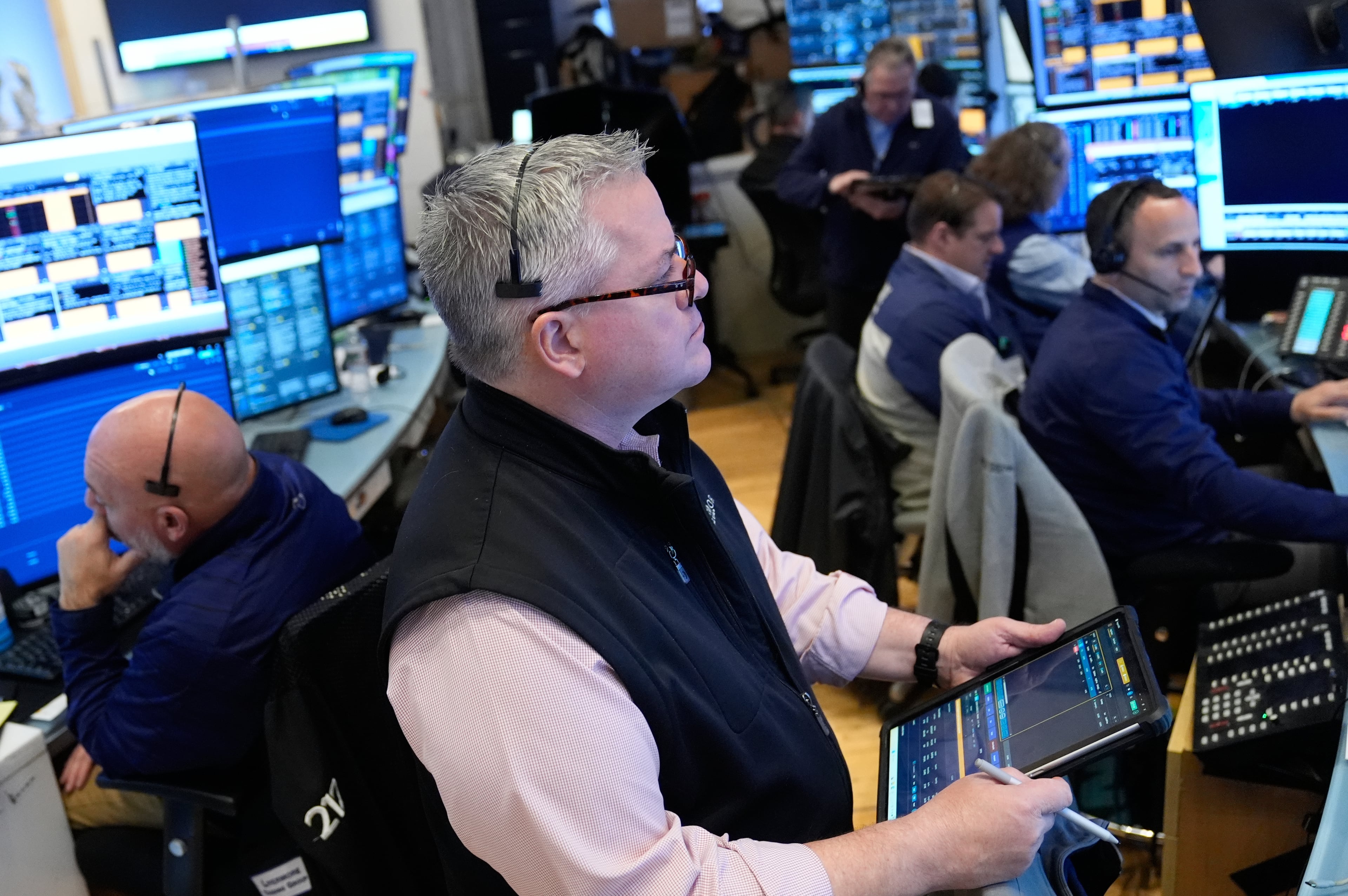
Trading on Wall Street mixed in premarket while oil prices fall on Trump's shipping waiver extension

Markets on Wall Street were mixed before the bell Friday and oil prices flipped lower after President Donald Trump extended a waiver that made it easier for foreign vessels to transport energy products to the U.S.
Futures for the S&P 500 rose 0.3%, while futures for the Dow Jones Industrial Average were unchanged. Nasdaq futures, led by chipmakers, jumped 1.3%.
The White House said early Friday that Trump issued a 90-day extension to the Jones Act waiver, making it easier for non-American vessels to transport oil and natural gas in the wake of the Iran war.
Trump first announced a 60-day waiver in mid-March and the move has been seen as helping to stabilize energy prices and making it easier for more ships to travel to the U.S. following the effective closure of the Strait of Hormuz.
The post on social media by a White House press aide said: “New data compiled since the initial waiver was issued revealed that significantly more supply was able to reach U.S. ports faster.”
Though oil prices fell Friday, they remain elevated since the Iran war began on Feb. 28.
The price for a barrel of Brent crude to be delivered in June fell 68 cents to $98.67 after reaching $107 a day earlier. The price for a barrel of Brent to be delivered in July, which is the more popular contract for traders, retreated to $93.77 after rising as high as $101.
The price for a barrel of U.S. crude fell $1.05 to $94.80 early Friday.
Progress on another round of peace talks between the United States and Iran was limited even after Trump said Tuesday that the U.S. was indefinitely extending a two-week ceasefire with Iran, a day before it was originally set to expire.
The Strait of Hormuz, a key passageway for global energy where roughly a fifth of the world’s oil and natural gas normally passed through before the war, remains largely closed and a U.S. sea blockade of Iranian ports is still in effect. After the U.S. imposed a blockade on Iranian ports last week, Iran attacked three ships in the strait on Wednesday and seized two of them.
The global energy shock caused by the Iran war has threatened to worsen inflation in many countries and shaken world markets. But Wall Street has still hit record highs, helped by strong corporate earnings and some optimism that the war will end soon.
Shares of Intel soared more than 27% overnight after the U.S. chipmaker blew past Wall Street's first-quarter sales and profit targets on soaring demand for its products, particularly those used in artificial intelligence applications. That brought much of the chipmaking sector higher, with Qualcomm, Broadcom and Micron all climbing between 2% and 4%.
In European trading, Germany's DAX inched up 0.1%, the CAC 40 in Paris dropped 0.5% and Britain's FTSE 100 was off 0.3%.
During Asian trading, Tokyo’s Nikkei 225 gained 1% to 59,716.18, led by heavy buying of technology stocks. On Thursday, it hit a record intraday high above 60,000.
Hong Kong’s Hang Seng reversed earlier losses to add 0.2%, closing at 25,978.07, while the Shanghai Composite index edged 0.1% lower to 4,079.90.
South Korea’s Kospi closed nearly unchanged at 6,475.63.
In Australia, the S&P/ASX 200 declined 0.1% to 8.786.50.
Taiwan’s Taiex jumped 3.2% as computer chipmaker TSMC, which makes up a key part of the index, gained 5.1%.
India's Sensex lost 1.4%.
More Stories
The Latest