Macron and Starmer welcome Hormuz reopening and push for permanent navigation security
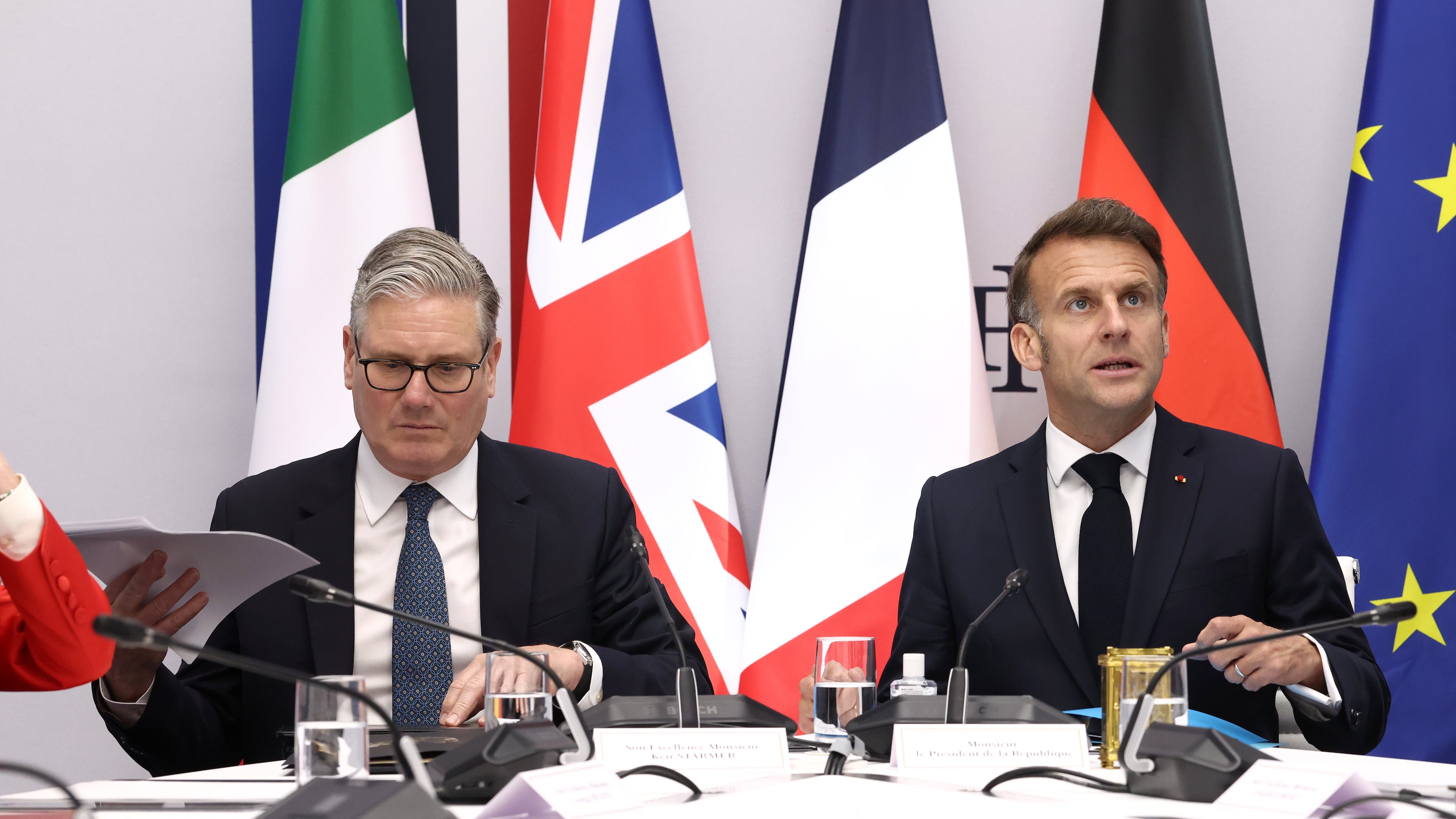
PARIS (AP) — The leaders of France and the U.K. on Friday welcomed the announcement by Iran and the U.S. that the Strait of Hormuz is open, but said freedom of navigation must be permanently restored to the key oil route choked by the U.S.-Israeli war on Iran.
President Emmanuel Macron and Prime Minister Keir Starmer said they would keep planning an international mission to restore maritime security, which Starmer said will be deployed “as soon as conditions allow.” They said military planners will meet in London next week.
Speaking after a gathering of some 50 countries and international organizations, Macron said “we all demand the full, immediate and unconditional reopening of the Strait of Hormuz by all parties.”
As the meeting was underway, U.S. President Donald Trump and Iran’s foreign minister declared the strait open to commercial vessels. Oil prices plunged after Iranian Foreign Minister Abbas Araghchi posted on X that passage for commercial vessels would remain “completely open” for the duration of a 10-day ceasefire in Lebanon.
Trump in an all-caps social media post said that the U.S. Navy’s blockade of Iranian ships and ports would remain in force “UNTIL SUCH TIME AS OUR TRANSACTION WITH IRAN IS 100% COMPLETE.”
Starmer cautiously welcomed the announcement, but said it must become “both lasting and a workable proposal.”
The Paris meeting is part of attempts by sidelined nations to ease the impact of a conflict they didn’t start and haven’t joined, but that has sent the global economy reeling. Petroleum prices soared after the war started on Feb. 28, when Iran effectively shut the narrow strait through which a fifth of the world’s oil usually passes.
The U.S. is not part of the planning for what has been branded the Strait of Hormuz Maritime Freedom of Navigation Initiative, which Macron said would be “a neutral mission, entirely separate from the belligerents to escort and secure the merchant ships transiting the Gulf.”
Starmer, facing political troubles at home, was greeted by Macron in the courtyard of the Elysee presidential palace on Friday afternoon. German Chancellor Friedrich Merz and Italian Premier Giorgia Meloni also attended in person. Others, including the prime ministers of Australia and Canada, the South Korean and Ukrainian presidents and representatives of China and India, joined by video.
Military planning underway
In an echo of the “coalition of the willing” assembled to provide security for Ukraine in the event of a ceasefire in that war, Starmer said that along with France, the U.K. will lead a multinational mission to protect freedom of navigation as soon as conditions allow.
“This will be strictly peaceful and defensive, as a mission to reassure commercial shipping and support mine clearance," he said.
He said more than a dozen countries had agreed to contribute assets, far fewer than in the wider Hormuz coalition.
Britain has discussed using mine-hunting drones, deployed from the ship RFA Lyme Bay.
The war has highlighted the shrunken state of the Royal Navy, which has deployed just one major warship, the destroyer HMS Dragon, to the eastern Mediterranean. France, which has the EU’s most powerful military, has sent its nuclear-powered aircraft carrier to the region, alongside a helicopter carrier and several frigates.
Meloni said she had expressed Italy’s “willingness to make its naval units available," while Merz said Germany could contribute mine clearance and maritime intelligence capabilities to such a mission, but would need parliamentary support and a ″secure legal basis″ such as a U.N. Security Council resolution.
He said Germany, ″if possible, would also like to see the United States of America participate; we believe this would be desirable.″
That's a departure from Macron, who has said the mission will involve countries not involved in the conflict.
Macron's office said roles for members of the coalition could include “intelligence, mine-clearing capabilities, military escorts (and) communication procedures with coastal states.”
Sidharth Kaushal, a research fellow in sea power at the Royal United Services Institute think tank, said mine-clearing and creating a warning system for maritime threats were more likely roles for the coalition than warships escorting commercial tankers through the strait.
“You need huge numbers of vessels for that sort of thing, which nobody has,” he said.
Trump dismisses NATO as ‘paper tiger’
Iran expert Ellie Geranmayeh, deputy head of the Middle East and North Africa program at the European Council on Foreign Relations think tank, said mine-clearing is an area where European countries and their partners could play a role.
“They would be a better party to do this than the United States, because once you have U.S. military doing this and lingering on Iranian shores, it creates a potential arena for Iran and the U.S. to have miscalculations and get back into a sort of military tension,” she said.
The operation is partly a response to Trump, who has berated allies for failing to join the war. The president has called allies “cowards,” said NATO “wasn’t there when we needed them” and telling Britain: “You don’t even have a navy.”
Kaushal said European countries were likely trying “to demonstrate the ability to provide security in a way that’s distinct from, if not completely separate from, the U.S. and which also demonstrates a capacity for independent action.”
“How many states actually have spare capacity to offer to this is a pretty open question.”
Trump appeared dismissive of European offers of help, though he referred to NATO rather than the Franco-British-led coalition.
“Now that the Hormuz Strait situation is over, I received a call from NATO asking if we would need some help. I TOLD THEM TO STAY AWAY, UNLESS THEY JUST WANT TO LOAD UP THEIR SHIPS WITH OIL," he posted on social media.
“They were useless when needed, a Paper Tiger!”
___
Lawless reported from London. Associated Press writer John Leicester in Paris contributed to this report.