Farewell to the king of Cabbagetown, who sometimes meowed at Dexter the cat

The king of Cabbagetown liked to tell a joke about death. It was cleaner than some of his other jokes. Local, too, with a reference to the cemetery he could see from his window. In his later days, Ronnie Edwards used to sit by that window and meow like a cat.
For years, the neighborhood had a favorite cat: Dexter, who lounged on the newspaper box in front of Little’s Food Store and had his own cat-crossing sign and cat crosswalk, complete with little white pawprints on the asphalt. But that was on Carroll Street. Around the corner, on Gaskill Street, at least some of the meowing came from Ronnie Edwards.
He meowed to people walking by, just to be funny and mysterious, or he called to them. He remembered the details of their lives with uncanny precision. He spoke to them affectionately. How does one become unofficial king of a place like Cabbagetown? It apparently helps to tell a lot of jokes, and to say, loudly and sincerely and repeatedly, to all sorts of people, “I love you.”
Edwards was one of the last of the so-called Old Cabbageheads, one of the last survivors in this old mill village to have actually worked in the mill. He died Feb. 17 at the age of 87, leaving his little brother, Marshall Edwards, 82, to watch over his little kingdom.

“Come in this house, young man,” Marshall Edwards says when a reporter knocks on the door of the house that Ronnie and Marshall used to share as widowers.
The reporter sits down in a rocking chair. Marshall says he and his son made that chair. It was where Ronnie sat when he was meowing out the window and telling neighbors he loved them. On the shelves near the window were compact discs that belonged to Ronnie: Marty Robbins, Hank Snow, Merle Haggard, and a Cabbagetown band called Slim Chance and the Convicts. An album called The Dark Side of the Moonpie. Through the window, on the front porch, a wide red swing hangs from the ceiling.
“Me and Ronnie set right here in this swing,” Marshall says, “and watched ‘em bury Kenny Rogers.”
The Gambler was born in Houston and sang a lot in Nashville. But after his death in Sandy Springs in 2020, he was laid to rest in Oakland Cemetery, the Atlanta graveyard visible from Gaskill Street in Cabbagetown.
That memory reminds Marshall of Ronnie’s joke about death. Or at least a joke Ronnie told about death. It’s hard to be sure who told it first. Three days later, someone else in Cabbagetown will claim to have told it to the king.

“Now, here was one of Ronnie’s favorite little things to mess with people,” Marshall says. “He’d say, ‘Did you know if you live within 10 miles of that cemetery, they won’t bury you in there?’ They’d say, ‘Well no,’ say, ‘I didn’t know that,’ say, ‘Why?’ He said, ‘Because you’re still alive.’”
Ronnie is still alive in Marshall’s mind. All Marshall has to do is close his eyes, he says, and he can see Ronnie. Time is a jumble in this neighborhood, where you can walk up Carroll Street and see the towering smokestack of the old cotton mill, long since converted to loft-style apartments; and hear the cafe sound system playing Sea Wolf and Arcade Fire, bands from the hipster golden age; and traverse what was once a settlement for impoverished factory workers to find parkside homes appraised at more than $600,000 and a woman talking on a cellphone about hypercompetence. This place used to smell like cabbage.
Yes, Marshall remembers that. The scent of cabbage around here. Cabbagetown has various origin stories, and now Marshall shares his own. He says two of his uncles pushed carts full of cabbage to the gates of the mill. The workers finished their shifts and bought the cabbage and brought it home.
“Oh,” he says, “I love cabbage.”
As he tells this story, he imagines the taste of cabbage the way his mother made it. She fried it with onions.
“It’d melt in your mouth, buddy,” he says.
As he gives a tour of his wood shop — the band saw, the curio cabinet, a couple of small wooden airplanes — he talks about running around old Cabbagetown with Ronnie. Not so many fences back then. They could go from Powell Street to Carroll Street back between the houses, and nobody seemed to mind.
Marshall walks up Carroll Street and sees what used to be the mill, the smokestack just east of downtown reaching toward the sky, and he remembers when they worked there. Ronnie worked in the bleaching room, where they’d bleach the cloth. Later he worked until his retirement as a stock clerk for the Alterman brothers’ grocery business.

Marshall walks by the Carroll Street Cafe, where earlier on this day Ricardo Seijas and James Robbins worked on a springtime mural on a giant chalkboard on the wall. The picture has large colorful blossoms and a red-haired Mother Nature. Through the cafe window, Marshall sees someone he knows.
“Hey, sweet girl,” he says. “Love you.”
Another friend comes up and says hello.
“How’s your brother?” he says.
“He passed away,” Marshall says.
A celebration of Ronnie’s life is scheduled for 2 p.m. Saturday at the Cabbagetown Community Center. It will not be sad, said his niece Anita Cole, Marshall’s daughter, because Ronnie wouldn’t have wanted that.

Who crowned Ronnie king of Cabbagetown? Jacob Elsas, whose great-great-grandfather founded the mill, said the neighborhood had a tradition of royal titles. Ronnie had a hat that said “King Of Cabbagetown” in gold letters. Marshall is not sure who gave it to him, or why, but the title caught on. John Dirga, executive director of the Cabbagetown Initiative, considered Ronnie the king. So did Brad Cunard of Little’s Food Store. So did James Kelly, also known as Slim from Slim Chance and the Convicts. So did Amber Brannon, one of Ronnie’s neighbors. So did Tad Porter, the guy who used to keep Dexter the cat.
As Marshall walks north on Carroll Street, he enters what used to be Dexter’s territory. Here are the things Porter made for the neighborhood cat. The little cat-crossing sign. The slender crosswalk. The sign in front of Little’s that says “CAT goes here”. Dexter used to lounge in front of that sign, on top of the Creative Loafing box.
Marshall sits down on a long green bench outside the store. Dexter used to visit him there. He’d jump up on the bench, sit on Marshall’s lap, and do that thing with his paws they call Kitty Biscuits. Then he’d curl up and go to sleep.
Ronnie and Dexter didn’t get along quite so well. Maybe Ronnie was too much like a rival tomcat. He’d meow loudly at Dexter, or do something else unsettling, and Dexter would take off. A streak of black lightning.

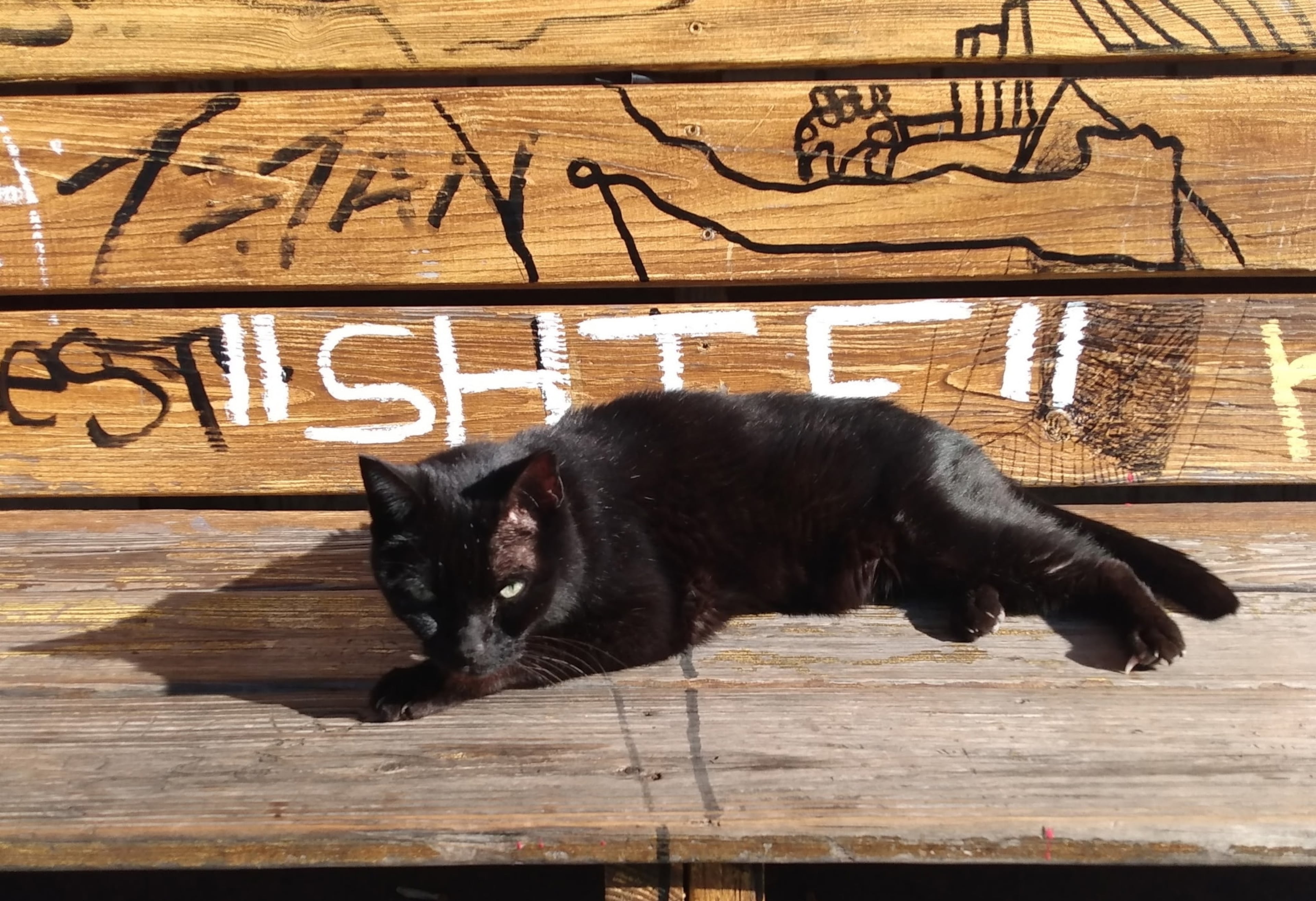
Ronnie had been through a lot in his life. Survived polio as a kid. Walked on crutches for so long that some people called him Stickback. According to Marshall, Ronnie had seven children, and three of them died before he did.
Dexter had done his own persevering. One time a woman catnapped him in the night, apparently thinking he was homeless. He was attacked by other cats and later found stuck in a fence with an injured leg and a shortened tail. He stayed inside for a while at Porter’s place and made a full recovery. But he couldn’t escape old age.
Marshall remembered his last visit with Dexter, around 2023. Dexter looked poor and thin. He could barely get up on the green bench. But he stayed with Marshall for one last good nap. When Marshall heard the news, he went to his wood shop, got some white cedar, and built a little box. It was Dexter’s casket.
Marshall remembered Ronnie’s last days, too. He walked over to visit Ronnie in the nursing home. Marshall spoke to him. Ronnie seemed unable to answer. But he did open one eye, and he seemed to be looking hard at a cup, so Marshall took the cup and gave him a drink.
“I told him I loved him,” Marshall said, “and it was the last time I seen him alive.”

In a phone call Monday, Porter was talking about Ronnie. A reporter mentioned the joke about Oakland Cemetery. Ronnie’s joke? No. Porter remembered telling that joke himself.
“He stole my joke,” Porter said.
Then he thought about it some more, and he reconsidered. It wasn’t his joke either. Someone else had told him this joke long ago, and who knows: Maybe that person had heard it from Ronnie.
That joke was like so many other things in this gritty wonderland known as Cabbagetown. The mural in the cafe. The long green bench outside Little’s. The music from the street musicians on a warm Friday night. Dexter the cat. And Ronnie himself.
They were part of the commonwealth.
They belonged to everyone.
About the Author

Thomas Lake is a senior reporter for The Atlanta Journal-Constitution. His work has been published in The Washington Post, The Wall Street Journal, Sports Illustrated and The Guardian. He's a co-founder of The Lake Family Band. Please email thomas.lake@ajc.com if you'd like to share a story idea.
More Stories

Keep Reading

