Her art is in the Smithsonian. A descendent is uncovering her Georgia past.
ATHENS — Alyse Minter began digging through her family history without knowing she was searching for one of the more important artists in American history.
A long-form marriage certificate led the genealogist and Library of Congress research librarian to her great-great-great-grandmother: Harriet Powers, born into slavery in northeast Georgia and later emancipated.
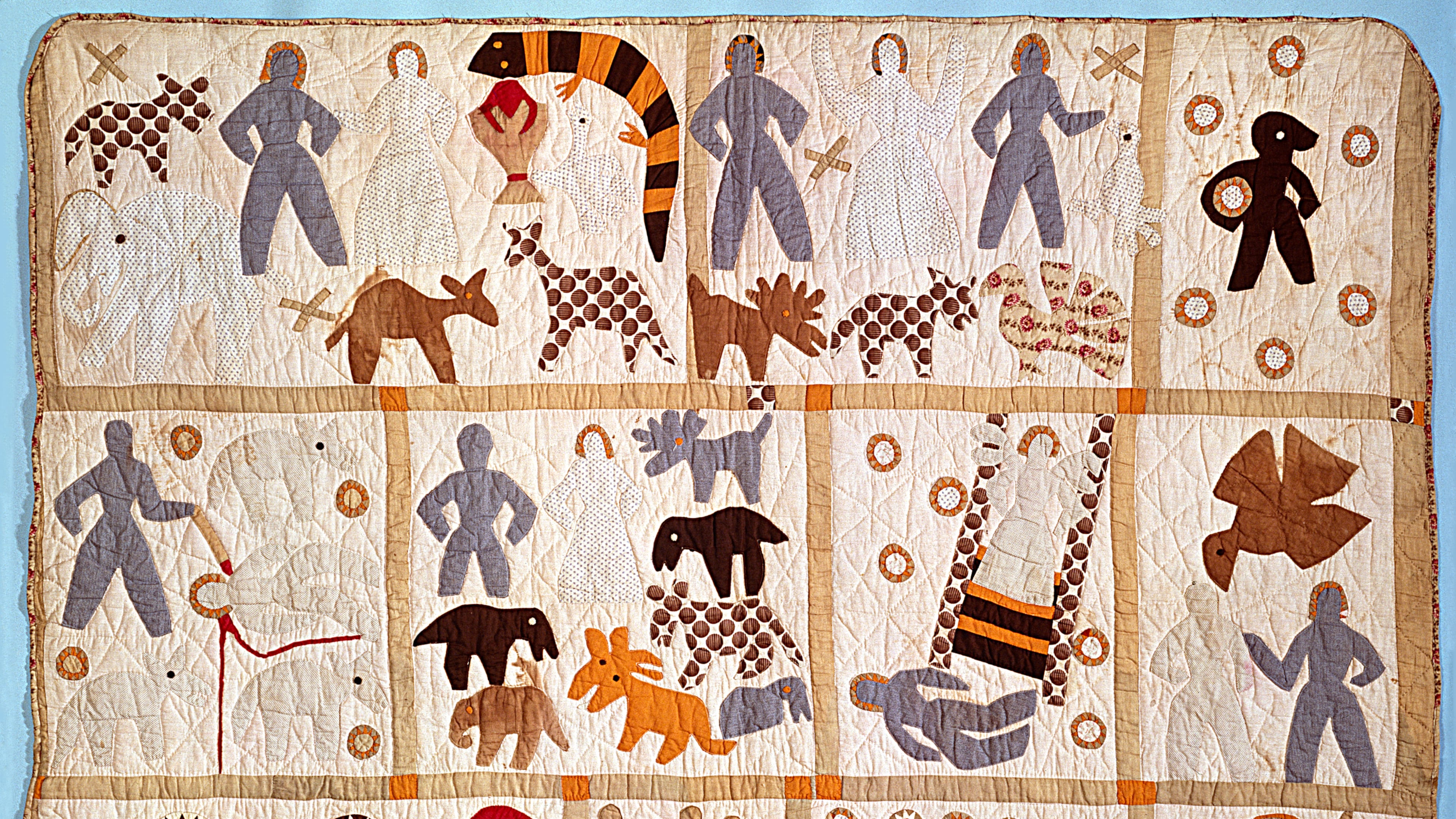
Roughly 150 years after Powers stitched biblical stories and lived experiences into fabric, her quilts now hang in the Smithsonian Institution and the Museum of Fine Arts, Boston.
For nearly two decades, Minter has worked to trace and preserve her ancestor’s life.
“It’s meaningful for me to be able to say, this is where I came from,” Minter said. “This is what my ancestors had to endure for me to get to where I am. And I want to be able to honor them by recognizing their personhood in a way that was not recognized when they were living.”

The U.S. Postal Service is issuing four Harriet Powers “Forever” stamps on Saturday in Washington, D.C., to honor the African American quiltmaker whose narrative applique works are celebrated as masterpieces of folk art and storytelling.
Powers was born into slavery in 1837 on a Madison County plantation owned by John and Nancy Lester. Census records show the Lesters owned six slaves during this time period, and Minter has discovered family documents that state Powers’ mother was enslaved with her.
Powers married Armstead Powers in 1855 or ’56 (documents vary) and after the Civil War the couple was emancipated. By 1870, census data shows they had settled in Sandy Creek, north of Athens in Clarke County. By the next decade, they owned a farm on at least 4 acres, with Armstead listed in documents as a laborer and Harriet described as a housekeeper.

In 1886 Harriet Powers exhibited a work, which came to be known as the “Bible Quilt,” at the Athens Cotton Fair.
The 11-panel quilt blends hand and machine stitching, its bold biblical scenes from Genesis to the crucifixion outlined in thread and framed by a printed cotton border.
Jennie Smith, a local artist and teacher at the time, was taken with the piece.
“Her style is bold and rather on the impressionists order while there is a naiveté of expression that is delicious,” she later wrote.
Smith offered to buy the quilt but was initially refused. Years later, facing financial hardship, Powers accepted $5 (roughly $180 today). The “Bible Quilt” is now held by the Smithsonian’s National Museum of American History.
Less is known about Powers’ other surviving work, the “Pictorial Quilt” (created 1895—1898). This appliqued cotton textile features 15 panels arranged in five rows of three, blending biblical narratives with historical and natural events, including the dramatic Leonid meteor shower of 1833 and the “Dark Day” of May 19, 1780, when dense smoke from massive Canadian forest wildfires darkened the sky unnaturally across New England.
Minter speculates Powers learned of these prebirth events through repeated stories from her mother and perhaps her grandmother.

That’s why Michael Thurmond, a Democratic candidate in the 2026 Georgia governor’s race, views Powers as a historian.
“She’s created a living document that speaks to this very day,” Thurmond said. “She stands alone in terms of her creativity and how she used resources at her disposal to preserve this history.”
Thurmond grew up in Sandy Creek, born to sharecropper parents in the 1950s. Arriving generations after Powers, he described his childhood home as rural and isolated — the roads were all dirt, their closest neighbor lived a mile away. He said Sandy Creek was where his parents felt safe to settle after moving from neighboring Oconee County following the 1946 Moore’s Ford lynching of two African American couples between Monroe and Watkinsville.
Thurmond said he didn’t know of Powers until he was an adult, but he feels a deep kinship with her.
“We’re connected through that land because she worked that land similar to what we did,” he said.
Today, hundreds of acres of the Sandy Creek area are a county-owned park — acquired by the local government in the early 1980s. There is a nature center, wooded trails, playgrounds and recreational lake.
Powers is buried 5 miles away in Gospel Pilgrim Cemetery. The prominent burial site for African Americans, founded in 1882, is listed on the National Register of Historic Places, with a new headstone dedicated for Harriet and Armstead in 2023.

With Powers, we know where she was born, where she lived, what she created and where she was buried. But much still is unknown.
Minter has traveled to Georgia multiple times to comb through courthouse and library records, filling in gaps and examining accounts from figures like Smith. Her goal: to write a book telling Powers’ full story as a daughter, wife, mother and grandmother who endured enslavement, embraced post-Civil War hope and navigated the brutal realities of Jim Crow.
“There’s internal motivation to restore some of those broken pathways of information and to reclaim the histories that have been taken away,” Minter said.
Thurmond said Powers inspired him last month to commission a quilt for his daughter made of at least 160 ties worn during his career as a lawyer and politician.
He named the piece “The Ties That Bind.”
“I wanted to create a family heirloom that will tell a story,” Thurmond said. “It’s not as powerful and compelling as Harriet’s story, but it’s a way to maintain and preserve family history.”

This year’s AJC Black History Month series marks the 100th anniversary of the national observance of Black history and the 11th year the project has examined the role African Americans played in building Atlanta and shaping American culture. New installments will appear daily throughout February on AJC.com and UATL.com, as well as at AJC.com/news/atlanta-black-history.
About the Author

Fletcher Page is Athens bureau chief covering northeast Georgia for The Atlanta Journal-Constitution.


