Rubio defends Trump on Venezuela while trying to allay fears about Greenland and NATO
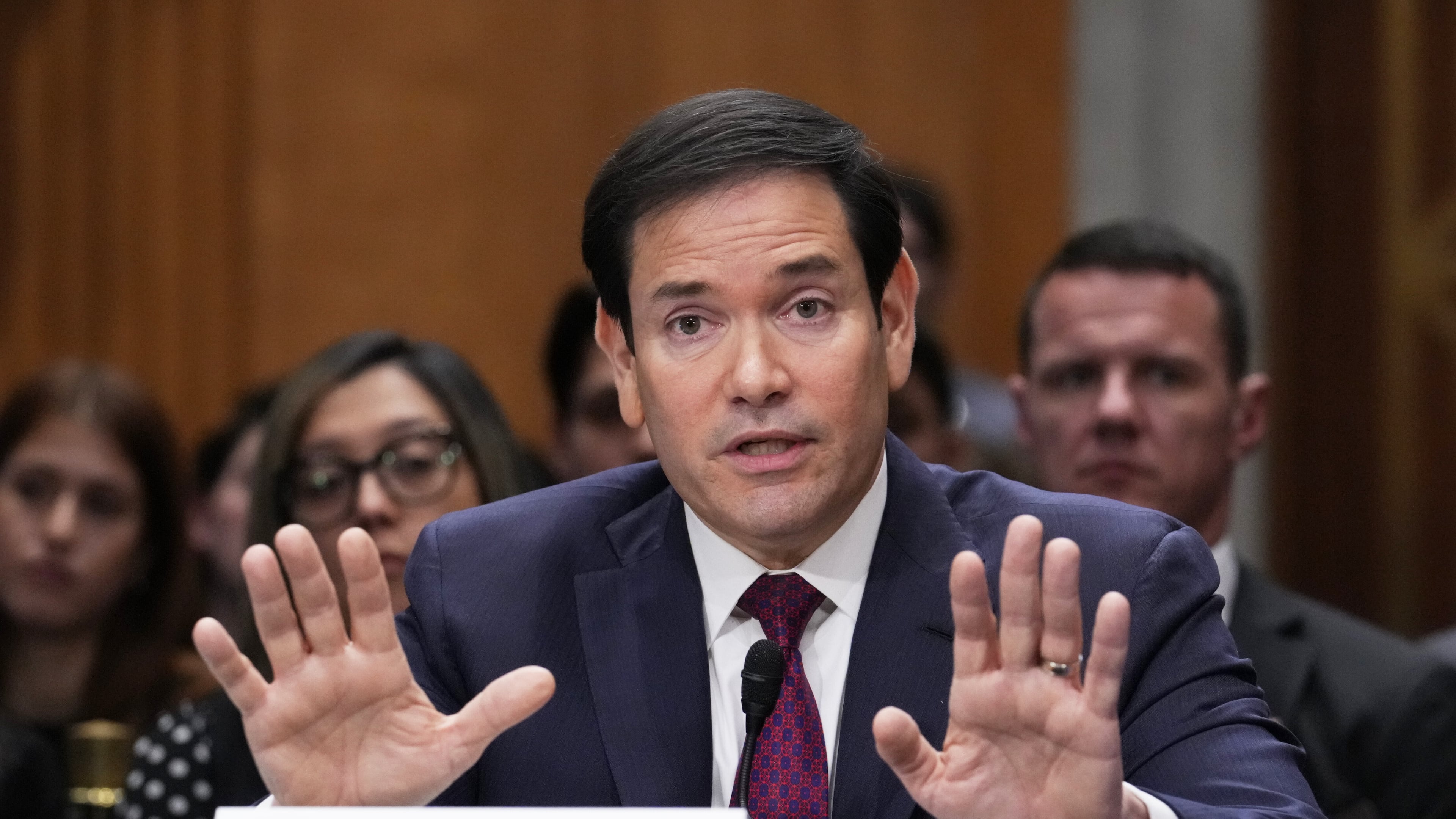
WASHINGTON (AP) — Secretary of State Marco Rubio gave a full-throated defense Wednesday of President Donald Trump's military operation to capture then-Venezuelan President Nicolás Maduro, while explaining to U.S. lawmakers the administration’s approach to Greenland, NATO, Iran and China.
As Republican and Democratic members of the Senate Foreign Relations Committee offered starkly different readings of the administration's foreign policy, Rubio addressed Trump's intentions and his often bellicose rhetoric that has alarmed U.S. allies in Europe and elsewhere, including demands to take over Greenland.
In the first public hearing since the Jan. 3 raid to depose Maduro, Rubio said Trump had acted to take out a major U.S. national security threat in the Western Hemisphere. Trump's top diplomat said America was safer and more secure as a result and that the administration would work with interim authorities to stabilize the South American country.
“We’re not going to have this thing turn around overnight, but I think we’re making good and decent progress,” Rubio said. “We are certainly better off today in Venezuela than we were four weeks ago, and I think and hope and expect that we’ll be better off in three months and six months and nine months than we would have been had Maduro still been there."
The former Florida senator said Venezuela's current leaders are cooperating and would soon begin to see benefits. But he backed away from remarks prepared for the hearing that Washington would not hesitate to take further military action should those leaders not fully accept Trump's demands.
“I can tell you right now with full certainty, we are not postured to nor do we intend or expect to have to take any military action in Venezuela at any time," Rubio said. “I think it would require the emergence of an imminent threat of the kind that we do not anticipate at this time.”
He said Venezuela soon will be allowed to sell oil that is now subject to U.S. sanctions, and the revenue would be set aside to pay for basic government services such as policing and health care. Oil proceeds will be deposited in a U.S. Treasury-controlled account and released after the U.S. approves monthly budgets to be submitted by Venezuela, he said.
Pushback against skepticism from Democrats
Republican senators, with few exceptions, praised the operation in Venezuela. Among Democrats, there was deep skepticism.
They questioned Trump's policies in Venezuela and their potential for encouraging moves by China against Taiwan and Russia even more so in Ukraine, as well as his threats to take Greenland from NATO ally Denmark and his insults about the alliance's contributions to U.S. security.
Rubio played them all down.
He said the uproar over Greenland within NATO is calming and that talks are underway about how to deal with Trump's demands. The Republican president insists the U.S. needs Greenland to counter threats from Russia and China, but he recently backed away from a pledge to impose tariffs on several European countries that sent troops to the semiautonomous Danish territory in a show of solidarity.
“I think we’re going to get something positive done," Rubio said.
Rubio dismissed criticism that Trump was undermining the alliance, while repeating the long-running American complaint that member nations need to boost their defense budgets.
“NATO needs to be reimagined,” Rubio said. “I just think this president complains about it louder than other presidents."
He said China's stated goal to reunify Taiwan with the mainland would not be affected by any other world event, including the Maduro operation.
“The situation on Taiwan is a legacy project" that Chinese President Xi Jinping has made "very clear that that’s what he intends to do and that’s going to be irrespective anything that happens in the world,” Rubio said.
As Trump once more threatens Iran with military action, Rubio said there was no current plan to attack. Asked about the potential for a change of government in Tehran, Rubio said that would require “a lot of careful thinking” because it would be “far more complex” than ousting Maduro.
He noted that the increased military presence in the Middle East — an aircraft carrier and accompanying warships arrived this week — is “to defend against what could be an Iranian threat against our personnel.”
More details about the raid in Caracas
The Republican committee chairman, Idaho Sen. Jim Risch, offered new details on the operation in the Venezuelan capital, saying it involved “only about 200 troops” and a “firefight that lasted less than 27 minutes.”
“This military action was incredibly brief, targeted and successful,” Risch said, adding that the U.S. and other nations may have to assist Venezuela when it seeks to restore democratic elections.
”Venezuela may require U.S. and international oversight to ensure these elections are indeed free and fair,” he said.
Sen. Jeanne Shaheen of New Hampshire, the committee's top Democrat, questioned whether that operation was worth it, considering most of Maduro's top aides and lieutenants still run the Venezuela and the economic situation there remains bleak.
"We’ve traded one dictator for another, so it’s no wonder that so many of my constituents are asking, why is the president spending so much time focused on Venezuela instead of the cost of living and their kitchen table economic concerns?" she asked. “From Venezuela to Europe, the United States is spending more, risking more and achieving less.”
Call for eventual democratic elections in Venezuela
Rubio delivered his strongest statement yet of support for democracy in Venezuela, while concerns persist that the administration’s stabilization efforts are narrowly focused on oil and U.S. national security interests.
“What’s the end state? We want a Venezuela that has legitimate democratic elections,” said Rubio, who met Venezuelan opposition leader María Corina Machado at the State Department after the hearing.
Machado reiterated her intention to return to Venezuela. “Dear Venezuelans, we are moving forward with firm steps,” she posted on X. “I will return to Venezuela very soon to work together on the transition and the building of an exceptional country.”
Before that, Rubio faced tough questioning from Sen. Cory Booker, D-N.J., about cooperating with interim leaders who had been part of Maduro's authoritarian government. Maduro's vice president, Delcy Rodríguez, is now the acting president.
The U.S. has said its demands for Rodriguez include opening Venezuela’s energy sector to U.S. companies, providing preferential access to production, using oil revenue to purchase American goods, and ending subsidized oil exports to Cuba.
Neither Rodríguez nor her government’s press office immediately commented on Rubio’s remarks. She said Tuesday that her government and the U.S. “have established respectful and courteous channels of communication.” So far, she has appeared to acquiesce to Trump’s demands and to release prisoners jailed by the government under Maduro and his predecessor, Hugo Chávez.
In a key step to the restoration of diplomatic relations, the State Department said it intends to begin sending additional diplomatic and support personnel to Caracas to prepare for the possible reopening of the U.S. Embassy, which shuttered in 2019.
Fully normalizing ties, however, would require the U.S. to revoke its decision recognizing the Venezuelan parliament elected in 2015 as the country’s legitimate government.
___
Associated Press writers Regina Garcia Cano in Caracas, Venezuela, and David Klepper in Washington contributed to this report.


