Inside Ted Turner’s CNN Center apartment, a time capsule being restored


1 / 18

Fish tank, jewel box, observation tower.
At the top of the former CNN Center sits a small residence that has been the subject of much mystery over the last several decades.
Cordoned off to the thousands of CNN employees who once reported to the building, it’s accessed by taking the elevator to the 14th floor, walking through a hallway that once housed a marketing department and opening an unassuming door that gave way to a narrow spiral staircase. They’re modest digs, closer to a studio apartment than an expansive penthouse.
The apartment, totaling about 800 square feet, is where Ted Turner spent many of his pivotal years in Atlanta growing CNN and Turner Broadcasting System. Turner, who died May 6 at age 87 after a period of declining health, was once the biggest landowner in the U.S. But he also counted the CNN Center loft as one of several residences he had across the globe.
For years colleagues would watch Turner descend from his pad in various shades of dress — from a bathrobe to a suit and tie — to collect the morning newspaper or inquire about sports scores. It’s also where his ex-wife, Jane Fonda, would spend much of her time in Atlanta during the 10 years of their marriage.
Much has changed in the building over the last five years. CNN vacated and real estate firm CP Group took over, planning to transform the brutalist compound into a mixed-use development.
The Center, stylized by CP Group as “The CTR,” will feature housing, office space and a revamped food hall on the ground floor. The atrium and food hall are expected to open June 12, days before Atlanta plays host to its first World Cup matches.
The apartment, however, will remain as the building begins its next chapter. CP Group is preserving the space as a nod to both the building and Atlanta’s history, and said it will make improvements to ensure it lasts for future generations.
“Ted Turner’s impact on Atlanta is impossible to separate from the story of this building and the evolution of downtown itself,” Chris Eachus, a partner at CP Group, said in a statement. “Preserving his apartment was important to us because it represents a unique piece of that legacy, and we plan to thoughtfully restore the space while respecting the character and history that make it so meaningful.”
The space, as former CNN executive Steve Korn remembers, is unremarkable aside from the fact that it existed.
“It was pure Ted,” said Korn, who spent just under two decades working with Turner and retired as chief operating officer of CNN in 2000. “It was convenient and it was modest.”
Turner contends in his autobiography “Call Me Ted” that he built the apartment in the name of efficiency. While millions of Atlanta drivers were wasting their time sitting in traffic, his commute was nothing more than a walking up a flight of stairs. Previously he’d been sleeping on a Murphy bed in his office.
Even when the news operation was housed at Techwood in Midtown, Turner made it a point to stay close to the business, Korn said.
The apartment is divided into two halves by a wall with an aquarium and a wood-burning fireplace, and it featured what in the ’90s were a pair of state-of-the-art televisions. Green-blue carpet, ubiquitous in many Atlanta homes built or renovated three decades ago, stretches across the floor.
A kitchen sits at the back left corner of the living space. The bedroom wall is painted a bright pink, a color also found in the bathroom, where an ivory color telephone is mounted next to the toilet.
He had an expansive walk-in closet with built-in filing cabinets. Floor-to-ceiling windows show a striking 360-degree view of the city skyline, with Bank of America Plaza, Westin Peachtree Plaza and Truist Plaza a stone’s throw away.
Turner left his position at AOL Time Warner, then the parent company of CNN and other Turner properties, in 2003 and left the board in 2006. But furniture and other personal effects remained in the apartment for years afterward.
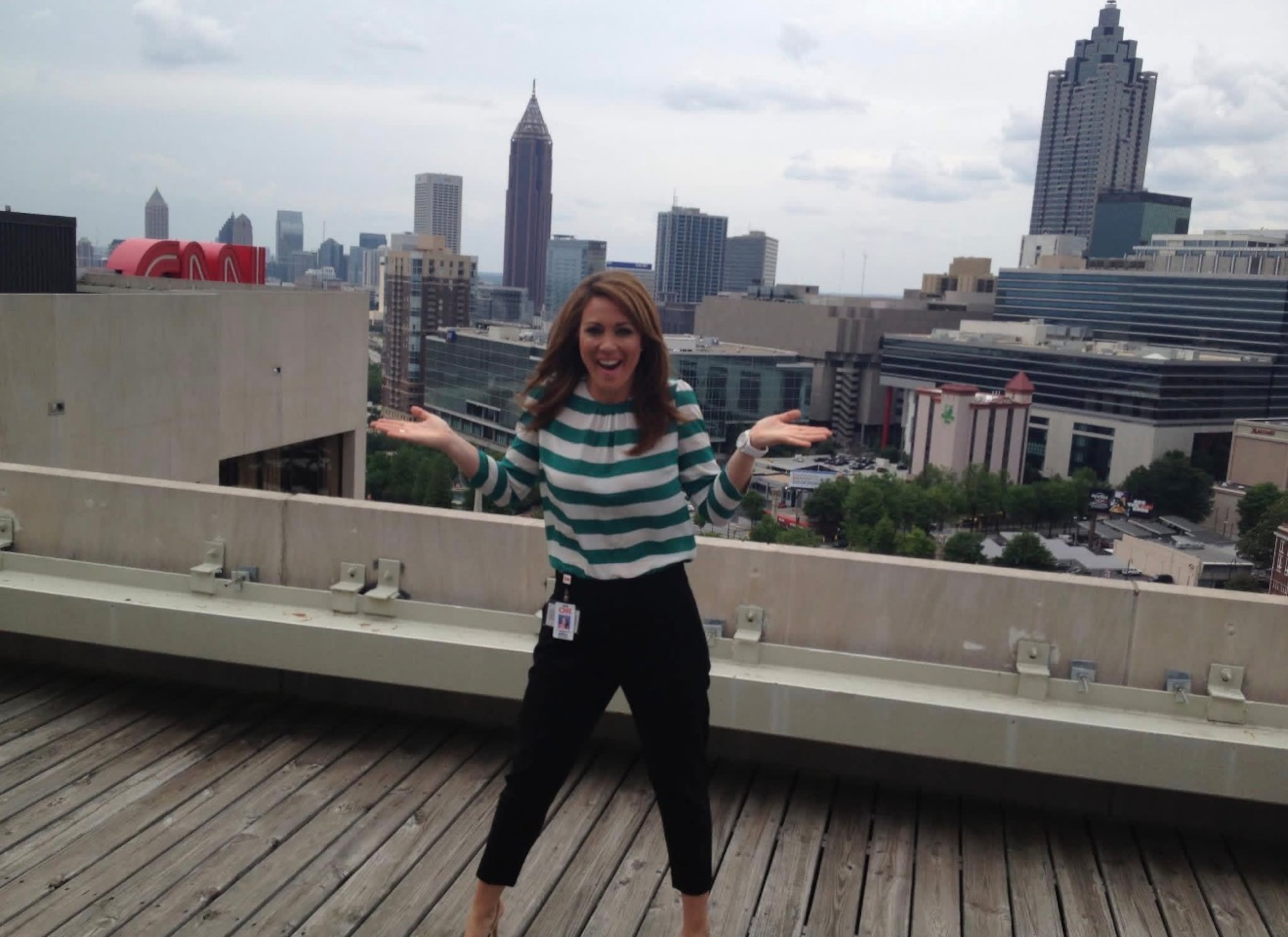
In 2012, then-CNN anchor Brooke Baldwin had the urge to visit the space, which was off-limits to much of the organization’s staffers.
An Atlanta native, Baldwin spent childhood afternoons at Atlanta Braves games with a pair of binoculars trying to catch a glimpse of Turner and then-wife Fonda. So when she began working at CNN in 2008 and began hearing stories about this fabled apartment above their newsroom, she had a burning desire to see it for herself and recruited a colleague to come with her.
“I mean, I’m a journalist. When somebody tells us something that piques our curiosity, how do we not follow the trail?” Baldwin told The Atlanta Journal-Constitution.
One afternoon after wrapping an afternoon broadcast, Baldwin wandered into the building’s stairwells and ascended until she reached the rooftop. She gasped when she saw that the apartment was real and rushed over to the windows. Inside, it was as if time stopped, she said. She remembered seeing a bed and dishes still in the kitchen.
Suddenly, two security guards burst through the door. In her ascent, Baldwin had unknowingly set off silent alarms. The guards eased when they saw that it was not an intruder, and after listening to her explain what she was doing, asked her to come back down with them.
Her trek up the winding stairs was one of respect for a man whose network pioneered 24/7 news.
“Just imagine this newsman, this pioneer of ‘Chicken Noodle News,’ wandering around this space,” Baldwin said, referring to one of the taunts critics had in the early days of the network. “The king of Atlanta at the top of this building with this killer view of the city. I just wanted to bear witness to where this legend lived.”
When CP Group inherited the apartment, it was mostly empty. Some footpads were left under the bathroom sink and the space served as storage for some production equipment. The kitchen appliances and televisions did not function, and there were no furniture impressions in the carpet.
The firm’s plans for the space are to turn it into a private event space and make it a stop on their tour throughout the building. It won’t be open to the public in the form of a house museum because it is hard to access.
There’s really one way up: through what Fonda described in her 2005 autobiography “My Life So Far” as the narrow “take-your-life-in-your-hands spiral staircase.” Built as a private residence, it doesn’t follow accessibility standards issued under the Americans with Disabilities Act.
People will be able to access the apartment, but on a controlled, smaller scale, said Giana Pacinelli, CP Group’s director of communications.
Improvements are underway. The sun-damaged carpet will be replaced with newer carpet in the same color, the drywall will be repaired and covered in fresh coats of paint in the same shades of blue and bright pink, and the fish tank will be filled.
The deck is being repaired and a glass guardrail is being installed around the perimeter of the roof. A new air conditioning unit has already been put in place.
CP also plans to furnish the bedroom area as an office, add seating and a television to the living room area and set up the kitchen as a bar, as well as adding art and memorabilia inspired by what he had previously in his apartments in Atlanta.