Georgia Power, environmental groups clash over challenge to data center expansion

Environmental groups argued Thursday state regulators erred by voting late last year to let Georgia Power add historic amounts of electricity capacity to serve data centers, arguing the company didn’t prove all of the power supplies were needed.
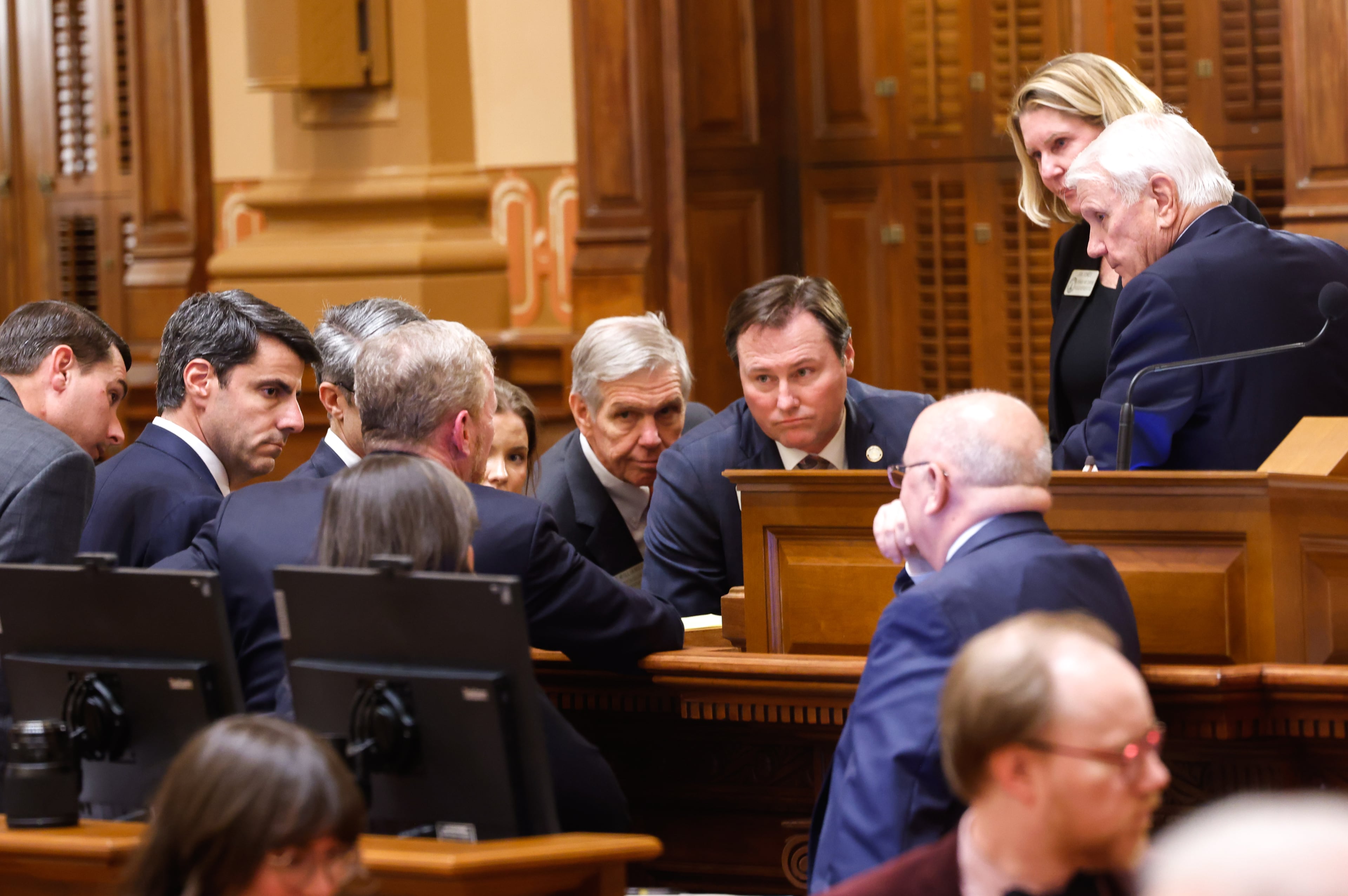
Thursday’s hearing was the last chance for parties to make their case to the Georgia Public Service Commission before a final vote next week on whether to revisit the decision.
The stakes for Georgia Power and residential customers in its territory — who have no choice but to receive electricity from the monopoly utility and are subject to PSC decisions about where their power comes from and how much it costs — are huge.
At the heart of the case is the PSC’s Dec. 19 vote to “certify” the addition of almost 10,000 megawatts of new gas-burning power plants, battery storage systems and some solar to Georgia Power’s fleet. The grid expansion — the largest in Georgia Power’s history — is slated to unfold over just five years and cost as much as $60 billion, according to some estimates. Certification paves the way for the utility to charge customers for costs down the line.

Last month, the Southern Environmental Law Center, representing Georgia Interfaith Power and Light and the Southface Institute, and the Sierra Club, on behalf of itself and the Southern Alliance for Clean Energy, filed a “petition for reconsideration” with the PSC.
The petitioners contend the PSC cleared Georgia Power’s expansion without enough data to show all of the new power plants are necessary, at least for now.
“We are asking the commission to reconsider the evidence in light of the actual legal standard, which does not allow charging captive customers until there’s proof of need at the time of use,” said Jennifer Whitfield, a senior attorney at the Southern Environmental Law Center.
They argued Georgia Power failed to show its expansion plan is in the public interest, the standard under Georgia law. State law says power resources can be “certified” if they’re found to “assure an economical and reliable supply of electric power and energy.”
The groups say the PSC should deny some of the previously approved power supplies because the utility doesn’t have signed contracts yet to support them.
Among the ones they’ve asked the PSC to revisit are a gas-burning unit slated for Georgia Power’s Plant McIntosh outside Savannah, plus other generation assets, totaling about 2,600 megawatts. That’s about a third of the total the utility had planned to add. Georgia Power has withheld the actual cost of Plant McIntosh’s new combustion turbine as trade secret information, but an expert witness testified last year that it was the most expensive gas unit she’d seen proposed anywhere in the U.S.
As part of the deal approving the expansion, Georgia Power agreed to use extra revenue from data centers to put $8.50 in “downward pressure” on the average residential customer’s monthly bills. But the petitioners say those promises are far from iron-clad and are only good for the years 2029 through 2031.
The groups have also asked that the PSC require Georgia Power to show the full customer rate impacts of its expansion.
“Georgia Power made a three-year bill promise in exchange for building tens of billions of dollars in assets,” Whitfield said. “We are simply suggesting that the actual financial impacts of these decisions should be subject to transparency and accountability in this proceeding.”
Georgia Power’s attorneys have pushed back against the petition to reconsider, claiming they presented sufficient evidence to support their expansion and that groups are simply seeking a “second bite at the apple.”
“The desire by the petitioners is to reargue everything that was litigated in this case,” Brandon Marzo, an attorney who represents Georgia Power, told the PSC Thursday. “The data, the evidence in this case, has been fully covered.”
The PSC’s public interest advocacy staff agreed with the company that the commission should not revisit the decision.
New PSC members have questions
But the new composition of the five-member PSC added a new wrinkle to the proceedings Thursday.
When the company’s expansion was “certified” back in December, the PSC was comprised entirely of Republicans. Since then, two of the commission’s GOP members were replaced by Democratic Commissioners Peter Hubbard and Alicia Johnson, who scored lopsided victories in elections last fall.
On Thursday, Hubbard had several questions for Marzo, including asking what steps the company will take if it becomes clear some of the new power supplies it’s adding aren’t needed.
Marzo said the company has levers it can pull, like delaying adding generation assets in the future or selling excess power to other utilities.
Johnson, however, made clear she believes the commission should take another look at the case.
“I think reconsideration is not delay for delay’s sake,” Johnson said, adding she thought it was “responsible governance.”
Commissioner Lauren “Bubba” McDonald seemed concerned that denying the company’s request could lead to reliability risks down the road.
“Do we wait until the lights go out before we try to solve the problem?” McDonald asked.
“I sure hope not,” Whitfield said, adding that the company already has sufficient power reserves it can lean on in cases when electricity demand spikes.
Just as they had during other recent hearings, several members of the public told the commission they were deeply concerned by the company’s approved plans, especially their effects on the climate.
Roughly 60% of the new resources Georgia Power is set to add rely on burning gas, which contributes greenhouse gases to the atmosphere that scientists have known for years are warming the planet and worsening many extreme weather events. Some of the new gas units the utility is set to build, like the one planned at Plant McIntosh, are expected to be in service for at least 45 years.
About the Author

Drew Kann is a reporter at The Atlanta Journal-Constitution covering climate change and environmental issues. His passion is for stories that capture how humans are responding to a changing environment. He is a proud graduate of the University of Georgia and Northwestern University, and prior to joining the AJC, he held various roles at CNN.