
Solidified starter Mike Hughes views Falcons drafting corner as ‘good thing’
The first time Mike Hughes bumped into new Falcons coach Kevin Stefanski in the hallway this spring, they skipped formal greetings and good-to-meet-yous. They had no need — they did that eight years ago.
Their conversation couldn’t have started anywhere but 2018.
Hughes, a highly touted cornerback from UCF, was the Minnesota Vikings’ first-round pick. Stefanski was the Vikings’ offensive coordinator. They worked on different sides of the ball and didn’t interact much, but Hughes spent the first two years of his professional career with Stefanski on the coaching staff.
“We go way back,” Hughes said during OTAs. “So, it’s all love.”
Love, however, didn’t stop the Falcons from giving Hughes competition for his starting spot this offseason. The team drafted Clemson cornerback Avieon Terrell in the second round in April, which brought Hughes back to 2018 for a different reason.
When Hughes entered the NFL, he joined a cornerbacks room with reigning first-team All-Pro Xavier Rhodes and returning starter Trae Waynes. Stefanski was there, too, and learned the significance of building depth at corner.
Such is life in the NFL, and Hughes felt no bad blood toward the Falcons for using an early pick at his position.
“I viewed it as something good,” Hughes said. “I see a lot of things on the internet, hear a lot of things. All it does is bring in competition to the room. Makes everybody better. I kind of know how it goes, though, and it wasn’t surprising to me.
“But it was definitely a good thing.”
Hughes particularly appreciated the uniqueness of Terrell joining his brother, A.J., in the Falcons’ secondary.
“That was like the craziest thing I’d ever seen, in a good way,” Hughes said. “It’s like a once-in-a-lifetime moment for those guys, so I was more than happy.”
Perhaps earlier in his career, the 29-year-old Hughes would’ve been bothered more by the Falcons’ decision. But he’s confident in his resume, and he’s confident in himself. He’s also overcome too much to worry about things out of his control.
Hughes suffered two season-ending injuries within his first three years as a professional. Some doctors questioned if he’d play football again after a broken vertebra in his neck prematurely ended his 2020 season, but he was medically cleared and eventually traded to the Kansas City Chiefs.
The New Bern, North Carolina, native won a Super Bowl with the Chiefs in 2021, then spent a year with the Detroit Lions before joining the Falcons in 2023.
Dating back to the end of 2023, Hughes has started 29 consecutive appearances for the Falcons. He’s missed time each of the past two years — two games because of a neck injury in 2024 and five with neck and ankle ailments in 2025 — but enters 2026 healthy in the second season of a three-year, $18 million contract.
Hughes, whose career could’ve ended three years into his time in the NFL, is preparing for Year 9 as a pro, a fact he said still doesn’t feel real. These moments, and this opportunity, were hardly guaranteed during his first stint with Stefanski.
“It’s definitely a blessing,” Hughes said. “It moves pretty quick, so you got to take advantage of every little moment and just never take it for granted.”
The 5-foot-10, 190-pound Hughes recorded 51 tackles, two tackles for loss and one interception last season.
According to Pro Football Reference, he allowed 41 receptions on 72 targets, limiting opposing quarterbacks to a 56.9% completion rate. He did, however, give up 531 yards and five touchdowns in 12 games, both more than he allowed in 15 contests the year before.
Falcons secondary coach Justin Hood noted the expectations Hughes carried when he was drafted, the injuries that limited him and the resurgence he’s enjoyed. Hood touted Hughes’ value to the team’s defensive back room and his status as the starter alongside A.J. Terrell.
“I love Mike,” Hood said during OTAs. “Every single year, you see his confidence grow. You just see him get comfortable and solidify himself as the corner opposite of A.J., and you see him grow.
“He’s really fun to coach when you watch his game and the way he prepares and the way he works, and then what he is for the room. So, it’s good.”
The Falcons will play their best five or six defensive backs, Hood said, and Hughes has fit that description each of the past two years. He has experience playing at nickel, too, and while he’s more comfortable on the perimeter, his versatility is an added benefit at a crowded position.
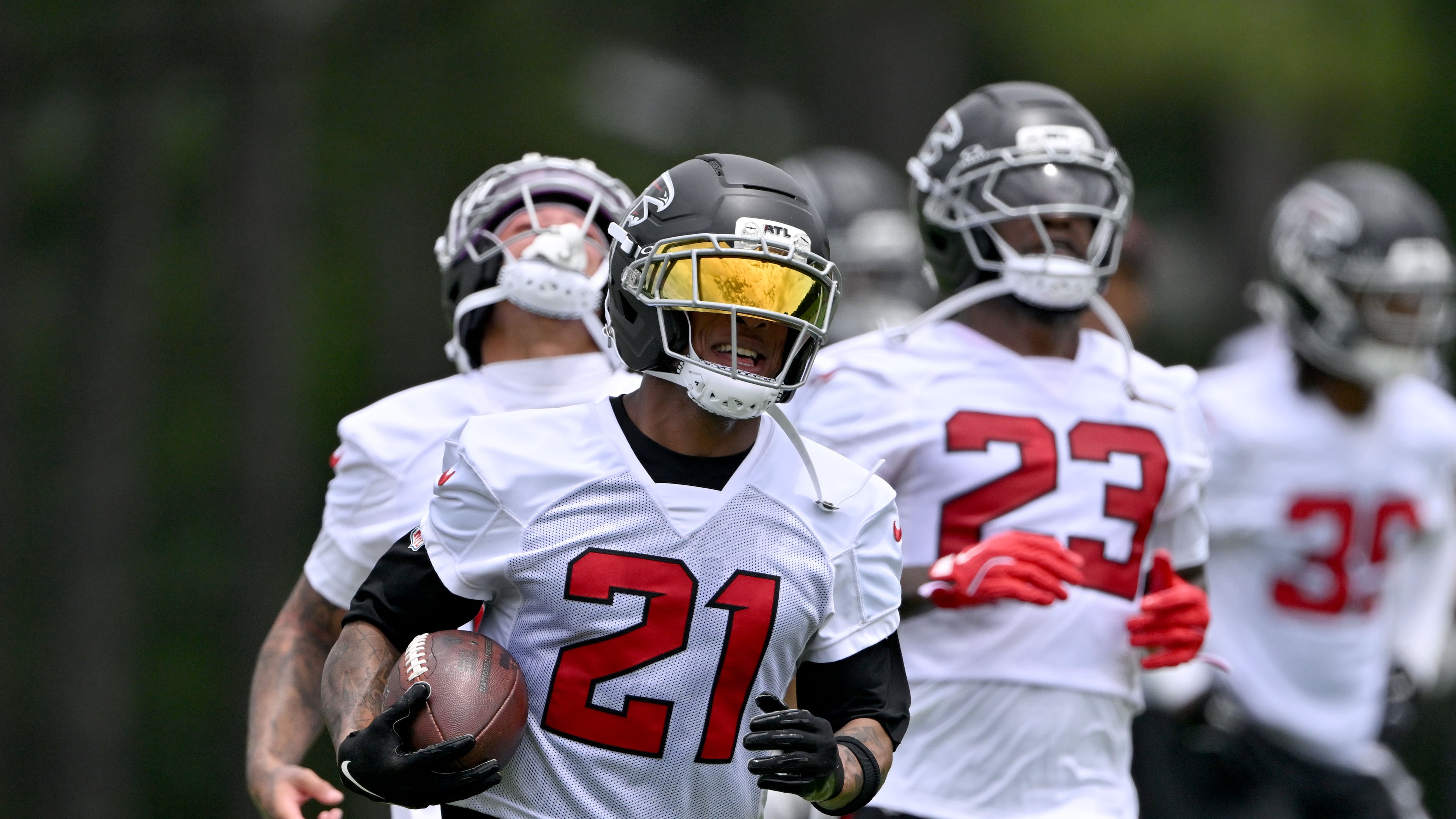
During OTAs, Hughes has worked with the first-team defense in his normal spot at cornerback, joining AJ Terrell and a rotating group of nickel corners.
Hughes’ veteran presence is a big part of his value. Stefanski, twice named the NFL Coach of the Year with the Browns before his six-year tenure ended in January, views Hughes’ longevity as a marker of his talent.
“You don’t play this long at that position without being a really good football player,” Stefanski said in May. “I think his game has continued to grow over the years. But just so impressed with Mike.
“Obviously, No. 1 job as a corner is to cover and just how he covers — but also how he tackles, how physical Mike is — is really impressive to me.”
Hughes has embraced a leadership role in a Falcons secondary littered with youth. He wants to give pointers, because improving his teammates equates to better competition, which makes everybody better.
Finding alignment — and believing everybody else knows what to do when they’re on the field with him — builds trust among defensive backs, where communication is critical.
Hughes also remembers how Rhodes, Waynes and others lent a hand in 2018, and it’s his responsibility to do the same.
“It’s all full circle, bro,” Hughes said. “I’m never taking any of these moments for granted. It’s cool to see the young guys come in and kind of try to mentor them and what they should expect from playing in the league.”
But Hughes has no plans of relinquishing a starting spot. He spent his offseason with a lot of family time, but a lot of training in California, too. At this point, much of his growth comes on the mental side. He’s learned more about offenses and schemes and how they try to attack defenses.
Health matters, too. Hughes said the secret to playing eight seasons, and nearing a ninth, is rooted in recovery and diet. He continues to refine both aspects within his offseason program.
Hughes didn’t have to spend much time learning a new system this spring. While Stefanski spearheaded a new regime led by general manager Ian Cunningham and president of football Matt Ryan, the team’s defense lost only two assistant coaches.
Defensive coordinator Jeff Ulbrich is back, and so are many of the same concepts that helped the Falcons defense take significant strides last season.
“Without giving away too much, we’re pretty much running the same stuff we did last year,” Hughes said. “Had a couple tweaks, and obviously you always want to throw some curveballs at offenses — bring in some new things and just try to improve on what you did last year.”
Hughes’ final point applies for the Falcons at large. They haven’t made the playoffs, let alone finished above .500, since 2017.
The Falcons hired Stefanski to change that. Hughes, who’s been part of two playoff runs but hasn’t been to the postseason since winning the Super Bowl in 2021, knows the recipe to success, but also the mistakes that lead to failure.
And eight years removed from their first meeting, Hughes feels the Falcons are in good hands with Stefanski.
“It’s all about guys buying in,” Hughes said. “So far, I think everybody’s bought in. Coach Stefanski is a great leader, but I think as long as we buy in, things will get turned around pretty good.”