Local Cape Verdeans hope World Cup boosts island nation into vacation spot
If you know, you know.
That has historically been a phrase to describe the tourist destination of Cape Verde, especially among Americans.
Now, on the FIFA World Cup stage, many are hoping to expand the island nation’s biggest industry as the tournament debutant faces favored Spain to open the World Cup in Atlanta on Monday at noon.
“If we can be among the best in soccer, this shows that within the next 50 years, we can also be the best in the health sector, education sector, transportation sector and tourism,” Cape Verde President José Maria Neves said Sunday. “So, our presence here is an inspiration for the next 50 years.”
Cape Verde qualified for the World Cup in October, and it was introduced on a global stage to many who were unfamiliar with the island nation.
“The result is whatever — win, lose, draw, whatever — you move on and keep going,” Atlanta resident and Cape Verdean Ryan Delgado said. “But I look forward to the amount of people who are like, ‘Who or what is Cape Verde?’ The amount of times I’ve already had to answer that question has been fun.”
The answer — it’s a country made up of 10 islands in West Africa with a population of approximately 530,000, with about 107,000 living in diaspora across the United States. The land was uninhabited before the Portuguese colonized the area, trafficking enslaved people from neighboring West African countries in the 15th century. It became a part of the transatlantic slave trade about 300 years before the United States engaged in the now-illegal export. Cape Verde, formally known as Cabo Verde, gained its independence in 1975, having just celebrated its 50th birthday.
Today, the tiny-nation-that-could is about to face a soccer juggernaut in No. 2 FIFA-ranked Spain.
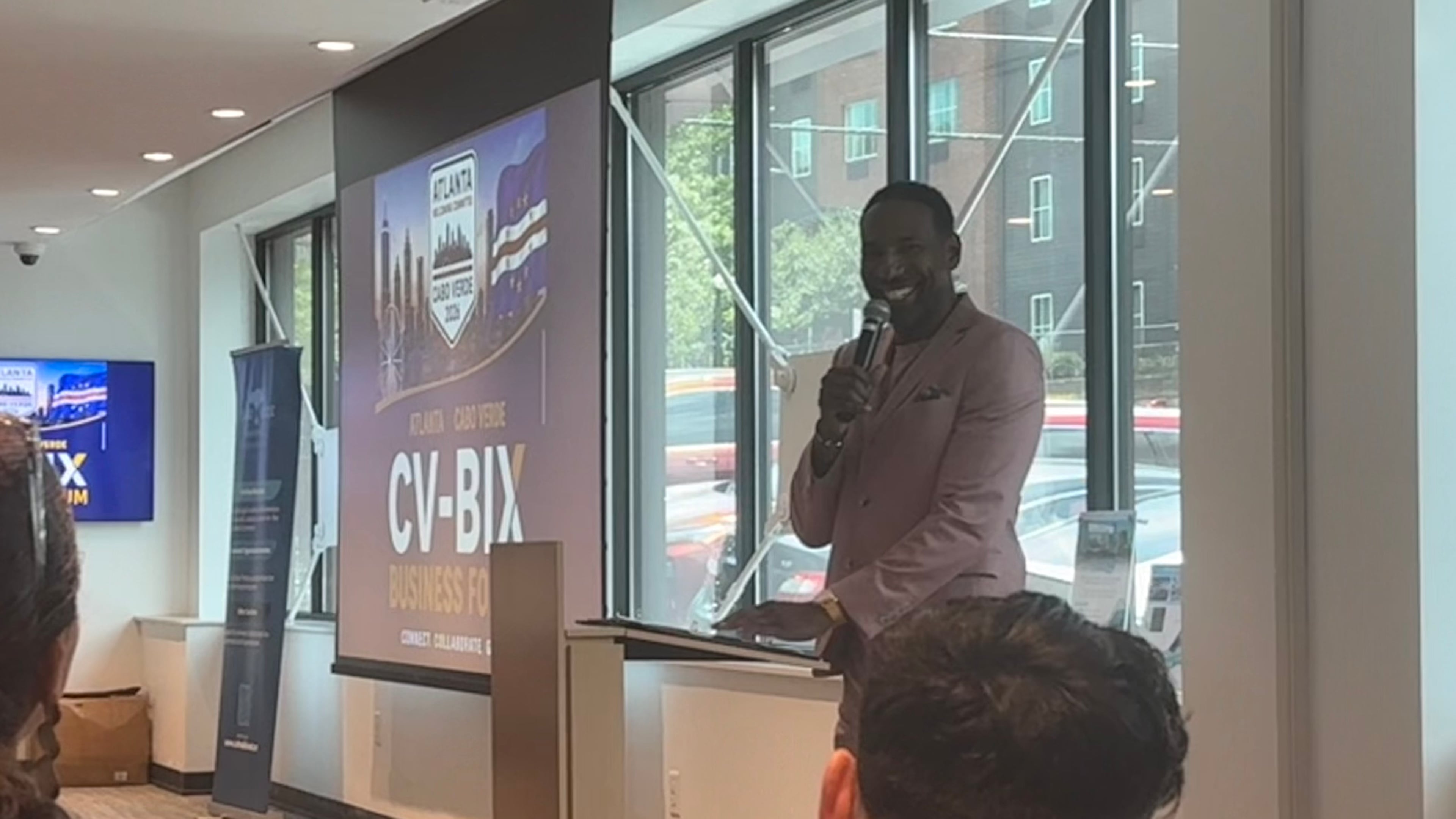
Before the match, local Cape Verdeans in Atlanta and a large subset from New England — where most of the diaspora in the U.S. lives — gathered for a business forum that featured Atlanta Mayor Andre Dickens and Cape Verde President Neves. The event Sunday had one goal: to build on the momentum from the world’s biggest stage in sports.
“This exchange is about building a bridge that carries investment, innovation and opportunity in both directions, both directions is important — bilateral trade — and we understand the importance of that bridge,” Dickens said.
Cape Verde is already a destination for many Europeans, especially those in Portugal, where there is most accessible flight. However, with a new direct flight out of Providence, Rhode Island, the hope is to extend that to American travelers.
Delgado made a “homeland” trip with his grandmother in 2024, visiting Praia, the nation’s capital, and the volcanic island of Fogo to trace his family’s roots which settled in New England several generations before. He took in all that the country had to offer, from striking views of the Atlantic to hiking the Fogo volcano.
But perhaps the most memorable moment was a simple seafood meal in a village he ventured out to for about an hour, alongside the volcano, to experience.
“It was probably one of the best things I’ve ever had,” Delgado said. “And those are sort of like human fulfilling experiences you try to seek when you go to islands.”
While the diversity of landscape, with both black- and white-sand beaches, remains its most alluring attraction, there’s also something intangible about the islands.
“I think it’s just purity,” Delgado said. “When I was there, it hadn’t been commercialized, and I don’t think that it ever needs to be. That stood out to me. Everything is very local, everything is for the people by the people.”
Simultaneously, to grow a certain level of commercialization is necessary. And while Delgado finds it “risky,” he hopes there’s a way to expand it without affecting the residents.
Capitalizing on this economic opportunity equitably is also on the minds of those driving the investment. Terza Lima-Neves, a Cape Verde scholar, said it must be a strategic partnership between the diaspora of Cape Verdeans around the world — which is larger than the population on the islands — to be development initiators instead of globalization agents.
That starts with building on green energy, like solar, and building a smart city.
Banco BAI Cabo Verde, a bank in the country, has prioritized those investments. The “Nos Zona Smart” city aims to create an “Atlantic hub connecting Africa to the world” on the Santiago Island, 25 minutes outside the capital city. The project is currently in the first phase of development, with a promise to build 1,244 residences across nine neighborhoods.
With the World Cup on the horizon, many hope this is just the beginning.
President Neves closed his remarks to hundreds of Cape Verdeans by offering an anecdote that, while a higher power did not bestow the land with a more profitable export like oil or gold, they have something else just as powerful.
“He didn’t give us the traditional natural resource, but he gave us sun, sunshine, the wind and the ocean,” Neves said. “Now, I invite you so that we may transform the sun into energy, the oceans into riches and the wind into new possibilities.”