How far will Trump go to influence the midterms?
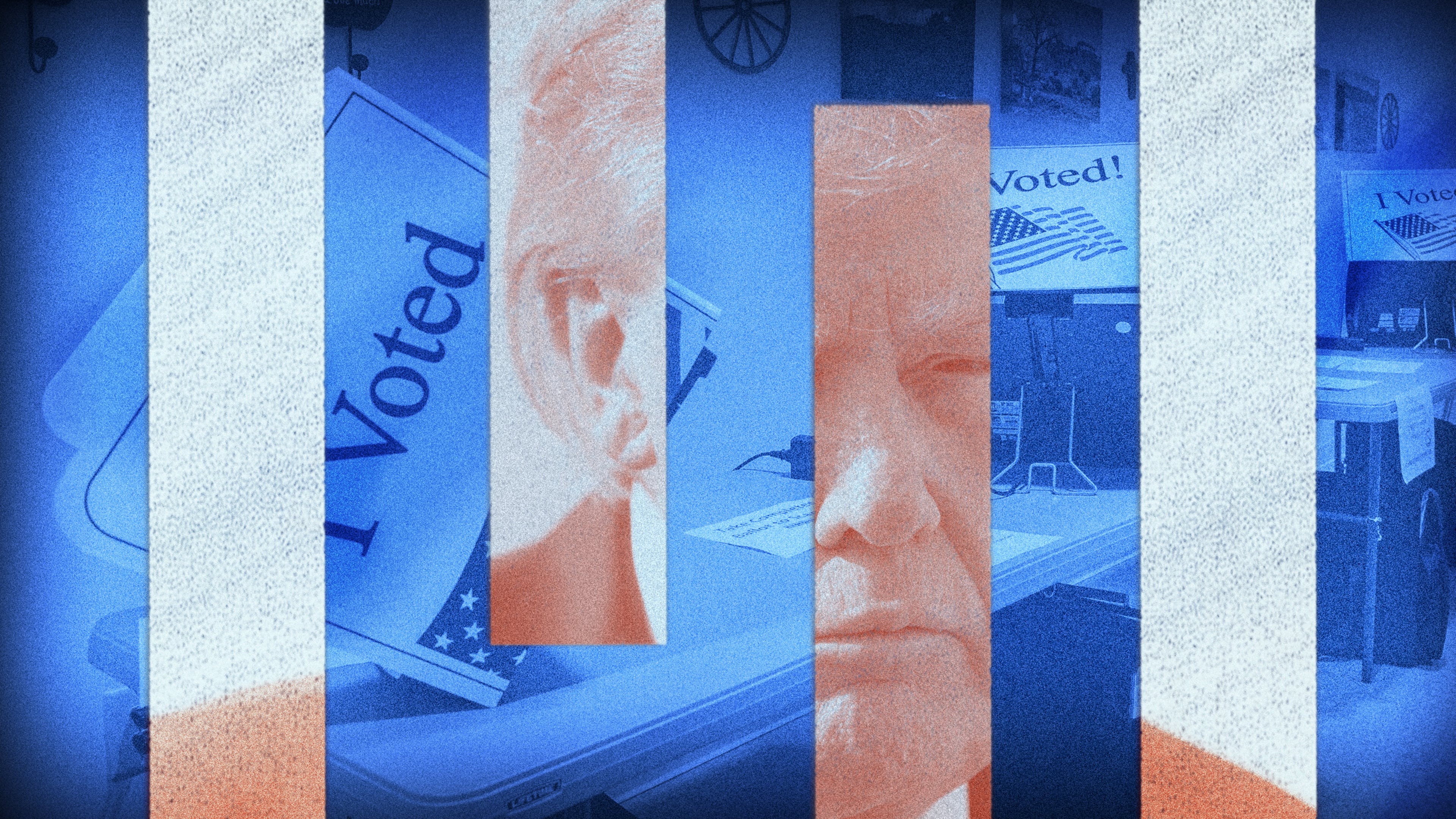


President Donald Trump’s critics are sounding warnings that he is laying the groundwork to do the same thing in November that he did six years ago — challenge the outcome of an election.
In the months leading to the 2020 vote, Trump sowed doubts by claiming his opponents would attempt to steal the election. He claimed victory before all the votes were counted, then rejected the final tallies that showed he lost. He filed dozens of unsuccessful lawsuits, pressured state officials and demanded Congress refuse to certify Democrat Joe Biden’s victory.
When that didn’t work, he urged supporters who came to his Jan. 6, 2021, rally in Washington to “fight like hell” — and many of them took his instructions literally, attacking the U.S. Capitol after the rally.
This year, experts fear Trump is using similar tactics to prevent a Democratic takeover in Congress. He’s stoked fears about election security, exaggerated vulnerabilities in voting machines and claimed that noncitizen voting is rampant.
Trump has also urged Congress to approve the Save America Act — legislation that would require documented proof of citizenship before registering to vote and photo ID to vote. But with Democrats and some Republicans concerned about the details, the bill is stuck in the Senate.
“Every American should be asking why Democrats are fighting against the SAVE America Act which includes commonsense election integrity measures, like Voter ID, that are strongly supported by the vast majority of Americans,” White House spokesperson Lauren Bis told The Atlanta Journal-Constitution. “This legislation will make sure Americans, and Americans only, decide our elections. President Trump has been clear and he is absolutely right: We fix this now, or we lose our country.”
The president’s supporters say he has legitimate concerns about election security.
“I’m not sure how President Trump advocating for identity verification reduces confidence in elections,” said Georgia Republican Party Chair Josh McKoon.
Democrats and some election security experts see more sinister motives.
If Democrats win control of the U.S. House or Senate — as numerous polls suggest they will — they could seek to rein in Trump tariffs, the Iran war and other initiatives. They could also investigate allegations of corruption that the Republican Congress has given scant attention.
Trump’s critics believe he will go to great lengths to avoid Democratic control of Congress. They fear he’ll try everything from seizing election equipment to deploying immigration officers at the polls come November.
“He doesn’t want to lose. If he can avoid it in some way, he will,” said Charlie Bailey, chair of the Democratic Party of Georgia.
Whatever his motivation, the president has sought to impose new election rules on states through executive orders that — so far — have been mostly rejected by the courts. Some of his supporters want him to declare a “national emergency” that they say would allow him to limit voting by mail, require hand-marked paper ballots and overturn a host of state and federal laws.
Those efforts may fail in court. But — as in 2020 — they could create doubt about the outcome of this year’s election.
“I think the president knows very well that he has no authority over elections and that the purpose of this campaign, ultimately, is not to win in a court of law or to succeed in changing the rules that govern our elections but rather to undermine public faith and trust in our elections,” said Sean Morales-Doyle of the liberal think tank the Brennan Center for Justice.
Georgia may once again play a significant role in whatever unfolds. The Justice Department is investigating Fulton County’s conduct of the 2020 election. Georgia is one of the few states with a statewide touchscreen voting system, which he and his allies distrust. And the state’s marquee U.S. Senate race could decide which party controls the chamber.
Asserting control

The U.S. Constitution grants states control over elections while giving Congress the power to pass election legislation. It doesn’t grant any explicit power to the president or the executive branch. That hasn’t stopped Trump from attempting to assert control anyway, using the machinery of the federal government to pursue his agenda on multiple fronts.
In recent weeks, the administration has threatened to withhold federal funds to states that haven’t complied with a sweeping set of election security demands and even threatened to arrest and prosecute state election officials who fail to comply with Trump’s efforts.
The U.S. Department of Justice has played a central role in the administration’s efforts. It’s sued Georgia and 29 other states seeking compliance with Trump’s orders, and lost every case that’s been ruled on. The Georgia case is still pending, but if the more than 20 cases judges have ruled on are any indication, that’s also likely to be dismissed.
The Justice Department intends to push forward anyway.
“The Department of Justice will continue to fight for the integrity of American elections. Ensuring that only eligible citizens vote is a core function of government, and states have an obligation to maintain accurate voter rolls,” Harmeet Dhillon, who leads the Justice Department’s civil rights unit, said in a statement.
Meanwhile, the U.S. Department of Homeland Security is seeking noncitizen voters and is planning a surge in several states, including Georgia, to investigate voter fraud from September to mid-October, according to CNN.
DHS has subpoenaed voting records for 13 voters in Georgia, according to the secretary’s office.
Trump has positioned noncitizen voters as an existential threat, but noncitizen voting is rare, studies and state audits have found. A review released Tuesday by the secretary’s office showed that about 430 people who have voted at some point within the last three decades in Georgia were flagged as potential noncitizens. About 8.2 million people are registered to vote in the state.
Voting rights groups say Trump’s warnings could create uncertainty in the electorate and spread specious claims about such voters cheating candidates out of wins come November.
The administration hasn’t stopped at noncitizen voters. It’s also targeted certain voting machines, a target of Trump supporters after the president’s 2020 loss.
In a letter last week, Homeland Security Secretary Markwayne Mullin asked the Justice Department to examine whether voting equipment that uses bar codes or QR codes to count votes is suitable for “voter verification or manual audits.” The letter asked the DOJ if such voting systems are compliant with federal law.
Any changes to QR code vote tallying would disproportionately affect Georgia, one of the few states in the country to use such a system statewide.
Casting doubt on elections
“He does have, unquestionably, large sway over the communications environment. When he says stuff — when he tells the truth or when he lies — people listen more than they listen to you and me,” said Justin Levitt, a Loyola Marymount University law professor.
During a primetime speech in July, the White House released a trove of documents that his allies billed as evidence of massive fraud.
The declassified reports revealed no shocking new evidence of election rigging. They did, however, offer Trump supporters ammunition to further spread conspiracies about elections.
Trump has installed allies receptive to his false claims of widespread voter fraud in the federal government, granting them an official platform where they could cast doubts about future elections.
Among those now inside the federal government are U.S. Attorney for the Middle District of North Carolina Dan Bishop, who is overseeing election fraud investigations and refused to certify Trump’s 2020 loss as a congressman, and Kurt Olsen, a twice-sanctioned lawyer who tried to help Trump overturn the 2020 election. Olsen referred the Fulton 2020 investigation to the DOJ.
The administration also has allies in Georgia. Some State Election Board members have spent years demanding further investigation into the 2020 election. At least two members of the board gave information to the FBI before the Fulton County raid. A majority of current board members still question what happened in 2020.
Georgia Secretary of State Brad Raffensperger and his office are readying for another contentious election cycle. Gabriel Sterling, the office’s director of special projects, cast Trump’s bluster as both a misunderstanding of election processes and a concerted effort to undermine faith in them.
“The irony of this is if you tell your voters that your votes aren’t going to count, what do they do? They don’t bother showing up,” Sterling said. “So you’re really hurting yourself in the long run.”
But voter distrust is one worry on a longer list.
Local election administrators are planning for the worst-case scenarios — everything from weather emergencies to election misinformation campaigns fueled by artificial intelligence. They’ve conducted tabletop exercises for predicaments they might find themselves in.
Joseph Kirk, the Bartow County election supervisor, said he most fears the “unknown unknowns” — events that administrators haven’t thought of or haven’t prepared for. In 2020, it was running an election during the COVID-19 pandemic. This year’s unknowns could come from the federal government.
Changing election rules?
Some of Trump’s most ardent supporters want him to declare a “national emergency,” have circulated a draft declaration and say they’re coordinating with the White House.
Under that proposal, all voters would be required to reregister in person with proof of citizenship. Absentee voting would be prohibited for those without a confirmed medical, disability or other authorized excuse. And voters could use only hand-marked paper ballots — not voting machines.
The 17-page proposal includes scores of other requirements, some of which would overrule state and federal laws. Supporters say such extraordinary action is needed to ensure the integrity of elections.
“We need a national emergency declaration to fix this, because Congress isn’t going to fix it. The states are not going to fix it,” Georgia election skeptic Garland Favorito, who believes the 2020 election was rife with fraud, said during a recent presentation on Trump’s latest allegations. “We now are dependent upon President Trump to execute a national emergency declaration and try to save this country before it’s too late.”
Critics say such actions would be blatantly illegal. They say any move by Trump to dictate election rules would be quickly struck down in court.
“Just declaring a national state of emergency doesn’t give Trump unlimited powers,” said UCLA law professor and election law expert Rick Hasen. “It only gives him the powers that are contained in various congressional statutes that say, ‘Here’s what the president can do in case of an emergency,’ and none of those statutes involve elections and election power.”
Trump has alternately dismissed and encouraged talk of an election takeover. During a recent interview, conservative commentator Wayne Allyn Root encouraged Trump to declare an emergency.
“Let me just say that stranger things have happened, OK?” Trump responded. “I’ll leave it at that.”
Trump has already sought to change election rules.
In March, he ordered federal authorities to compile a national list of verified citizens and instructed the U.S. Postal Service to refuse to deliver ballots from anyone who does not appear on the list.
“It would literally change the function of the USPS, which is charged with delivering mail and not identifying who can vote,” Celina Stewart, chief executive officer of the League of Women Voters, told reporters in a briefing last week. “It would not be a good thing for voters. Millions of people could be shut out (of voting).”
Numerous Democratic-controlled states and voting rights groups have sued to block Trump’s mail voting plan, and experts say it will likely be struck down. But the issue remains unresolved, creating uncertainty as election officials prepare for November. Litigation over the plan is expected to make it to the Supreme Court before the midterms.
The Trump administration also has slashed staffing at the U.S. Cybersecurity and Infrastructure Security Agency, which plays a key role in election security. CISA earned Trump’s ire by declaring the 2020 election “the most secure in American history.”
Experts fear the reduced staffing will leave the country’s election infrastructure more vulnerable to bad actors like Iran. Raffensperger said cybersecurity is his No. 1 concern heading into the midterms.
“We’ve kind of kicked the one hornet’s nest of the Iranians, and they’ve got some really smart folks over in the cyberspace,” Raffensperger said.
Ahead of the 2020 election, Sterling said the secretary’s office had more than 30 confidential security briefings with the agency. They’ve had zero this year.
The Trump administration stopped funding an election information sharing center that notifies state officials of election threats in other states.
Georgia, however, hasn’t relied on CISA as much as some states and counties, Sterling said.
Experts worry the president could take more direct action to disrupt the election, like sending Immigration and Customs Enforcement officers to polling places or seizing election equipment.
They say ICE patrols could discourage some U.S. citizens from showing up to vote. And though the officers couldn’t visit many polling places, the administration could publicize those patrols to have a bigger impact, Levitt, the Loyola Marymount election law expert, said.
“I absolutely think it’s a possibility somewhere,” Levitt said. “And I absolutely think it’s a realistic possibility that they will do media on it to try and project the fact that it is everywhere, but it won’t be everywhere.”
A spokesperson for the Department of Homeland Security said ICE is “not planning operations targeting polling locations.”
“ICE conducts intelligence-driven targeted enforcement, and if an active public safety threat endangered a polling location, they may be arrested as a result of that targeted enforcement action,” the spokesperson said.
Election experts also worry federal authorities could seize election equipment — say, voting tabulation machines. That could raise questions about whether they tampered with or mishandled the equipment.
“Yes, you could get a court order to get them returned,” said Stephen Richer, a legal fellow at the libertarian Cato Institute. “But could you stand by them once they’re returned?”
Across the country, Democratic attorneys general and secretaries of state are preparing for such scenarios, according to the New York Times. Bailey said the Democratic Party of Georgia has established a voter education hotline to answer questions about eligibility.
“You have the vote,” Bailey said. “He can’t take it from you.”
It’s less clear whether Raffensperger and Georgia Attorney General Chris Carr — both Republicans — are preparing for such actions. Both declined to address possible interference by the Trump administration. A spokesperson for the attorney general’s office did not respond to requests for comment.
“We are constantly working with our state and federal partners to prepare for any contingency and expect a secure and well-run election,” a spokesperson for the secretary’s office wrote in a statement.