Georgia voting overhaul could bring big payday to companies
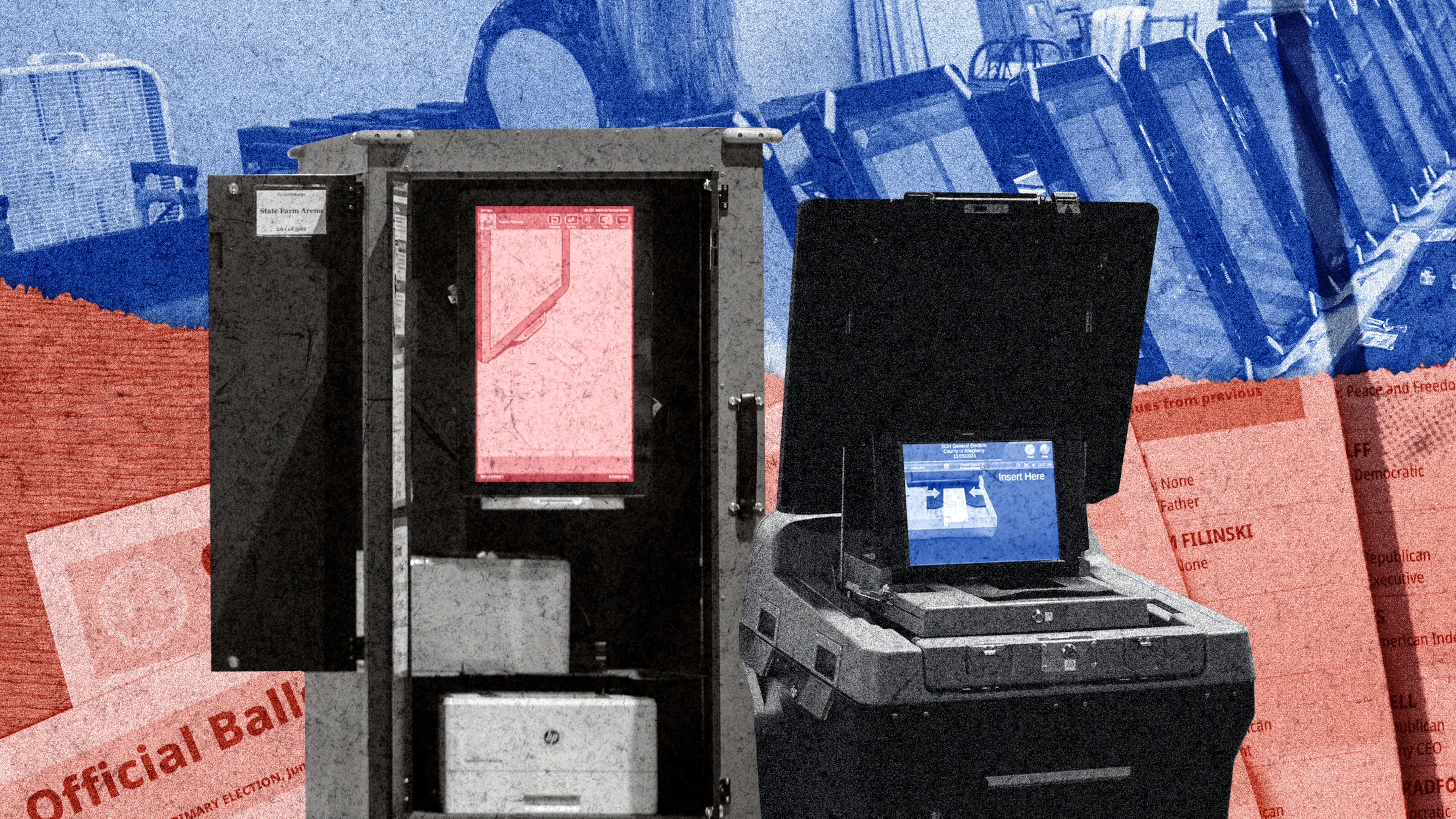


A vendor set up outside the state Capitol during the General Assembly’s legislative session in March to tout his voting touchscreens and ballot tabulators.
Election Systems & Software wasn’t there by chance. The Nebraska-based company was angling for a lucrative statewide contract it expected to go out for bid in early 2027, one that would determine how millions of Georgians cast ballots.
On paper, the state isn’t due for new voting equipment until 2029. But after years of headlines about unpatched security flaws, unceasing conspiracy theories and polling showing a sizable chunk of Georgia voters with little confidence in the current system, lawmakers may choose to remedy the situation by taking bids for new machines in time for the 2028 elections.
The contours of what that new system may look like could emerge during the June 17 special session. Lawmakers are tasked with redrawing the state’s political maps and finding a way to replace the QR codes currently used to count votes ahead of a self-imposed July 1 deadline.
Vendors, however, are quietly positioning themselves for an even bigger prize: the prospect of a rare statewide contract worth upward of $100 million.

A $100 million prize
Georgia is a particularly large prize for voting machine companies.
About 70% of voters across the country primarily use hand-marked paper ballots to vote, according to the national election integrity organization Verified Voting. Georgia relies on touchscreens that print out paper ballots.
Not only that, but of the 10 largest states in the nation, Georgia is the only one that uses a single voting system. Other states certify multiple voting systems and then individual counties buy the equipment they prefer directly from the manufacturer, according to Mark Lindeman, Verified Voting’s policy and strategy director.

When Georgia’s current Dominion Voting System equipment — 30,000 machines worth some $107 million — was first deployed ahead of the 2020 presidential primaries, it was considered the country’s largest-ever election equipment rollout. The state’s 10-year contract expires in 2029.
The election equipment market is dominated by three companies: Election Systems & Software, Hart InterCivic and Dominion, which was sold to Liberty Vote last year. According to one study, the three companies collectively control nearly 90% of the market.
The industry is notoriously opaque. Even though taxpayer dollars pay for voting machines, the major companies are privately owned and don’t publicly disclose their financials, including how much they charge for voting machines.
The stakes are high. Jurisdictions buy voting machines infrequently — typically once a decade and sometimes less — and government contracts often end up in court as companies try to block deals with their competitors. So it’s hardly a surprise that during the 2026 legislative session, companies bolstered their lobbying operations in Georgia and employed prominent lobbyists.
“Virtually every active and even some prospective voting system and equipment vendors have a presence in Georgia in one form or fashion,” said state Rep. Victor Anderson, R-Cornelia.
ES & S has hired nine lobbyists — nearly double their team from 2025 — including former Georgia Secretary of State Lewis Massey, a Democrat, and John Watson, a former chair of the Georgia Republican Party.
Liberty Vote employed six lobbyists during the 2026 session, including heavy hitters Trip Martin and Boyd Pettit, as well as Jay Roberts, Gov. Sonny Perdue’s floor leader in the state House, and Brad Bohannon, former deputy chief of staff for Gov. Brian Kemp.
Machine mistrust
The lobbying comes as a fervent cadre of citizen activists is demanding the state switch to paper ballots. Their movement gained steam after President Donald Trump’s 2020 defeat.
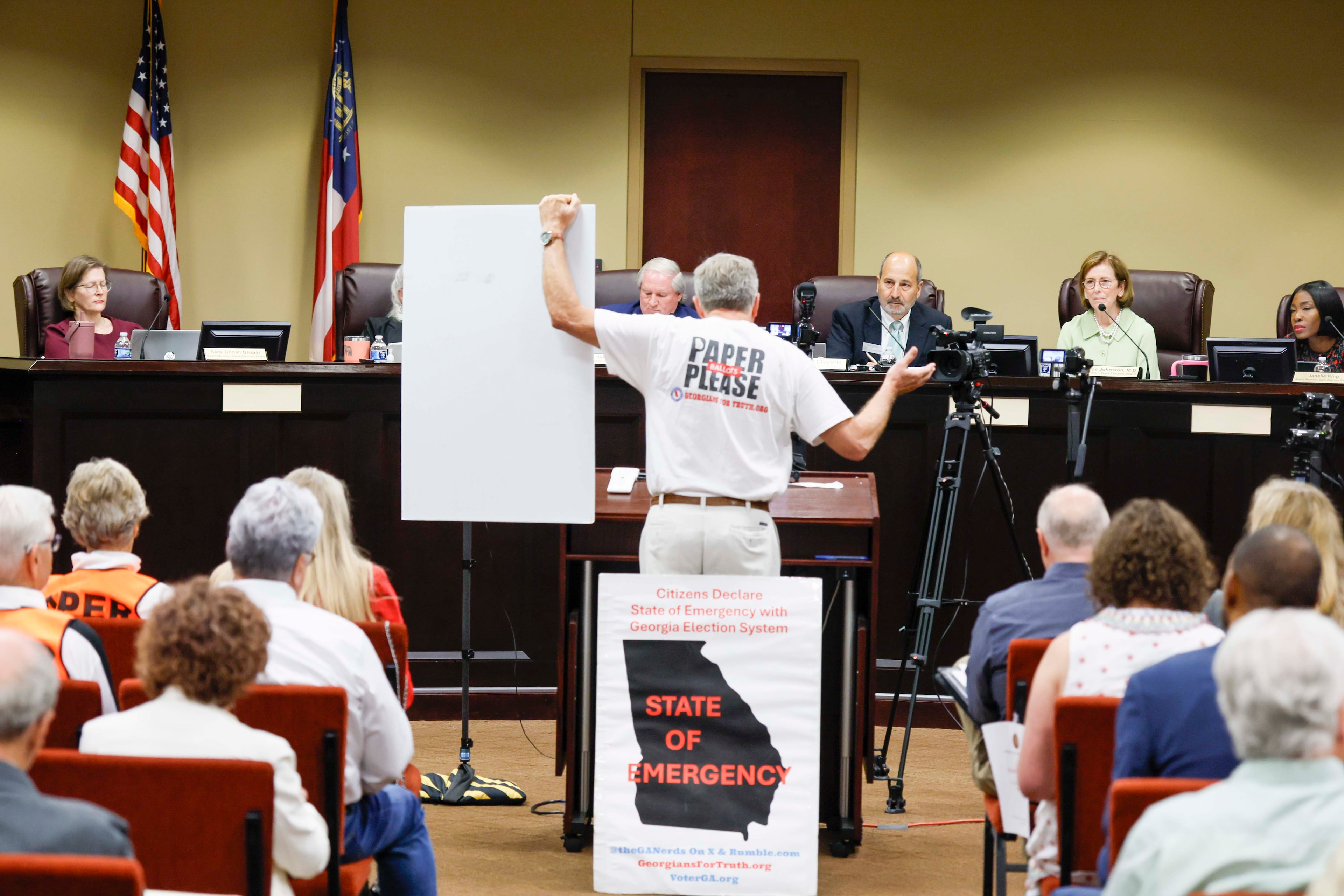
In response to public pressure, Republican lawmakers passed a law two years ago setting a deadline for removing the QR codes for this July, but they neglected to find a path to make that promise a reality before adjourning the 2026 legislative session.
David Becker, executive director and founder of the Center for Election Innovation & Research, a Washington, D.C.-based nonprofit that works with election officials to build voter confidence, said Georgia’s current voting system works “exceptionally well” and has withstood scrutiny in recent election cycles.
“There’s no evidence they’ve ever been breached or have failed to perform in any way,” he said.
But conservative activists have pushed a slew of conspiracy theories about the machines since Trump’s 2020 loss, with some calling for the state to adopt hand-marked paper ballots and counting every race on each ballot by hand, a process experts say takes longer and is more prone to error. While many security experts favor hand-marked ballots, they say those ballots should be scanned by machines and a sample should later be hand-audited.
Andrew Appel, an election security expert at Princeton University, said companies don’t want vulnerable machines, but touchscreens are more profitable than pen and paper and are already embedded in how some election administrators across the country run elections.
“I wish some of those election administrators would look around at all those other states that use hand-marked, machine-counted, paper ballots,” he said.
Cherokee County Elections Director Anne Dover said she’s confident in the security of Georgia elections, pointing to audits and other procedures already in place, but she hopes the state will fund upgrades if it chooses to keep the current system.
“I would like to see any updates that need to be done, but unfortunately, that’s out of our hands,” she said.
A path forward
Whatever lawmakers decide when they come back to Atlanta later this month to resolve their voting system mess, the consequences go beyond a procedural fix. Delaying implementation of a new system until after the midterms, which seems to be a likely outcome, would leave the state with the same system for another election without patching vulnerabilities and leave the prospect of a future statewide contract up for grabs.
Lawmakers will be on a tight timetable. Legislators must fix the mess before the July special election to fill a vacancy in Congress created by U.S. Rep. David Scott’s death — giving them weeks to pass legislation and even less time for six counties to implement any changes.
Many local election officials have warned that hastily overhauling election conduct is dangerous.
Marilyn Marks, the executive director of the Coalition for Good Governance, an organization that advocates for paper ballots, compared a delay to putting duct tape over a check engine light. The problem, she said, is the touchscreen system itself, not just the General Assembly’s self-imposed bar code deadline.
An immediate statewide switch is far-fetched. Anderson, who has led efforts to address the QR code problem in the House, said lawmakers are discussing a number of ideas with leadership. The most obvious choice would delay the implementation deadline and lay out guidelines for a new system by 2028, he said. That would suit the vendors already competing for what comes next.
State Rep. Saira Draper, D-Atlanta, told the AJC soon after the special session was announced that changing how Georgians vote in the middle of an election year was “a slap in the face to Georgia voters who want fair and free elections.”
While delaying the switch had broad, bipartisan support in the House this spring, it never budged in the Senate. Pressing for the same plan during a special session could be arduous. It would require the support of the Senate, led by Lt. Gov. Burt Jones, who by the time the session begins will either be the Trump-backed Republican nominee for governor or a lame duck, depending upon the outcome of the June 16 primary runoff election.
Jones was among the 16 GOP activists who signed documents stating they were presidential electors for Trump in 2020, even though Biden had won Georgia’s electoral votes.

During this year’s legislative session, he backed a proposal to switch to hand-marked ballots before the July deadline. Asked about a delay, Jones said in a statement that he looks forward to working with the Legislature and governor to continue his “fight for election integrity.”