Conspiracy theories may explain why someone blew up the Georgia Guidestones

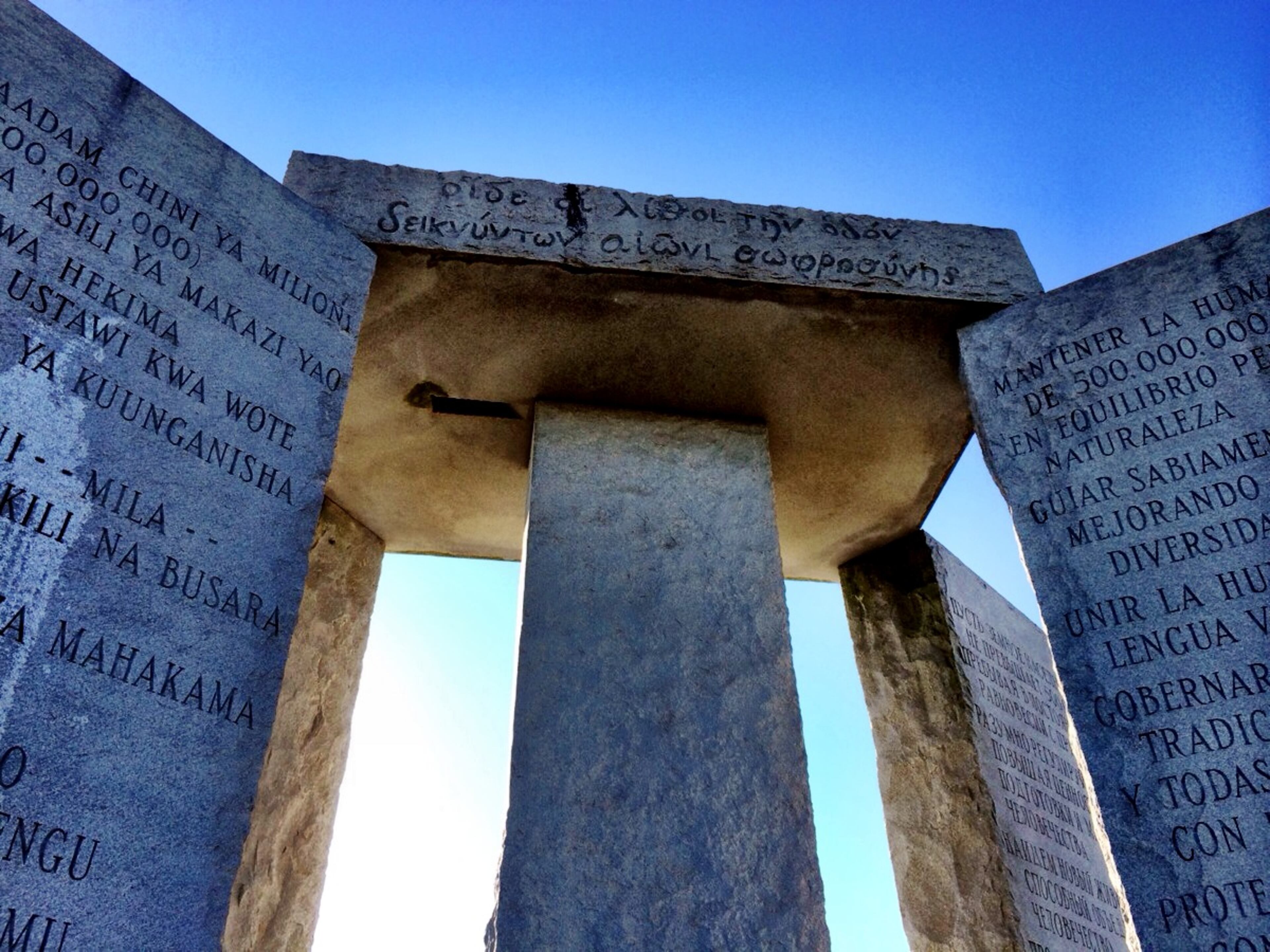
In September, I set out with a team to solve a mystery. We wanted to figure out who destroyed a strange monument in Elbert County called the Georgia Guidestones on July 6, 2022, and why.
That journey is the subject of “Who Blew Up the Guidestones?” a six-part narrative audio series produced by Goat Rodeo and The Atlanta Journal-Constitution.
As we traveled down rabbit holes, through granite quarries and graveyards, and into fringe corners of the internet, something odd began to happen. The question at the heart of our investigation — “Why did someone blow up the Guidestones?” — had morphed into a new question. I started to wonder, “Why didn’t someone blow up the Guidestones sooner?”
It felt like every day reporting this story I would learn about a new conspiracy theory aimed at the enigmatic granite structure, sometimes referred to as “America’s Stonehenge,” calling for its demise.
The monument was the source of so much intrigue that the 42-year history of the Georgia Guidestones is basically just a history of popular conspiracy theories over that same period. Whatever the conspiracy theory du jour, the Guidestones had a place in it. I soon came to see them as blank slates onto which each generation could project their own anxieties and fears.
The details would vary, of course. The Georgia Guidestones were either satanic, extraterrestrial or otherwise sinister for some reasons I had trouble following. But the prescription was always the same: The stones must fall.
And eventually they did.
Disinformation campaigns can destroy lives

Conspiracy theories are not a new phenomenon, especially in U.S. politics. Back in 1964, historian Richard Hofstadter described what he called the “paranoid style in American politics” as “an old and recurrent phenomenon in our public life which has been frequently linked with movements of suspicious discontent.”
Fads come and go, even in politics, but this particular style has had remarkable staying power. Conspiracy theories seem never to go out of fashion.
That’s not to say the conspiracy theories themselves have remained the same. As AJC Politics Editor Chris Joyner told me, “Conspiracy theories used to be fun. There were no action items with conspiracy theories about the Loch Ness Monster or Sasquatch.”
He was not being literal. Joyner knows there have been far too many destructive conspiracy theories throughout global history.
There was nothing fun about the pogroms sparked by antisemitic hoaxes like the late-19th-century “Protocols of the Elders of Zion,” for instance, or the many innocent lives ruined by Wisconsin U.S. Sen. Joseph McCarthy’s hearings and blacklists during the Red Scare in the 1950s.

Rather, as someone who has covered the political extremism beat for some time, Joyner was making a more contemporary observation and pointing out one reason behind the general feeling that something is fundamentally broken in U.S. politics.
For 42 years, the Guidestones stood — hated, but upright — until someone decided to take matters into their own hands, cross off an action item on their to-do list and blow up the monument.
It is difficult for me now to view this event through anything other than the lens of conspiracy theory history, the point at which conspiracy theories in America took a darker, more destructive turn.
History shows people bend reality to fit their world view
Unfortunately, this trajectory seems likely to continue. One recent Journal of Experimental Social Psychology study found that a higher willingness to believe conspiracy theories coincided with both perceived and actual economic inequality, which is on the rise.
This makes sense intuitively. Higher inequality can lead to the perception that society is breaking down. And in such confusing, uncertain times, people will naturally search for meaning in a seemingly meaningless world.
Conspiracy theories offer answers, even if it’s false advertising.
Research on conspiracy theories suggests that conspiracy theories can be dangerous even if only a small number of people believe them. They can also lead to greater polarization, a toxic information sphere, loss of media literacy and an inability to discern what’s real and what’s not.
It’s that last part that worries me most.
As we began to make some truly interesting discoveries over the course of our investigation, I began to worry that some people will simply ignore these revelations and either adapt the conspiracy theories at the heart of their worldview to explain this new contradictory reality or just make new ones.
Just look at the mystery behind the origin of the Georgia Guidestones.
Their creator, R.C. Christian, chose to remain anonymous precisely because he did not want his identity to take away from the true meaning of the stones. He went through great pains to spell out their meaning explicitly by carving them into the granite monument and publishing an accompanying manifesto.
And yet, various groups of people concocted their own theories — and have continued doing so even after a documentary crew found R.C. Christian’s true identity, a man who espoused the same worldview in the manifesto.
To me, that’s the real danger of conspiracy theories: an unwillingness to confront reality, even when it’s literally etched in stone.
Journalist Tyler McBrien is managing editor of Lawfare. He hosts the AJC and Goat Rodeo’s “Who Blew Up the Guidestones” six-episode podcast, which launched March 17.


