The Latest: Trump kicks off three-day Asia trip in Philippines
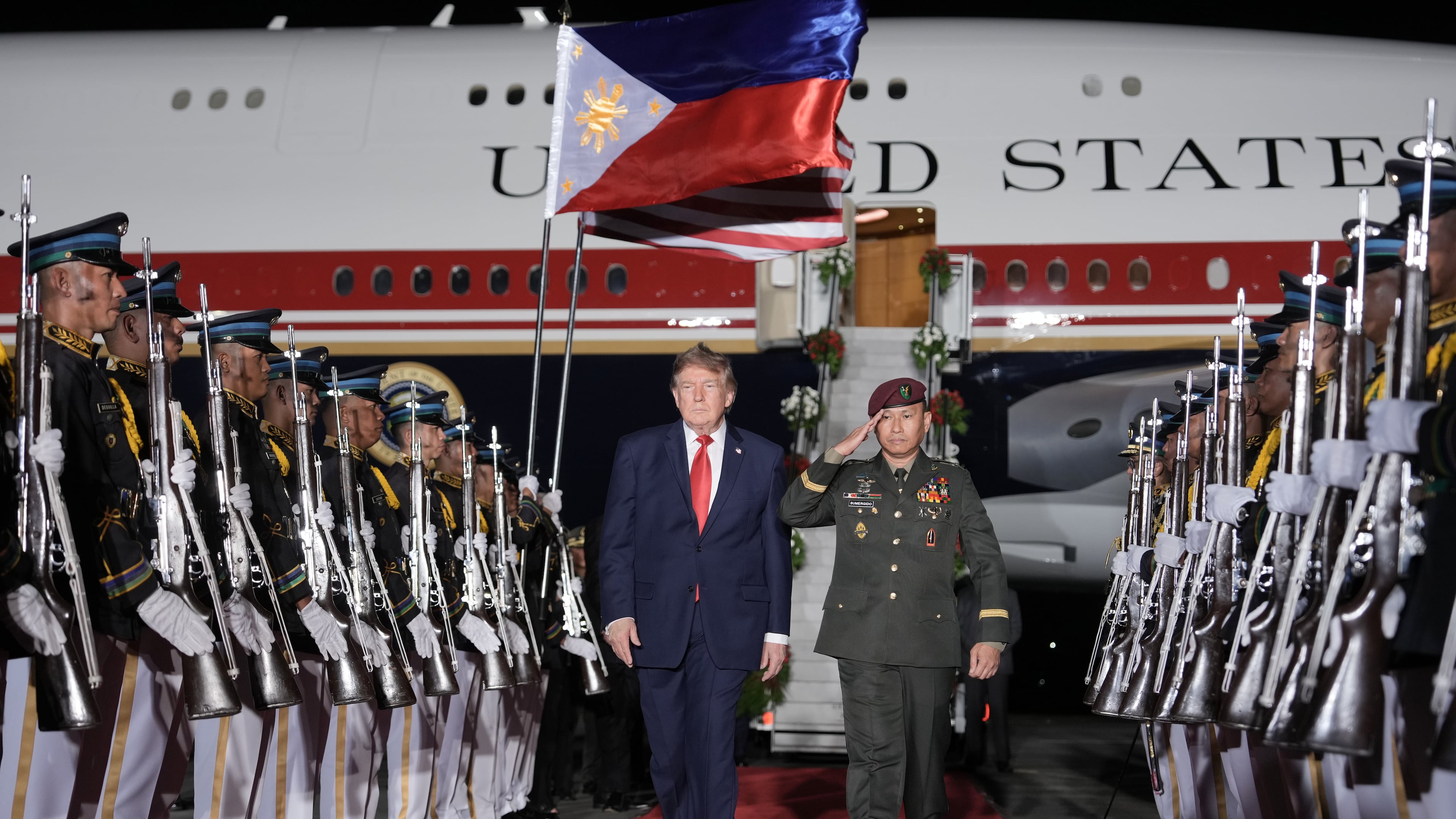
President Donald Trumparrived in the Philippines on Tuesday, where he was scheduled to meet regional partners, talk trade, and seek a break from a series of setbacks at home, ranging from a major disruption to the U.S. aviation industry to a scandal that has shaken the global AI industry.
Manila, the Philippine capital, is Trump’s first stop on a three-day trip that will later take him to China for historic three-way nuclear talks with Chinese President Xi Jinping and Russian President Vladimir Putin, and, according to Trump, potentially for a meeting with North Korea’s leader Kim Jong Un.
A network the National Security Agency uses to communicate classified information was offline after what one U.S. official described as “routine maintenance.” Another official clarified that “mission/critical capabilities remain fully operational.” The NSA episode is the latest in a recent series of cyber-related disruptions to critical government and private sector functions, including one that resulted in a nationwide ground stop of air traffic and one that triggered online banking delays.
Here's the latest:
Duffy says he’s open to Congress breaking up funding request
After pitching skeptical Republican senators on a $50 billion funding request for the nation’s air transportation system, Transportation Secretary Sean Duffy expressed openness to other options. That could include Congress breaking up the request into pieces, with the initial focus on the most critical needs for air safety.
“I would hope that they don’t do that to me, but I’ll take what I can get,” Duffy told reporters after the meeting with GOP senators.
Congress approved $12.5 billion last year to modernize key infrastructure for air travel. Duffy said all of that money has been “set aside,” requiring lawmakers to approve additional funding.
He acknowledged the breadth of the request, which has spurred pushback from some Republicans who have expressed concern that it goes beyond core safety needs.
“I wanted to put everything on the table,” Duffy said. “I wanted to show it all to them. I know the Congress will … pressure test it, look at it and they’ll make a determination.”
Trump administration further streamlines foreign arms sales approval process
The State Department has announced a new overhaul of its arms sales approval process for closely allied foreign governments.
In upcoming changes to the International Arms Trafficking Regulations, the department said Tuesday it would remove items from the U.S. Munitions List that do not provide “a critical military or intelligence advantage” to the purchaser. This will largely affect so-called “dual-use items” that can have both civilian and military functions.
In addition, the department, which is in charge of approving foreign arms sales, said it would create a general license category that will pro-approve the sale of certain materiel to “most trusted partner governments.” It will also adopt a presumption of approval for some requests that must still go through the vetting process, it said.
The changes are the latest modifications to the arms sale approval process that the Trump administration has sought to speed up to benefit both American defense contractors and allied countries.
Republicans voice concerns about big funding package for air transportation system
Several Republican senators are voicing skepticism about a $50 billion request from the Trump administration for the nation’s air transportation system.
“I don’t think the full $50 billion will be funded. Some of that is not safety related,” said Sen. Ted Cruz, chairman of the Senate Committee on Commerce, Science, & Transportation, which has jurisdiction over air safety issues.
“We’re not going to give them $50 billion,” said Sen. John Kennedy, R-La. “But I think that we are willing to provide the money to replace the copper wires with fiber optics, and to try to stop the bleeding.
The lawmakers’ comments came after a closed-door meeting with Transportation Secretary Sean Duffy. The administration formally requested a $50 billion investment Tuesday to boost airline safety and the nation’s airports. The request came after the longest air traffic ground stop in 25 years.
Sen. Rick Scott, R-Fla., said he understands the need for upgrades, but doesn’t believe taxpayers should have to pay for them.
“I don’t understand why the airline industry is not paying for this,” Scott said.
Trump says the US will catch up with China on rare earth minerals production in 10 months
President Donald Trump on Tuesday said the U.S. will catch up with China on rare earth mineral production in 10 months, though experts in the industry believe it will take years.
“We are making rare earth at a level that we’ve never made before,” Trump said in Manila when appearing with leaders from Japan, India and Australia, a grouping known as the Quad to counter China’s influence in the region.
“Everything that we need, we’ll have in 10 months,” Trump said. “We’re producing major numbers when it comes to rare earth.”
China has used its near-monopoly in rare earth minerals processing to force a trade truce with the U.S. in 2025. Since then, the Trump administration has invested domestically and forged partnerships to rebuild the country’s rare earth elements supply chain.
US conducts new limited strikes on Iran, official says
A U.S. fighter jet has carried out a strike on a missile launch site in the Strait of Hormuz belonging to Iran’s paramilitary Revolutionary Guard, a U.S. official says.
The official, who spoke on condition of anonymity to detail sensitive military operations, says “precision munitions” were used in the strike on Qeshm Island and that the U.S. was responding to “aggression” toward U.S. personnel.
The U.S. military has periodically carried out what appear to be limited strikes on Qeshm Island and other Iranian targets this month.
Classified network at NSA offline, defense official says
A network the National Security Agency uses to communicate classified information was offline after what one U.S. official described as “routine maintenance.”
A defense official said Tuesday that the problem affected NSANet, a classified internal network. A U.S. official said that the NSA “experienced temporary degradation during scheduled routine maintenance” and that though “while some internal systems were affected, mission/critical capabilities remain fully operational and our ability to defend national security continues.” Another person familiar with the matter said the issue occurred during routine patching.
The three individuals spoke on condition of anonymity to discuss non-public information.
The NSA episode is the latest in a series of cyber-related disruptions to critical government and private sector functions, including one Friday that resulted in a ground stop of air traffic in the United States, and a technical issue that affected the banking industry on Monday.
FAA halts installation of routers that led to ground stop
The Federal Aviation Administration has paused the installation of the routers that were linked to last week’s national ground stop, and turned off any Juniper routers that were already installed.
The decision was made after technicians linked Friday’s disruption of key air traffic control systems to one of these routers that had just been installed in El Dorado, Arkansas.
For now, the FAA is relying on older Cisco routers that have been in place for 25 years to continue operating the network while they investigate the cause of Friday’s problems at 17 of the nation’s 22 regional air traffic control centers.
The routers that malfunctioned last week are being tested in a lab at the headquarters of the company that installed them named L3Harris.
Republican in Alaska’s governor’s race praises Democrat who withdrew to help his fellow Democrat
The top-finishing Republican in Alaska’s gubernatorial race praised as a statesman the Democrat who dropped out of the race to support a fellow Democrat.
Republican Bernadette Wilson, endorsed by President Donald Trump, had urged the other two Republicans in the race to withdraw after the open primary to create a clearer lane for her against Democrat Jonathan Kreiss-Tomkins in the Nov. 3 ranked vote general election, which Kreiss-Tomkins won.
The two Republicans, a former mayor and a former state attorney general, stayed in the race, highlighting differences in experience and priorities with the business owner Wilson. They urged voters to rank the GOP candidates, calling that an important strategy.
After advancing from the August primary, Democrat Tom Begich withdrew and endorsed Kreiss-Tomkins. His campaign said it was the best way to bring Democratic donors and voters together.
Wilson said Begich’s decision showed a willingness “to put pride and ego aside.”
Newsom visits Democratic leader Jeffries on Capitol Hill
Jeffries said they talked about disaster assistance and also priorities for health care and lowering the high costs of living.
“We’re committed to making sure that we deliver disaster relief to the people of Altadena and the Pacific Palisades,” he said, calling it unacceptable that those communities have gone without aid nearly two years after the devastating wildfires.
He said he also thanked Gov. Gavin Newsom for his leadership around the state’s response to nationwide Republican redistricting efforts.
Jeffries demands briefings for Congress about outages, ground stop
House Democratic Leader Hakeem Jeffries said he spoke to Duffy on Sunday but there are still more questions and answers about the airline disruptions.
Taken together with other recent outages, he said it’s unclear if it’s infrastructure related or whether there’s “malignant activity.”
He mentioned the Microsoft email outage, the FAA ground stops and reports of problems at the NSA.
“I think it’s time for the administration to come up to the Hill and explain themselves,” he said, “so we can be informed about the steps that need to be taken.”
He panned the administration’s request for $50 billion to modernize the air traffic control system as Congress assesses the situation.
Duffy says no more ‘piecemeal’ on aviation investments
Transportation Secretary Sean Duffy is pitching to lawmakers the Trump administration’s request for $50 billion to fully modernize the nation’s air traffic control system.
Duffy said there has been a historic underinvestment in aviation. And now lawmakers have a choice.
“They have to make a decision. What do they want to do? Everything? Or do they want to give me some piecemeal?” Duffy said. “ I hope they don’t piecemeal it. There’s been too much piecemeal happening over the course over 20 or 30 years. I hope we get the full investment.”
Duffy’s comments came as he prepared to meet with GOP senators Tuesday on Capitol Hill. Earlier in the day, the administration made a formal request for the funding and detailed where it hopes to invest the money. The beefed-up request comes after the longest nationwide ground stop in 25 years.
Cao’s nomination hearing for Navy secretary wraps up following clash over Navy suicide attempts
The Senate committee hearing to consider Acting Navy Sec. Hung Cao for the permanent job wrapped up after 2.5 hours that focused largely on the Iran war’s costs and conditions aboard Navy ships supporting the war.
The hearing ended with a clash between Cao and Democratic New York Sen. Kirsten Gillibrand over sailors’ suicide attempts aboard the USS Abraham Lincoln aircraft carrier, which supported the war during a record-breaking deployment.
Gillibrand targeted Cao’s assertions that reports of mental health concerns were dishonest. She also dismissed Cao’s use of the term “suicide mitigations” to describe suicide attempts.
Cao said a sailor who jumped off the Lincoln was not attempting suicide because he later admitted as much and was wearing a life preserver. Gillibrand pushed back: “What was he trying to do, swim to Guam?”
Trump administration nominates officer to top Army post
The Trump administration has nominated Gen. Christopher LaNeve to Chief of Staff of the Army — the top uniformed post in the service — after he stepped into the job for months following the unexplained firing of Gen. Randy George in April.
Adam Telle, the man currently serving as the acting Secretary of the Army following the departure of Dan Driscoll from the top civilian post in August, said that LaNeve “is the right leader at the right time to modernize the Army and ensure our Soldiers are prepared to dominate on any battlefield” in a post to social media.
LaNeve has seen a meteoric rise through the ranks since the start of the Trump administration. LaNeve was promoted to be Hegseth’s top military aide shortly after he arrived at the Pentagon and was suddenly nominated him to be the Army’s vice chief of staff last October even though there was an officer in the job at the time.
US House Oversight chairman James Comer to run for Kentucky governor
The Kentucky Republican congressman announced he’s running for Kentucky governor in 2027.
Comer said in an online town hall Monday night that serving Kentucky “is a calling for me.”
“With your support, we can restore hope and create growth all across Kentucky,” Comer said.
As head of the House Oversight Committee, he’s conducted extensive investigations of former President Joe Biden and his family as well as the Trump administration’s handling of the Jeffrey Epstein files.
Comer has served as Kentucky’s agriculture secretary and was also a state lawmaker.
Two Democrats have announced their campaigns for governor: Lt. Gov. Jacqueline Coleman and Rocky Adkins, a former top adviser to Gov. Andy Beshear.
Beshear, who’s been mentioned as a potential presidential candidate, will leave office next year after serving two terms.
Mullin defends use of government plane to go to college football game after ground stop
Homeland Security Secretary Markwayne Mullin on Tuesday defended his use of a government plane to fly to a college football game shortly after a nationwide ground stop which caused massive travel disruptions and left people stranded across the country.
Mullin, speaking on CNBC, acknowledged earlier reporting in the New York Post that he flew to the LSU-Texas college football game a day after all planes were grounded.
Mullin answered in the affirmative when asked whether he’s required to fly on government planes and that he paid for the trip personally.
“We would have never went if the airways weren’t completely open,” he said on CNBC. “They’d been completely open for 21 hours.”
He added: “We would have never taken airspace if airspace wasn’t open. And we still gotta live our lives at the same time.”
Hours before his flight, Mullin was at the White House alongside Transportation Secretary Sean Duffy giving updates on the ground stop.
The longest flight stoppage in 25 years lasted more than four hours and ended around 8:15 p.m. ET Friday, allowing some domestic flights to take off from U.S. airports.
Cao confirms US Navy blockade of Iran costs about $32 million a day
Cao confirmed the figure during his Senate confirmation hearing Tuesday for the position of Navy secretary. He was being questioned by Democratic Massachusetts Sen. Elizabeth Warren, who cited reports on the blockade’s costs.
“That means the American taxpayers are spending about $1 billion a month just on this blockade,” Warren stated.
Navy secretary nominee dismisses lawmakers’ questions on food shortages on destroyers
Democratic Sen. Mark Kelly asked Cao about the current conditions on the various destroyers that are deployed around the world, including reports of diminishing rations that have caused some sailors to lose an alarming amount of weight.
Cao responded, “Well, senator, it’s just not what they want. It’s like my kids opening up the refrigerator door and saying there’s nothing to eat in here.”
“Mr. Secretary, somebody doesn’t lose 45 pounds just because they don’t like the options. I don’t think that’s a fair assessment,” Kelly said.
Cao says Navy still hasn’t assessed damage to US base in Bahrain hit by Iranian strikes
Acting Navy Secretary Hung Cao told Democratic Sen. Elizabeth Warren that he doesn’t know the cost of the damage to a U.S. Navy base in Bahrain that was struck by an Iranian attack. Cao previously told The Epoch Times that Iranian strikes “blew the hell out of” the installation.
Cao told Warren the Navy hasn’t been able to conduct a full damage assessment because it’s in a “nonpermissive area for us to go.” He did not confirm a Wall Street Journal report that estimated the cost to be $400 million. But Cao said he would find out the costs.
Warren noted that the base is home to U.S. Naval Forces Central Command and the 5th Fleet.
Republican senator rejects Trump’s plan to return to steam catapults on aircraft carriers
The Republican chair of the Senate Armed Services Committee has rejected President Trump’s plan to return to the use of steam-powered catapults to launch jets off aircraft carriers.
“Returning to steam is a nonstarter, and everybody needs to understand that,” said Sen. Roger Wicker of Mississippi. Wicker was speaking to Acting Navy Secretary Hung Cao during his nomination hearing to become Navy secretary.
Democrats have also expressed an aversion to returning to steam.
In August, Trump ordered the U.S. Navy to remove the advanced electromagnetic system used to launch fighter jets from its newest type of aircraft carrier and return to older steam catapults he has long said he prefers.
Trump’s mandate would likely cost billions of dollars and revert the Navy’s most advanced ships to a system that takes more sailors to operate and is more difficult to maintain.
Navy secretary nominee says Iran war is ‘stressing’ naval resources but says it’s a worthy cause
After back-to-back questions about the impact of the ongoing war, Cao acknowledged the extent that Washington’s targeting of Tehran has had on naval resources.
“But again, I’ve grown up where I lost a country where I didn’t have a flag to stand under,” he responded to a question from Democratic Sen. Mazie Hirono. “And I’m telling you right now that I will fight every single day to keep that from happening to my children or my grandchildren.”
Cao notes boost in production of cruise missiles and use of expired munitions
He says there’s been a boost in production of Tomahawk cruise missiles and other weapons, addressing a concern that the Iran war has drawn down the nation’s stockpiles of key munitions.
“When I was in uniform, we only produced 125 tomahawks a year. Right now we’re well above 60 every month,” Cao said.
Cao said efforts are also underway to boost the production of interceptors that are used by Navy ships to shoot down incoming missiles.
Cao also said the Navy is using expired munitions, comparing the practice to adding water to expired bread and putting it in the microwave. He didn’t say what kind of munitions those were.
“For some of these munitions, we recoded them. And so we’re able to shoot off the expired munitions,” Cao said.
Democratic senator says Navy nominee is ‘failing these sailors’ over long deployments
Sen. Richard Blumenthal grilled Cao on the concerns that lawmakers have raised over sailors’ mental health, following reports of crew stress and supply shortages on the USS Abraham Lincoln aircraft carrier. The warship endured a record-breaking deployment supporting the Iran war before returning to its homeport of San Diego in October.
“Your solution seems to be to continue just asking these sailors and their families for more without giving them or us the truth about what the nature and length of their deployment is going to be,” the Connecticut lawmaker said.
“I don’t control the deployment lengths,” Cao said. “You see as eight suicide attempts, I see it, eight suicide mitigations.”