Spain's Sánchez faces political test as deadly train crash casts shadow over election campaign
MADRID (AP) — Spain's Prime Minister Pedro Sánchez hoped to leverage widespread discontent over unaffordable housing when he called snap elections in October. Then a high-speed train rammed into another, killing 69 people and casting a pall over the nation.
It was Spain's second deadly rail collision this year and couldn't have come at a worse time for Sánchez.
With the campaign officially underway, the 54-year-old progressive is working to keep the tragedy from derailing his message to voters. Instead, he has projected his administration as willing to assume responsibility for errors on its watch. More than that, he has folded the disaster into his campaign's main message: that a right-wing government would be worse for Spaniards, who need government help for housing, healthcare, infrastructure and more.
“If there is one lesson to be drawn from the Urda rail tragedy, it is that public services matter,” Sánchez wrote on X after the collision. “This is what is at stake.”
It may be a tough sell. Until this year, there had never been a fatal crash on Spain’s dedicated high-speed lines, and analysts told The Associated Press that the lethal crashes won't be so easy to downplay.
Sánchez draws inspiration from the left’s victories in Brazil and US
On the morning of Oct. 28, Sánchez was putting a message of positivity onto social media:
“There are so many reasons to be optimistic in this country. We respond to the haters with data, intelligence and humor.”
Minutes earlier, as he would soon learn, a high-speed train south of Madrid slammed into a stationary one, leaving authorities searching for dozens of bodies in the wreckage.
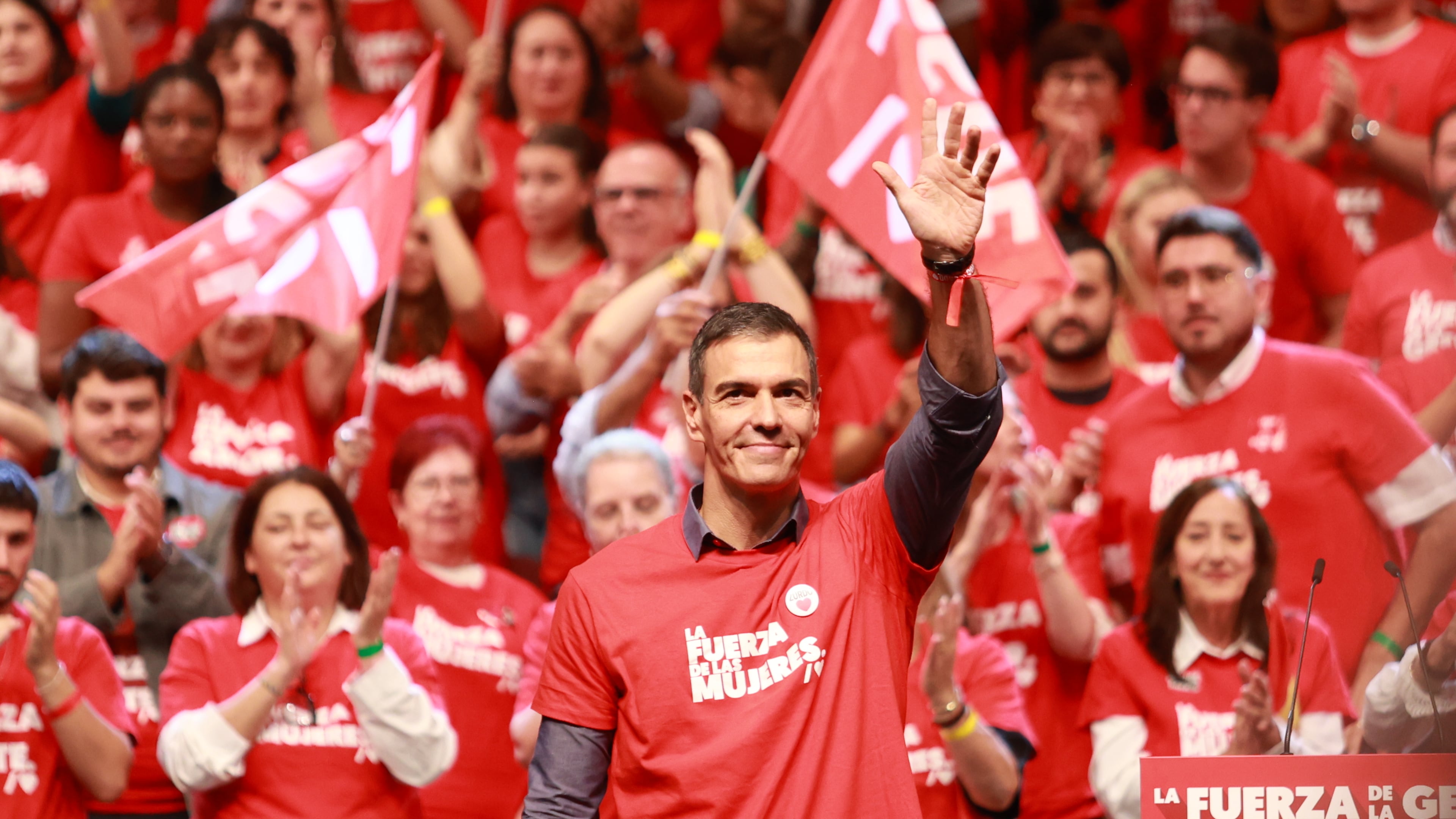
Even so, in recent weeks he has kept an uplifting tone, especially in his speeches while sporting red T-shirts emblazoned with aspirational slogans: “The Strength of Love,” “The Strength of the People,” and “Vote with Strength.” He spoke at his campaign kick-off event Thursday night in Seville, hours before the official midnight start.
The Spanish leader has also tried to invigorate his campaign by pointing to recent elections in Brazil, where leftist President Luiz Inácio Lula da Silva secured reelection with a come-from-behind victory in a runoff, and in the U.S. where Democrats seized control of the Senate and the House.
“It has happened in Brazil, it has happened in the United States, and it will happen in Spain too. The key is mobilization,” he said in an interview with newspaper La Vanguardia this week.
A Spanish prime minister is elected by Parliament, needing an absolute majority in the first vote or a simple majority in the second, often relying on coalition agreements or support from other parties.
Sánchez’s strategy is to “instill a sense of hope, the idea that things can be reversed, that change is possible — and, by doing so, to launch a campaign of optimism and foster a positive outlook,” said Alejandro Quiroga, a professor of political science at Madrid’s Complutense University.
On Monday, the Brazilian president will visit Spain and lend his support to the Socialist’s campaign. It’s unclear how much the Spanish leader will benefit from basking in the reflected glory of a foreign leader; analysts including Quiroga and Sánchez’s party officials themselves acknowledge that the 2 1/2-week campaign will be dominated by domestic concerns, such as housing, immigration and corruption — and last month’s deadly crash.
Turning the transport minister’s resignation into a campaign strength
Six days after the rail accident, Sánchez’s transport minister Óscar Puente stepped down. He did so at the tail-end of a parliamentary grilling about his administration of the country's high-speed rail network, the second largest in the world after China's.
At every turn since, Sánchez and his top officials have pointed to the minister's resignation as proof that the government is accountable.
“We have stepped forward with absolute transparency,” Sánchez wrote soon after on X, calling the minister's move an “act of dignity.”
Sánchez himself was notably absent at a state funeral held this week in central Spain for the crash's victims, perhaps due to the potential for volatile scenes at the service attended by mourning family members of the dead.
But ordinary Spanish voters have shorter memories, and Sánchez appears to be counting on that, according to Quiroga. Still, his right-wing opponents are sure to make the two crashes a central topic of their campaigns and debates, as they undercut Sánchez's arguments about his record.
“There is a sense of public shock, compounded by the nature of these accidents,” said Montserrat Nebrera, former conservative politician and political analyst. “It points to a failure in management over the last eight years.”
Several opinion polls conducted before and after the Oct. 28 train crash showed Sánchez’s Socialist Party behind the combined support of the conservative Popular Party and far-right Vox.
Focus back on housing after a general strike and nationwide protests
On Wednesday, a nationwide protest over soaring rents and home costs drew over 100,000 people to the streets of Spain's major cities. It was well-timed for Sánchez, bringing the national conversation back to Spain’s housing woes on the eve of the campaign.
The demonstration was part of a general strike — the first in 14 years in Spain — and the first whose main driver was born from frustrations over housing.
While Sánchez’s Socialist Party did not organize or participate in the strike, his government praised the effort. Affordability issues are traditionally more favorable to left-wing politics and he has sought to appease housing activists who, since the dramatic eviction of an 87-year-old woman, have been protesting regularly.
Right-wing parties' rejection of Sánchez's two proposed emergency housing decrees served as the trigger for him to call the early general election, on Nov. 29. His government on Thursday passed one of them through a smaller interim parliament.
Sánchez and his allies hope the move shows Spanish people that he's working on their behalf, and that the Popular Party's promise to repeal the decree if it takes power will help motivate voters.
“Yesterday, the right to housing won on the street and in workplaces, and I hope it will win again at the ballot box,” Housing Minister Isabel Rodríguez told lawmakers after its passage.