Receding floodwaters leave a sea of mud and shattered homes in the US Southwest
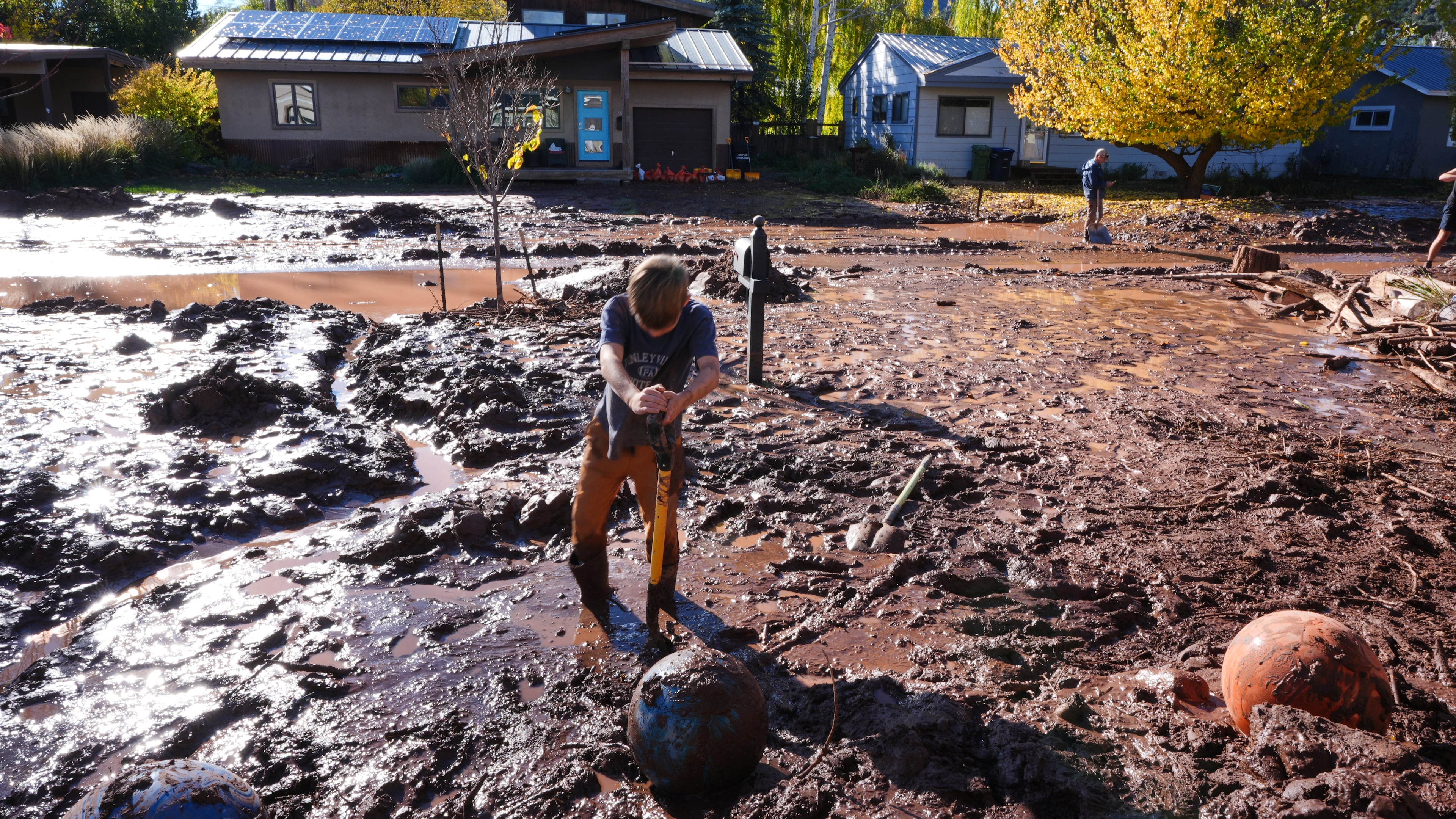
PAGOSA SPRINGS, Colo. (AP) — Skies began to clear Tuesday, but while floodwaters from almost two weeks of on-and-off heavy rain still inundated parts of the U.S. Southwest, other areas left mud-caked by receding torrents presented homeowners and businessowners with the filthy work of cleanup.
Jack Ellis, a retired schoolteacher, surveyed damage along the San Juan River in Pagosa Springs, Colorado, which has suffered through multiple rounds of severe flooding in recent weeks.
“This is quite a disaster for everybody, especially in the low-lying areas,” Ellis said. “We dig in and dig out, and that’s what it’s going to take."
In all, more than 20 trillion gallons (76 trillion liters) of rain — 10 months of the flow over Niagara Falls — have fallen on the Four Corners states and Nevada in the past two weeks, according to former National Oceanic and Atmospheric Administration chief scientist Ryan Maue.
After rain atop rain, flood risk persists
The U.S. Southwest has endured two recent major rounds of storms, with rain falling on ground already saturated from an especially wet fall.
One person died in floodwaters, and police suspect a second death was weather-related.
Skies were clearing after some rivers crested at levels lower than forecasted overnight, offering a measure of relief to areas that were bracing for more catastrophic flooding, including Shiprock and Farmington in northwestern New Mexico. Devin Neeley, a spokesperson for San Juan County, New Mexico, said major rivers in the area remained above flood stage.
“Now it’s a waiting game for the waters to recede,” Neeley said, adding that the county would likely soon lift evacuation orders impacting at least 20,000 residents and begin to focus on recovery.
Flooding in Florida, too, complicates voting
The situation wasn’t unique to the region. As downpours swamped eastern Florida, at least 20 polling places were changed in at least eight counties after Gov. Ron DeSantis issued an emergency declaration.
Flooded areas included Brevard County on the east-central coast, where over 2 feet (61 centimeters) of rain has fallen since Sunday. In Palm Beach County in southeast Florida, over 20 inches (51 centimeters) fell, cutting off access to condominiums and submerging cars in parking places.
Some communities in Colorado and Utah, too, had to make alternative Election Day voting plans because of the flooding.
Alyssa Gallegos, a contract mail carrier for the U.S. Postal Service, spent Tuesday morning helping get mail-in ballots from mailboxes to the post office in time for a 7 p.m. deadline for counting.
“Regardless if we’re in a crisis and having a hard time, the world doesn’t stop turning,” Gallegos said. “They’re not gonna wait for us, so we just gotta stay with it.”
In Rock Point, Arizona, in the Navajo Nation, officials were forced to relocate a polling place because of flooding impacts. Valinda Shirley, vice president of the Rock Point Chapter, the local seat of tribal government, said hundreds of voters are still unable to cast ballots in both the U.S. midterms and the Navajo Nation presidential election because a major bridge closure and washed-out dirt roads have left them stranded on election day.
“I have people that are still texting me asking how I can get them out so they can vote,” Shirley said Tuesday afternoon.
Another blow for Colorado hot-springs tourist town
An eighth-generation Pagosa Springs local, Gallegos said her ancestors went through a catastrophic flood in 1911 but no one alive in her family expected anything like it in their lifetimes.
She was watching videos of the devastation on social media Monday when she spotted her stepfather’s home swept off its foundation by raging floodwaters. Inside, she knew, were old photographs and other treasured possessions from her childhood.
“My heart’s crushed,” Gallegos said. “And it’s not just him, it’s all the people.”
Cleanup and repairs could take weeks or more in Pagosa Springs, a tourist town famous for hotels with riverside hot springs.
The downtown area remained closed to traffic Tuesday while workers used heavy equipment to clear mud, water and debris from roads.
Walkways and bridges collapsed or were heavily damaged. Outside a resort entrance stacked with sandbags, a sign read “Love Pagosa.”
Basement becomes ‘soup bowl’ in Durango
In Durango, about 60 miles (96.5 kilometers) to the west, Willow Bradner's ranch-style home was surrounded by about 2 feet (60 centimeters) of mud. Nearly 5 feet (1.5 meters) of water from an overflowing creek poured inside at one point.
“Our basement became a soup bowl,” she said.
The basement had been a selling point when she bought the property in 2024. Bradner said she and her husband once asked if they needed flood insurance and were told they were not in a flood zone.
They and their teenage daughter had been offered a place to stay through the end of the year. But the loss of their home and uncertainty about the future were overwhelming, Bradner said.
"The majority of our savings is in this house,” she said. “We have to dig deep, and we have to rebuild.”
___
Peters reported from Santa Fe, New Mexico, and Gruver from Fort Collins, Colorado. Kathy McCormack in Concord, New Hampshire contributed.