Global markets broadly rise on AI chip demand despite Wall Street's retreat on inflation data
HONG KONG (AP) — World shares were mostly higher Wednesday after a retreat on Wall Street as U.S. inflation rose higher than expected in October, while U.S. futures edged higher and oil prices rose.
In early European trading, Germany’s DAX rose 1% to 26,621.01 after inflation fell to 2.8% in October from a year earlier, according to the federal statistics office on Wednesday.
The CAC 40 in Paris picked up 0.6% to 8,331.94. Britain’s FTSE 100 added 0.7% to 10,825.97.
The future for the S&P 500 rose 0.6% and that for the Dow Jones Industrial Average gained 0.2%.
In Asia, Taiwan led the regional markets as its benchmark Taiex rose 3.6%.
Taiwan Semiconductor Manufacturing Co., or TSMC, climbed 3.1% after the AI chipmaker reported its October revenue was nearly sixfold higher than a year earlier, showing that demand for AI chips remains solid.
TSMC's board also approved up to $1 billion in investment in Anthropic and OpenAI, according to a company statement Tuesday.
Japan’s benchmark Nikkei 225 advanced 1.3% to 61,248.59. SoftBank Group’s shares pared losses to close 0.4% lower as the investment giant reported a quarterly net loss of 1.1 trillion yen ($7 billion) on Tuesday after markets closed.
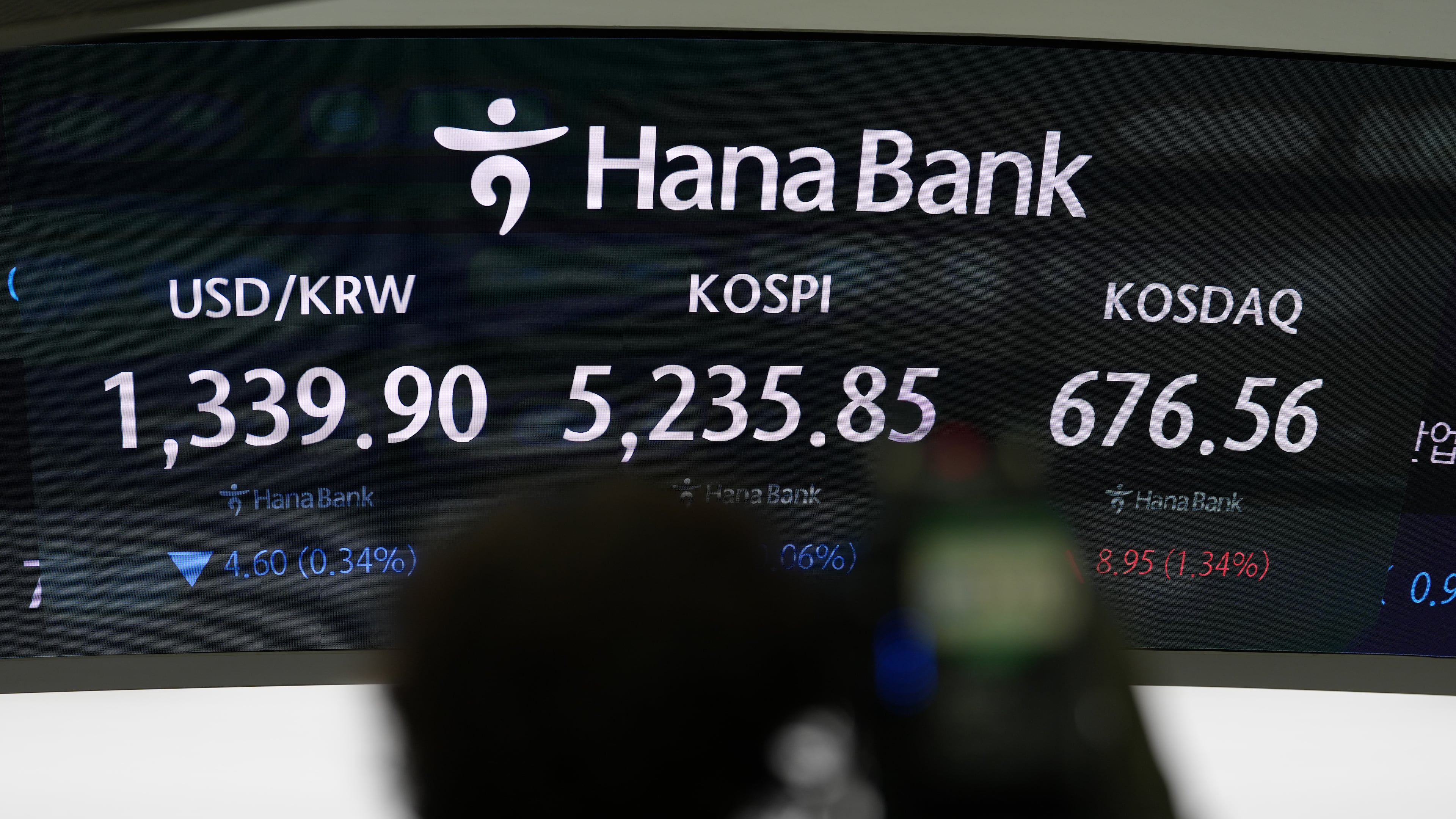
South Korea’s Kospi was up 2.4% to 5,365.75. Chipmaker Samsung Electronics gained 3.4% and SK Hynix jumped 5.4%.
In Hong Kong, the Hang Seng fell 1.1% to 24,296.22, while the Shanghai Composite index recovered 0.5% to 3,680.64.
China’s biggest online shopping festival, Singles Day, began Wednesday. Its sales data will offer a gauge of consumer demand in the world's second-largest economy.
Australia’s S&P/ASX 200 edged 0.3% higher at 9,153.20.
India’s Sensex rallied 0.9%, reaching its highest level in six months.
On Tuesday, the S&P 500 slipped 0.4% and gave back some of its big rally from the day before. The Dow Jones Industrial Average dropped 0.3%, and the Nasdaq composite sank 0.7%.
Pressure from the bond market undercut stocks following the discouraging report on inflation. People had to pay prices for groceries, electricity and other costs of living that were higher in October than economists expected. That could push the Federal Reserve to hike its main interest rate at its next meeting in December.
One Fed official hinted the central bank may increase the federal funds rate by double the typical amount in December because of how high inflation has remained for years.
The yield on the 10-year Treasury leaped to 4.99% from 4.88% late Monday. It was a notable move for the bond market and the yield helps set where rates are for mortgages and other loans going to U.S. households and businesses.
Tuesday’s jump in yields came even though oil prices fell again. The price for a barrel of Brent crude oil fell 1.2% to $91.49. U.S. President Donald Trump said late Monday that the war in Iran, which sent oil prices much higher, “militarily is effectively over.”
The single heaviest weight on the S&P 500 was Nvidia, which fell 5.5%. The chip designer has been under pressure since the company's board announced an investigation into its CEO, Jensen Huang, following revelations of his affair with a purported Chinese spy. Trump said the FBI is investigating the affair, which Huang has acknowledged and apologized for.
Recent shakiness of stocks related to the artificial-intelligence industry has raised questions about whether Anthropic, the company behind the Claude chatbot, may delay its initial public offering of stock.
But Anthropic said in a filing with U.S. regulators on Tuesday that the company is seeking a valuation of roughly $1.3 trillion. That would make it one of the most valuable companies on Wall Street, worth more than Walmart, JPMorgan Chase, ExxonMobil or Coca-Cola.
The U.S. bond market will be closed on Wednesday for Veterans Day, while the stock markets remain open.
In other dealings Wednesday, the price of Brent crude, the international standard, rose 0.2% to $91.71 a barrel. U.S. benchmark crude oil gained 0.1% to $86.12 per barrel.
The U.S. dollar rose to 158.88 Japanese yen from 158.70 yen. The euro fell to $1.1150 from $1.1171.