Wall Street shakes again as Nvidia and other jittery AI stocks swing lower
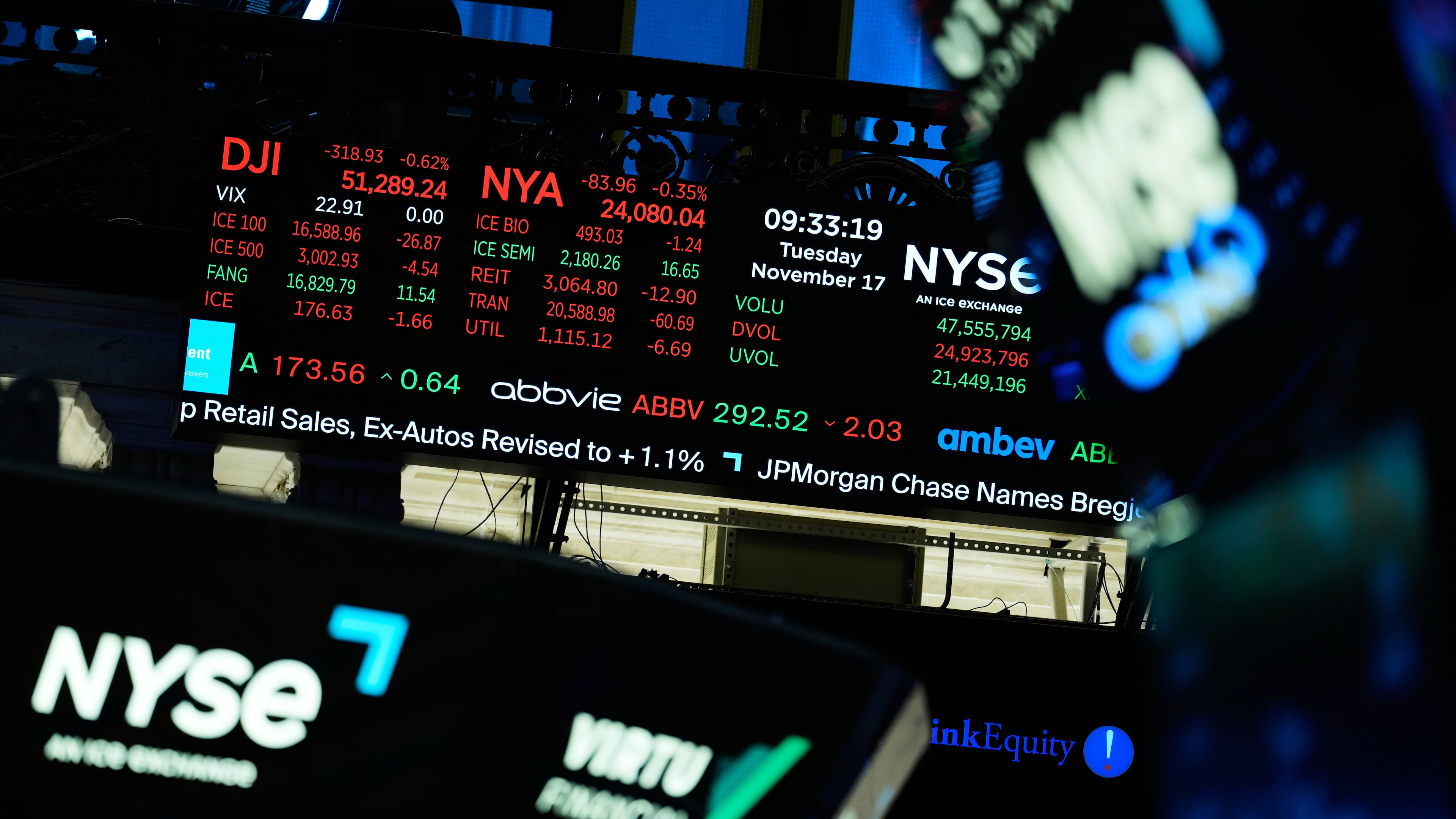
NEW YORK (AP) — The U.S. stock market shook again as Nvidia and other jittery AI stocks led widespread losses on Wall Street. The S&P 500 sank 1% Tuesday after swinging between nearly no change and a loss of 1.7%. The Dow Jones Industrial Average dropped 1.6%, and the Nasdaq composite fell 0.7%. The center of the action was again Nvidia, which veered lower after drifting between modest gains and losses in the morning. Financial stocks were also heavy weights. Treasury yields eased as investors herded into things seen as safer to own, while oil prices rose. Stock indexes fell across Europe and Asia.
THIS IS A BREAKING NEWS UPDATE. Check back for updates. AP’s earlier story follows below.
NEW YORK (AP) — More swings for Nvidia and other jittery stocks in the artificial-intelligence industry are dragging the U.S. market downward Tuesday.
The S&P 500 sank 1.5% and is on track for its first back-to-back losses of at least that much since March. The Dow Jones Industrial Average was down 985 points, or 1.9%, with an hour remaining in trading, and the Nasdaq composite was down 1.4%.
The center of the action was again Nvidia, which resumed its whipsaw moves and eventually became the heaviest weight on the market. After flipping between modest gains and losses in the morning, it veered lower and dropped as much as 3.7% before paring its loss to 2.4%.
The moves come ahead of the chip company's latest earnings report, which is scheduled to arrive after trading ends for the day. It will be Nvidia's first earnings report since interim CEO Colette Kress took over for Jensen Huang, the leather-jacketed star who became one of the most famous faces of the AI boom.
The pressure is on Kress and Nvidia to show whether the company’s tremendous growth can continue following the stunning resignation of one of AI’s strongest influencers. Nvidia is creating a new board committee to oversee national security and global trade compliance following revelations that Huang had a relationship with an alleged spy for China.
Huang said on the X social-media network Tuesday that he would come back as CEO if “the Board of Directors decides that my return is in the best interest of our shareholders, our employees, the company, and America.”
Other stocks in the AI industry likewise dove after giving up early-morning strength. Advanced Micro Devices went from an early gain of 1.6% to a drop of 3.4%. CoreWeave flipped to a loss of 1.3% after initially climbing 1.8%.
AI-related stocks have been shaky for months because of a rolling chain of worries. At first, it was concerns that AI stock prices had broadly shot too high in their frenzy. Then it was worries that high interest rates would mean less borrowed money to fund further growth. More recently, it was concerns that Democratic victories in this month’s U.S. midterm elections could mean tougher regulations and restrictions on AI data centers.
Such stocks can almost single-handedly set the U.S. market’s course because they’ve grown into some of Wall Street’s most valuable and most influential.
Most of Wall Street was weak Tuesday, and nearly nine out of every 10 stocks within the S&P 500 fell.
Home Depot sank 2.7% even though it reported profit for the latest quarter that edged past analysts’ expectations.
The retailer has been hampered by a housing market chilled by expensive mortgage rates, which have climbed with Treasury yields because of high oil prices, high inflation and other factors.
The 10-year Treasury yield climbed toward 5.15% Tuesday morning from 5.12% late Monday before later pulling back to 5.10%. It erased its gain after the sharp drops for AI stocks pushed investors to herd into investments seen as safer bets.
In the morning, yields got support from a report showing better growth in an underlying measure of spending at U.S. retailers than economists expected. Such spending, along with big investments in AI, has helped the U.S. economy continue to grow despite frustration with high inflation.
Elsewhere on Wall Street, stocks of banks were lower amid concerns about how much pain the broad U.S. economy will feel from any pullback in AI-related spending.
JPMorgan Chase fell 2.7%. A day before, a technical issue at the bank had slowed transactions for customers trying to use the Zelle payment system.
Apple and Marriott had only modest moves following outages in their systems. Apple slipped 0.8%, and Marriott fell 0.6%.
United Airlines had its own operational struggles, as a system outage lasted more than 90 minutes and forced the carrier to delay departing flights Monday. The outage came just days after a malfunction in the Federal Aviation Administration’s network prompted a nationwide ground stop.
United’s stock lost 3.7%, but that may have been due more to a rise in oil prices.
The price for a barrel of Brent crude oil rose 0.8% to $93.14. It’s been yo-yoing amid uncertainty about what will happen in the war with Iran.
The downward momentum on Wall Street was strong enough to erase early gains for the The Walt Disney Co. and pull it down 1.3%, even though it reported stronger revenue for the latest quarter than analysts expected.
Stock prices generally tend to follow the path of corporate profits over the long term, depending on how interest rates behave. The big businesses across the S&P 500 index are on track to deliver earnings per share for the summer that are nearly 32% higher than a year earlier, according to FactSet.
In stock markets abroad, indexes sank across much of Europe and Asia. South Korea’s Kospi fell 2.6% and dropped to its lowest closing level since February.
___
AP Writers Elaine Lai and Matt Ott contributed to this report.