In first visit to Ceuta, Spain's king asks for 'good faith' from Morocco after migration crisis
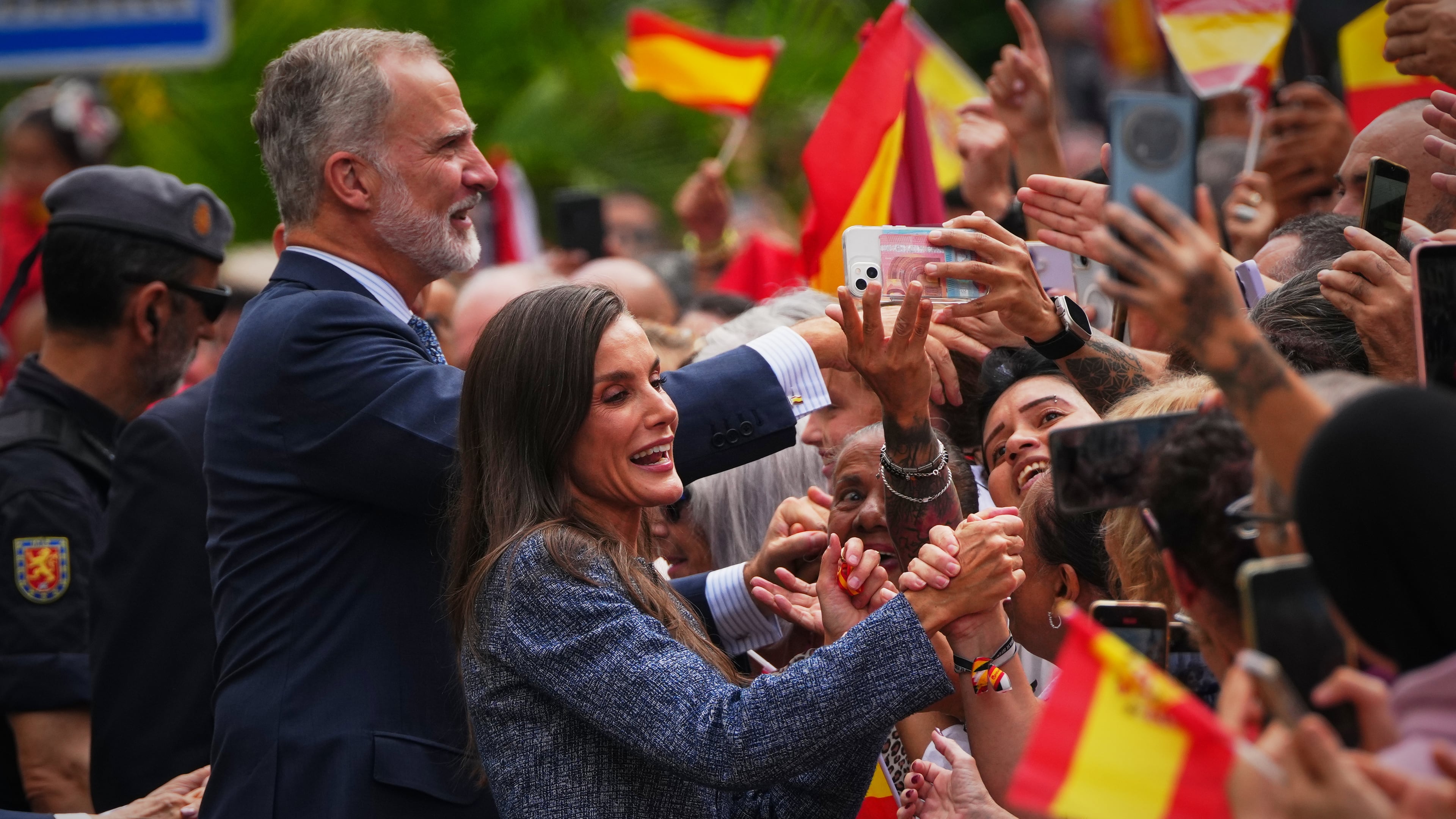
CEUTA, Spain (AP) — King Felipe VI delivered a staunch message of support for Ceuta as being an integral part of Spain on Tuesday when the monarch visited the North African territory amid a protracted migration crisis that has strained relations with Morocco.
His visit with Queen Letizia came with the city of 84,000 residents still grappling with the mass crossing of nearly as many migrants from Morocco in July. The crossing left at least 140 migrants dead and shook the city perched on the Mediterranean coast.
While Spain's government has defended Rabat's role in helping the return of the majority of the 80,000 who entered Ceuta, many in Spain, including police and some lawmakers, doubt that Rabat could not have known about the mass movement of people. Some, including Ceuta's mayor, called it an “invasion.”
“Ceuta is Spain. Therefore its frontier ... is a European border, and any threat to it is a threat to the European Union,” Felipe said in a speech that was wildly applauded at a gathering of figures from Ceuta’s civil society.
In his only mention of Morocco, Felipe said that Spain and the EU want healthy relations with Rabat, but that they must be based on “good faith.”
“That relationship,” he said, “must be based on trust, mutual respect and the goal of promoting stability, peace and regional security. Making that possible demands good faith from both sides."
Large crowds gathered to greet the royals and shake their hands at Ceuta's central Plaza de Africa when they arrived. Some broke into the familiar sports chant, “I am Spanish, Spanish, Spanish.” Church bells rang as people waved Spanish flags.
Felipe received the key to the city from Ceuta’s top elected official, Juan Jesús Vivas, who called for the expulsion of all migrants who remained after the mass crossing.
“Thank you for coming to boost our morale, to resist and to see the light at the end of the tunnel,” Vivas told the royals.
The royal couple will stay overnight in Ceuta before traveling on Wednesday to Melilla, Spain’s other North African exclave. The trip marks the first visit by a Spanish monarch to the two cities since Felipe’s father, Juan Carlos I, toured them in 2007.
Morocco does not recognize Spanish sovereignty over the two small territories, which have been under Spanish control for centuries.
Diplomatic observers in Spain will be watching closely for Rabat’s response to Felipe’s visit. Morocco’s Foreign Ministry did not immediately respond to requests for comment about the royal visit to the Spanish exclaves.
Royals pay respect to dead migrants at cemetery
Felipe and Letizia were accompanied by religious authorities from Ceuta’s four main religions — Roman Catholic, Islam, Judaism and Hinduism — at the Sidi Embarek cemetery, where they paid their respects to dozens of unidentified migrants who died in the crossing. The royals also visited a school.
The city has a history of religious coexistence, but the border crisis has strained relations between its Christian and Muslim communities.
Later, during his speech, Felipe said it was "important and necessary that once again we express our sympathy for all the people who died in such a tragic and senseless manner.”
Felipe also demanded that the estimated 15,000 migrants who remain two-and-a-half months later in Ceuta be treated with respect.
During a recent visit to Ceuta, The Associated Press found many underage migrants still living on the streets.
Some migrants have also reported abuse. The Spanish government is investigating allegations detailed in an Amnesty International report of mistreatment and torture by Spanish soldiers. One migrant said soldiers beat him so badly he needed staples to close wounds to his head.
Many of the remaining migrants, including minors, have had to sleep in poor conditions or now-demolished makeshift camps. Their presence has fueled social tensions in Ceuta and become a political issue across Spain, where opposition parties hope to use migration concerns to unseat the progressive government in next month's elections.
Ceuta and Melilla the focus of complex relations with Morocco
Juan Carlos’ visit to Ceuta and Melilla nearly 20 years ago triggered a diplomatic crisis. Morocco recalled its ambassador to Spain, and Moroccans protested outside Spanish consulates and near the border. King Mohammed VI, Morocco’s highest authority, condemned that visit as a “nostalgic act from a decidedly bygone era.”
Asked whether the Spanish government feared a similar response this time, spokesperson Elma Saiz insisted on what she called “fluid” communication with Morocco during the migration crisis.
“This is a historic trip, but it is happening within the absolute normality of the visit of Spain’s majesties to two Spanish cities,” Saiz said. “As you all know, the days of July 29 and 30 were days of extraordinary tension where the communication with Morocco was fluid and constant.”
Haizam Amirah-Fernández, director of the Madrid-based Center of Contemporary Arab Studies, is among the analysts who believe Morocco, even if not directly involved, was likely aware of the buildup of people spurred by social media to cross into Ceuta. He described the mass crossing as an “assault” on Spain’s sovereignty.
A Spanish Defense Ministry intelligence report issued July 30, as thousands streamed across the border, described Moroccan forces as passive and negligent in their efforts to stop migrants.
Against that backdrop, the royal visit signals that Spain is shedding its longstanding reluctance to send its monarchs to the exclaves, Amirah-Fernández said.
He called it an “anomaly” that Spanish monarchs regularly tour the mainland and islands but rarely visit the North African cities. He attributed that reluctance to concerns in Madrid that such visits would strain relations with the Moroccan monarchy.
“The message is clear to all parties, to the population of Ceuta, to the population of Spain, to the European Union, to the international community and to the southern neighbor, who allowed for this assault to happen,” Amirah-Fernández said.
___
Joseph Wilson reported from Barcelona, Spain. AP writers Suman Naishadham in Madrid and Akram Oubachir in Casablanca, Morocco, contributed.