In legal fight, Atlanta’s ‘Urban Cowboy’ may help all property owners


A decade after Fulton County seized seven horses from Atlanta’s self-described “Urban Cowboy” in an animal cruelty investigation, his legal battle for compensation has become a high-stakes case with wide implications for property owners and governments.
Brandon Fulton, who has a ranch in Camp Creek, says the county didn’t return his seized horses or compensate him for their value, though it dismissed the associated animal cruelty charges against him in 2018.
Fulton sued the county in 2020 and the parties have since been locked in a legal battle that is set to create binding precedent in Georgia, Florida and Alabama. Those states, alongside the federal government, have weighed in, urging federal judges to side with the county.
The case was argued Tuesday in Atlanta before all 12 active judges of the U.S. Court of Appeals for the 11th Circuit. Fulton was there, distinguishable from the suited lawyers in his cowboy hat, tasseled leathers and snakeskin boots. His 2-year-old Friesian, “B-NYC,” a nod to his New York roots, was tethered outside the downtown courthouse.
After the hearing, Fulton told The Atlanta Journal-Constitution that while the legal arguments have become complicated, his case remains simple at its core.
“I think it’s just logic,” he said. “I would say keep (the horses) if I was found guilty. But my (criminal) case was dismissed. Just return the property.”
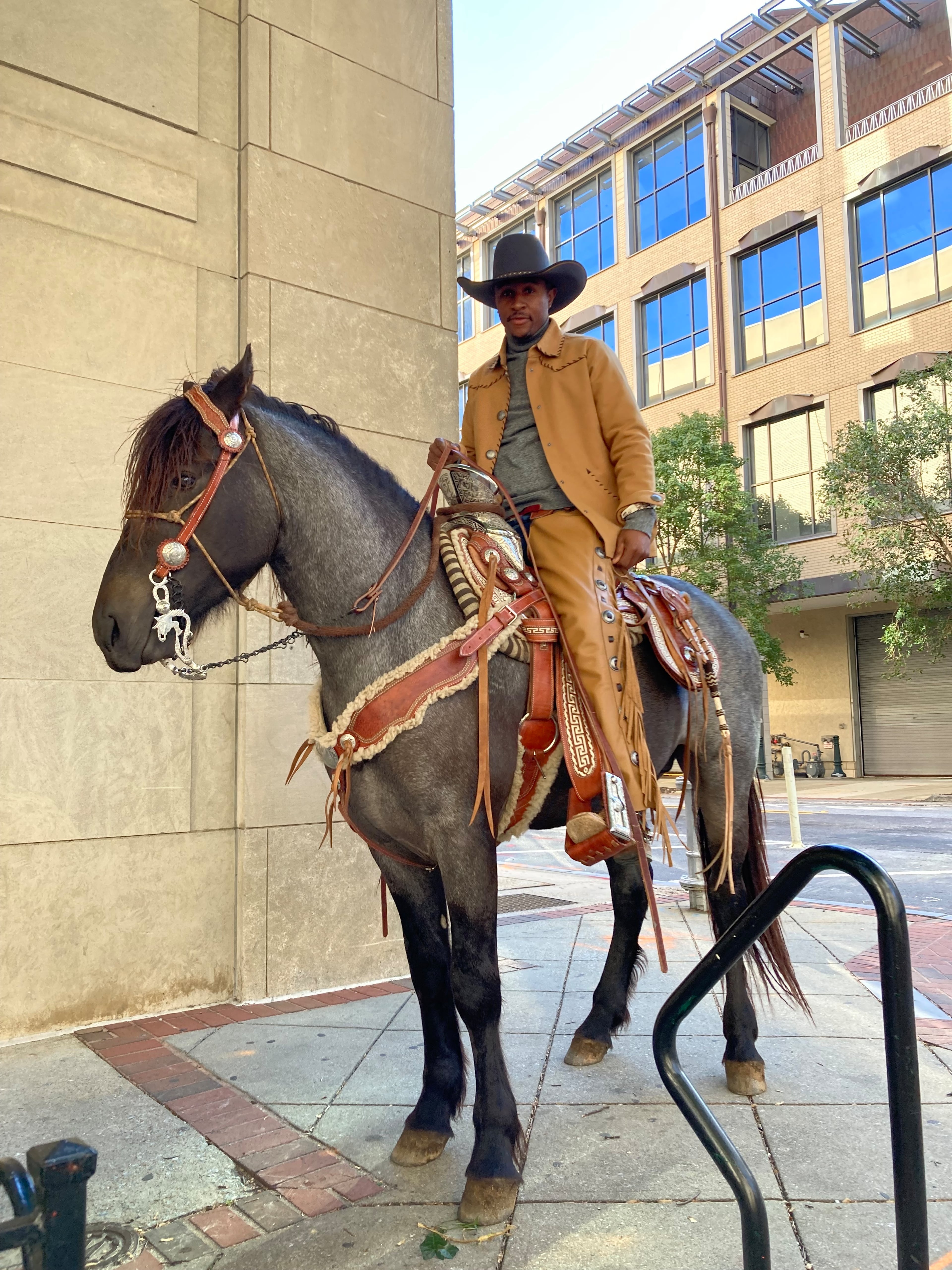
Fulton said he believes the horses seized by the county in 2016 were sold. He said one of them had been appraised at $350,000 before the seizure, but that “it’s hard to put a price on something you value in your heart.”
The 11th Circuit judges must decide whether Fulton can amend his previously dismissed lawsuit to pursue a claim against the county under the so-called Takings Clause of the U.S. Constitution’s Fifth Amendment. It says private property shall not be taken for public use without just compensation.
Fulton argues, with backing from several legal nonprofits, that he can sue directly under the Takings Clause without having to satisfy a higher bar in the separate federal law that plaintiffs typically bring such claims under, known as Section 1983.
The county disagrees, arguing there is no such right of action expressly provided by the Takings Clause. That view is shared by the federal government and Georgia, Florida and Alabama, where the 11th Circuit has jurisdiction.
It is the second time 11th Circuit judges are considering the question.
In 2025, a divided three-judge panel narrowly held in Fulton’s favor, allowing him to amend his complaint to include a Takings Clause claim. Chief Judge William Pryor Jr. dissented, saying the other panel judges, Robin Rosenbaum and Nancy Abudu, had improperly invented a type of claim that shouldn’t exist.
Before Fulton could amend his complaint, the 11th Circuit wiped out the panel’s ruling. It agreed in May this year to rehear the case as a full court, at the county’s request.
A ruling in Fulton’s favor could make it easier for property owners nationwide to seek compensation from governments for the taking of their property.
On Tuesday, the judges poked holes in both sides’ arguments, making it difficult to discern how they might decide the case in coming months.
Judge Kevin Newsom noted that, for decades, there has been no recognition of a direct Takings Clause claim.
“How can you say that for 80 years everyone misunderstood this?” Newsom asked Fulton’s lawyer, Brian Williams.
Williams said the recognition now of such claims would not conflict with relevant legal history and case precedent. And he said it doesn’t matter that property owners like Fulton can alternatively pursue compensation under state laws or the federal Section 1983 law, which allows suits against municipalities that, through official policies or customs, violate the U.S. Constitution.
Pryor pushed back on that notion Tuesday, suggesting the reason Fulton’s case can’t proceed is because he “failed to take advantage of those (other) remedies.”
Judge Adalberto Jordan challenged that with a hypothetical scenario in which no alternative avenues existed for property compensation claims in state or federal law. He questioned how a property owner like Fulton could get relief in that scenario, as promised by the Fifth Amendment.
Fulton initially pleaded a Section 1983 claim, alleging the county had violated the Fifth Amendment’s Takings Clause. But the claim was dismissed in February 2021 by U.S. District Judge Steve Jones, who found Fulton hadn’t shown that the taking of his horses was tied to a county policy or practice.
Jones denied Fulton’s request to amend the lawsuit, saying only federal officers can be sued directly under the Takings Clause.
On Tuesday, the county’s lawyer, Cameron Norris, said the Constitution itself “is silent on how you get to go to court” in such cases. He said even if the county can be sued directly under the Fifth Amendment, Fulton’s case would fail anyway because the county was authorized to use its “police power” to seize the horses.
“This is a sheriff taking abused horses away,” he said.