Third time the charm? Democrat Christina Bohannan tries again in pivotal US House race in Iowa
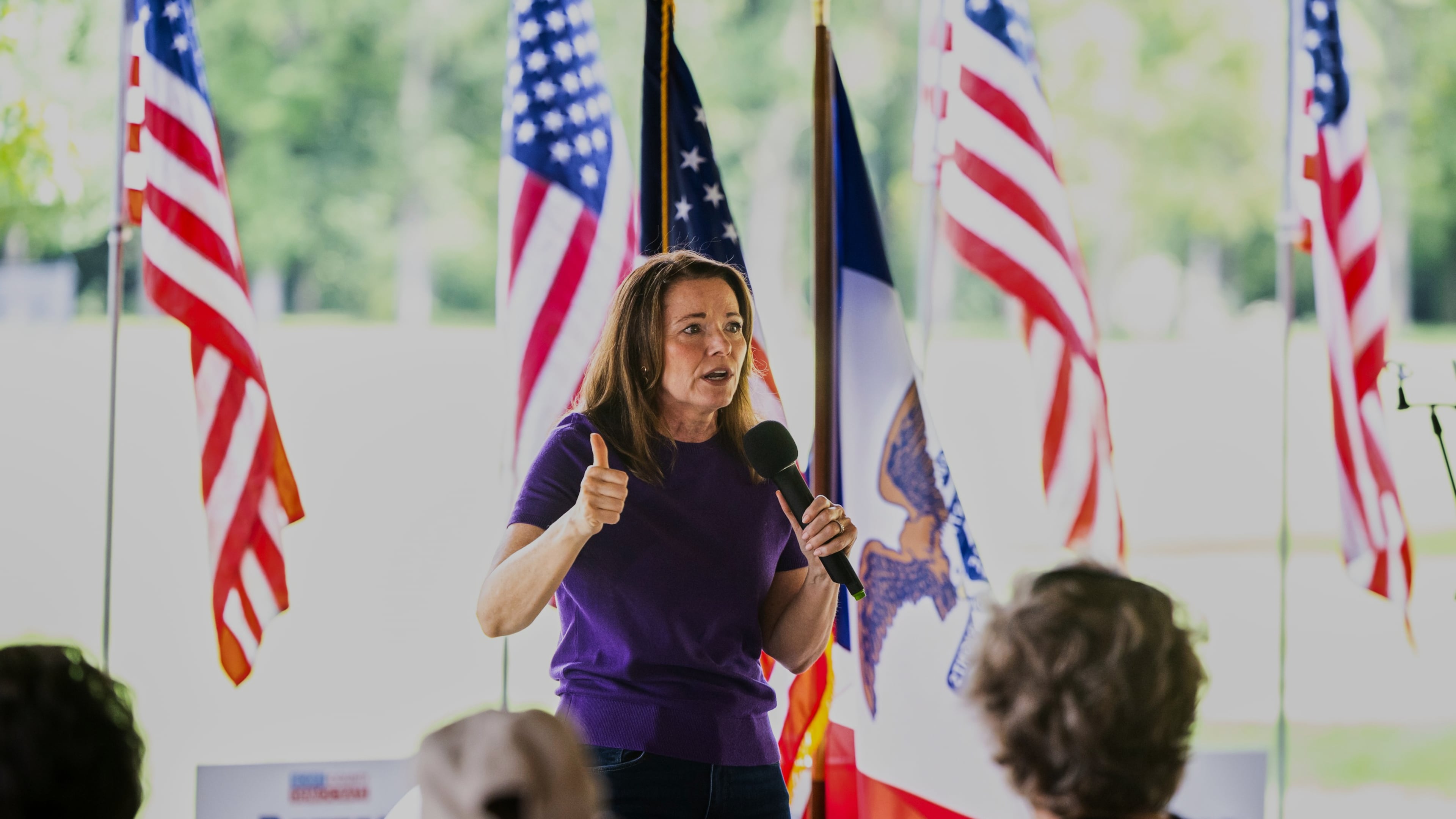
COLUMBUS JUNCTION, Iowa (AP) — It may have seemed out of place for a university professor from the liberal enclave of Iowa City to be holding court at a roadside bar and grill in a rural county where Republican Donald Trump won overwhelmingly two years ago.
But that's part of Christina Bohannan's long learning curve as a Democratic candidate for Congress.
“It’s a big district. It takes a lot of time to get around, get people to know you and trust you,” Bohannan told a couple dozen voters in the tiny Louisa County town of Columbus Junction on a recent Sunday afternoon.
She would know. It's her third crack at it.
Bohannan lost to Republican Rep. Mariannette Miller-Meeks in Iowa's 1st Congressional District in 2022 and 2024. Now she's banking on Trump's sagging popularity, healthcare struggles and economic concerns to put her over the top in a race that could help Democrats regain control of the U.S. House.
Miller-Meeks is digging in for a difficult campaign, describing Bohannan as a “radical progressive.” If Bohannan pulls off a victory this time, it could be the first ripple of what Democrats see as a potential national wave.
The Democrat is reaching into rural counties to shave the Republican edge
That's why Bohannan was in Louisa County, a place she did not visit in the months leading up to the 2024 election, when she lost to Miller-Meeks by only 799 votes.
It was the second-closest House race that year, and far closer than Bohannan's loss in 2022, when she fell short by 23,000 votes.
Iowa's 1st District is a microcosm of the state, largely rural with urban and suburban pockets. A geographic area larger than Massachusetts, more than half of its 20 counties have populations of less than 20,000 residents.
Cindy Starr and her husband Tim Knutson had never met Bohannan before they made the drive from nearby Wapello to see her at 92 Roadside, a Louisa County social hub named for the highway that runs past it.
“We’d never heard of any campaign event for her before,” said Starr, a 62-year-old retired social worker.
“Somebody rang our doorbell,” said Knutson, a 60-year-old retired meatpacking plant manager. “That’s never happened before.”
Two years ago, she lost the county by almost 1,400 votes.
This time, Bohannan has a more aggressive ground game, reaching out in rural counties she lost, but also beginning her canvassing in January as opposed to April. Her campaign’s door-knockers travel with a letter from Bohannan introducing herself.
Pushing against the image of a left-wing college professor
Bohannan's day job — University of Iowa law professor — can be tricky in a district where Trump won by 8.4 percentage points in 2024 and where the school is often parodied by Republicans as a haven for left-wing liberals.
“I’m not some radical,” said the 55-year-old former environmental engineer whose legal scholarship has focused on intellectual property, business innovation and copyright law.
She portrays her low-income upbringing in rural central Florida, her father’s nomadic life as a construction worker and her family’s healthcare crises during her youth as experiences that echo across the Mississippi Valley district where union manufacturing jobs have been declining for decades.
“Iowa is just a really good, common-sense state full of fair-minded, common-sense people,” she told The Associated Press. “Sometimes the Republicans have a point. I think tax dollars are precious. I think sometimes we do tend to stifle economic growth with maybe unnecessary regulation.”
Miller-Meeks did not agree to an interview.
Bohannan has been gaining ground in the district
Along with trying to shave the Republican advantage in the district's dozen-plus rural counties, Bohannan is also trying to gain a foothold in its more urban and suburban hubs.
Johnson County, with Iowa City and its teeming suburbs, and Scott County's economically diverse cities of Davenport and Bettendorf help make the district among the most competitive in the country.
Bohannan won more than 70% of the vote in Johnson County in 2022 and 2024. She also improved her performance in Scott County, losing in 2022 but winning narrowly there in 2024.
Those gains in a high-turnout presidential year, combined with the very narrow final margin — after a recount — made the decision simple for Bohannan to sign up a third time.
“That was a big part of it. That means tens of thousands of Trump voters split their ballot and voted for me,” she told The Associated Press after a stop at a Scott County Democrats’ picnic in Bettendorf. “It’s not always easy to get people, especially in this toxic political environment, from the other party to support you. But we’re taking the time. We’re going to every corner of the district.”
Now, she is trying to hold the edge in Scott County, hoping the recent move of more independent voters into the Democrats' ranks continues.
In another potential boost to Bohannan, Democratic voter registration in Iowa rose more than Republican registration ahead of the June primaries.
In Scott County, the district’s most populous, the trend has continued since the primary, said Terry Olsen, vice chairman of the Scott County Democrats and a former Republican.
“Every month it’s been moving,” Olsen said, though Democrats still narrowly trail Republicans and independent voters in the county. “But it’s a different strategy than 2024, trying to grab more of that rural vote and still boost turnout in the cities. That’s the hope, at least.”
Trump's agenda could drag down Miller-Meeks
Bohannan believes that Trump's failure to curb inflation since returning to the White House will drag down Miller-Meeks, who was first elected in 2020.
Miller-Meeks voted for measures blocking Congress from challenging Trump's emergency tariff actions, and the trade war has cut U.S. soybean sales. She has voted in support of Trump's ability to continue U.S. military operations against Iran, as drivers in her district pay nearly $4 per gallon for gas and farmers pay $5 per gallon for diesel fuel.
And Miller-Meeks last year supported Trump's signature tax-break and spending cuts bill, which is expected to reduce federal Medicaid spending over the coming years. Hospitals and other healthcare providers have warned that the changes could put additional financial pressure on rural facilities that rely heavily on Medicaid reimbursements.
Miller-Meeks, a physician, defended her record in a statement by saying “I’ve spent my career on the side of patients, not the big insurance companies and bureaucrats standing between them and the care they need.”
She said the legislation included "common sense provisions the majority of Americans support," and she said Bohannan “would have kept subsidies flowing straight to big profitable insurance companies that deny claims, jack up premiums, and restrict which doctors you can see.”
Healthcare funding pressures have surfaced in Miller-Meeks’ district. MercyOne Clinton Medical Center announced it would end its obstetrics, labor and delivery services in 2026, citing rising costs, staffing shortages, inadequate reimbursement, and changes to Medicaid policy among the factors.
“In the past, when I ran the last couple of times, people weren’t entirely clear on what Miller-Meeks had been up to,” Bohannan said. “And now people know what they are paying at the grocery store. They know what they are paying at the gas pump.”