Behind the scenes on a tragic morning of gridlocked Atlanta traffic
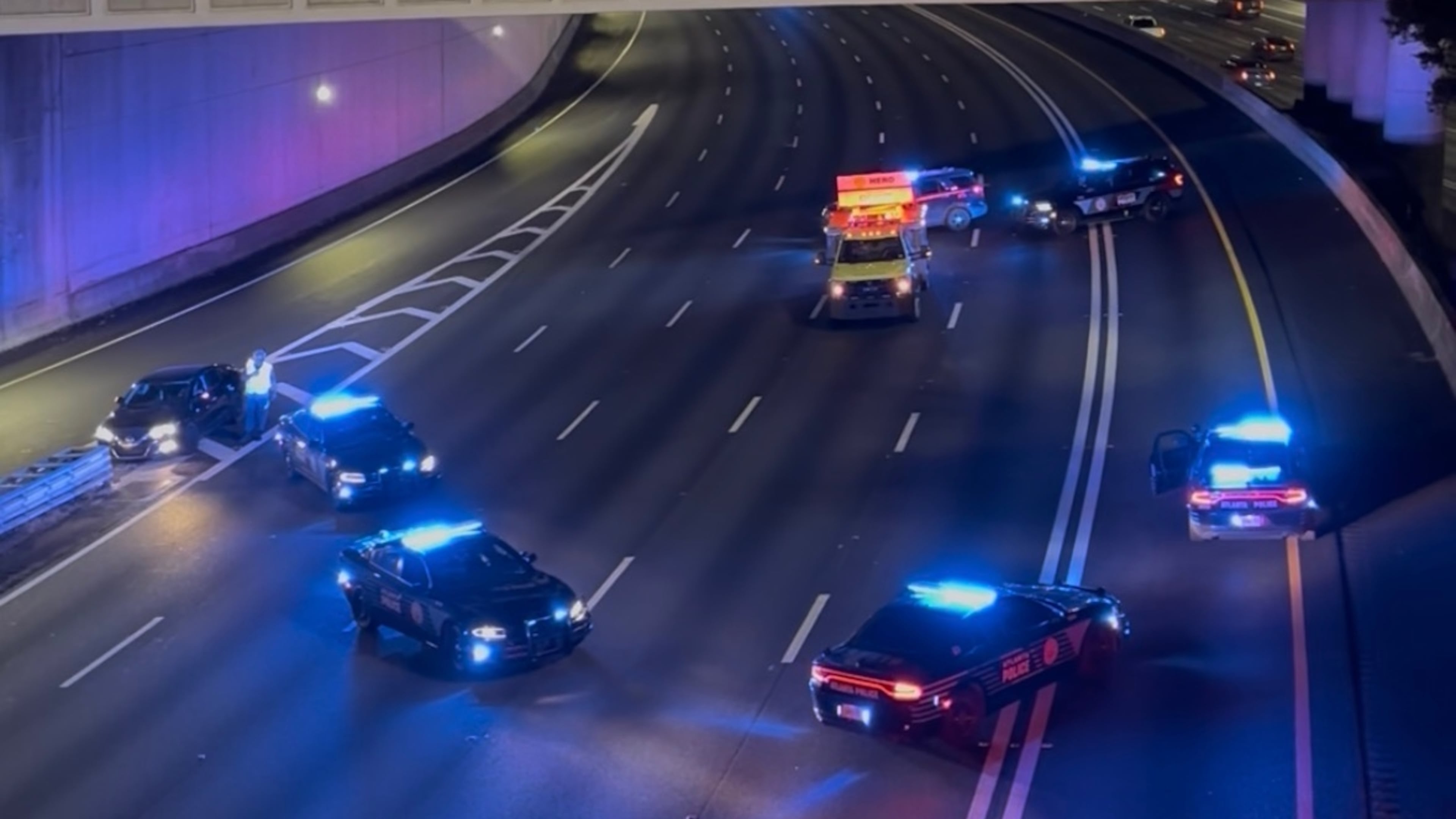

The terrible traffic jam during Thursday morning’s commute will go down as one Atlantans will remember — and wish they could forget.
I-75/I-85 northbound (Downtown Connector) was shut down from about 5 a.m. to after 8:30 a.m., as Atlanta police investigated after a pedestrian was hit and killed at the Williams Street curve, just after Spring Street (Exit 249D).
The ensuing traffic jam sent reverberations far and wide and snarled thousands of people. The alternates to the alternates were jammed. Days like that are ones I do not forget either as a reporter.
As I was preparing to do a story about autonomous vehicles for 11Alive, I heard some chatter on the Atlanta police scanner about a person in the roadway that may have been struck by a vehicle on that stretch of interstate. I messaged my traffic co-anchor Rachel Cox-Rosen, who immediately pulled up Georgia Department of Transportation cameras and found numerous police officers and highway emergency response operators descending upon and closing all six northbound lanes of the connector. Photojournalist Stephen Boissy and I pointed the 11Alive Traffic Impact Tracker down I-75/I-85 southbound to Williams Street.
Assignment: changed.
We exited and popped a U-turn to take the ramp to I-75/I-85 northbound where we knew the front of the scene ended. When we crested that single-lane bridge, we saw an armada of a half-dozen Atlanta police forcing traffic off onto Spring Street. We parked on the narrow right shoulder and wedged out of the truck, between the doors and the wall.
Boissy and I donned our road vests, as is 11Alive policy any time we exit our vehicles on the side of a main road, and skipped to the left side of the bridge to see more police cruisers, crime scene investigation vans, HERO units and eventually the Fulton County Medical Examiner’s Office. Almost as soon as we arrived, we learned this was a fatality.
As Cox-Rosen built maps of alternate routes and backups, I focused my reports on scene-setting for our viewers. I wanted to reflect the seriousness and implications of the incident.
I have watched numerous scenes like this over my 22 years of Atlanta traffic reporting and knew it would not clear anytime soon. Around 6 a.m., the HERO unit removed some flares and cones, which led to false hope that lanes would open sooner than we thought. Instead, they had just stopped letting traffic as far up as Spring Street.
At least three cars rested on the right shoulder next to the Williams Street on-ramp and one had serious hood and windshield damage. Those vehicles remained there until just before lanes opened. Those drivers’ days (and lives) were rattled far more than those stuck in the backup behind them.
As the sun rose, the tragic scene became more apparent. Investigators scoured and spray-painted across all lanes. As I write this, Atlanta police are still investigating the incident that killed 33-year-old Darryl Clay. Authorities have not said why he was on the interstate.
Police, in a news release, said he was struck by a vehicle while in the far-right lane, and the driver remained at the scene. The man was hit again “by an unknown number of additional vehicles,” police said.
Atlanta fire crews arrived around 8 a.m. and finished their work just before 8:30 a.m., before lanes could open.
With Atlanta’s most famous and busy freeway shut for so long on a Thursday — a weekday that has some of the worst traffic and a day normally rife with college commuters during the first week of classes at Georgia Tech and Georgia State University — the backups were epic. The traffic wall on I-75/I-85 northbound started north of Langford Parkway (Ga. 166, Exit 243). The closure channeled extra traffic to and then backed up I-285 northbound on both sides of town from well before its two I-20 intersections.
The I-285 northbound alternate went to mush as Cox-Rosen covered a multilane wreck near Hollowell Parkway (Exit 12). And the surface street alternates were absolutely horrible: Northside Drive, Peachtree Street, West Peachtree Street (right, there are a lot of Peachtrees), Moreland Avenue and Monroe Drive/Boulevard. There was no fast way to go north to and through town.
But those streets were moving. I-75/I-85 northbound was absolutely not.
By the time lanes opened later in the morning drive, the skies also opened. Rain soaked Atlanta, and some of it was heavy. A car also stalled in the center lane of the northbound interstate backups, adding to the misery.
Boissy and I rode out to the western suburbs in time to see a crash come and go on I-20 eastbound near Six Flags. The drive from that part of I-20 back to our 11Alive studios took well over an hour. We needed 20 minutes just to ramp from I-20 eastbound to I-75/I-85 northbound.
The pedestrian incident had cleared over an hour before that.
These delays were long and tiring. We heard the horns honking constantly in all the extra traffic entering the freeway via the Williams Street ramp on which we stood for much of the morning.
But our frustrations and inconvenience pale in comparison to the sadness of those who knew the deceased or to the trauma the drivers involved experienced.
Doug Turnbull covers the traffic/transportation beat for WXIA-TV (11Alive) with Rachel Cox-Rosen. Their reports appear on the 11Alive Morning News from 6 to 9 a.m. and on 11Alive.com. Email Doug at dturnbull@11alive.com. Subscribe to the weekly “Gridlock Guy” newsletter for the column here.