Dolly Parton built a better world, with rhinestones and songs
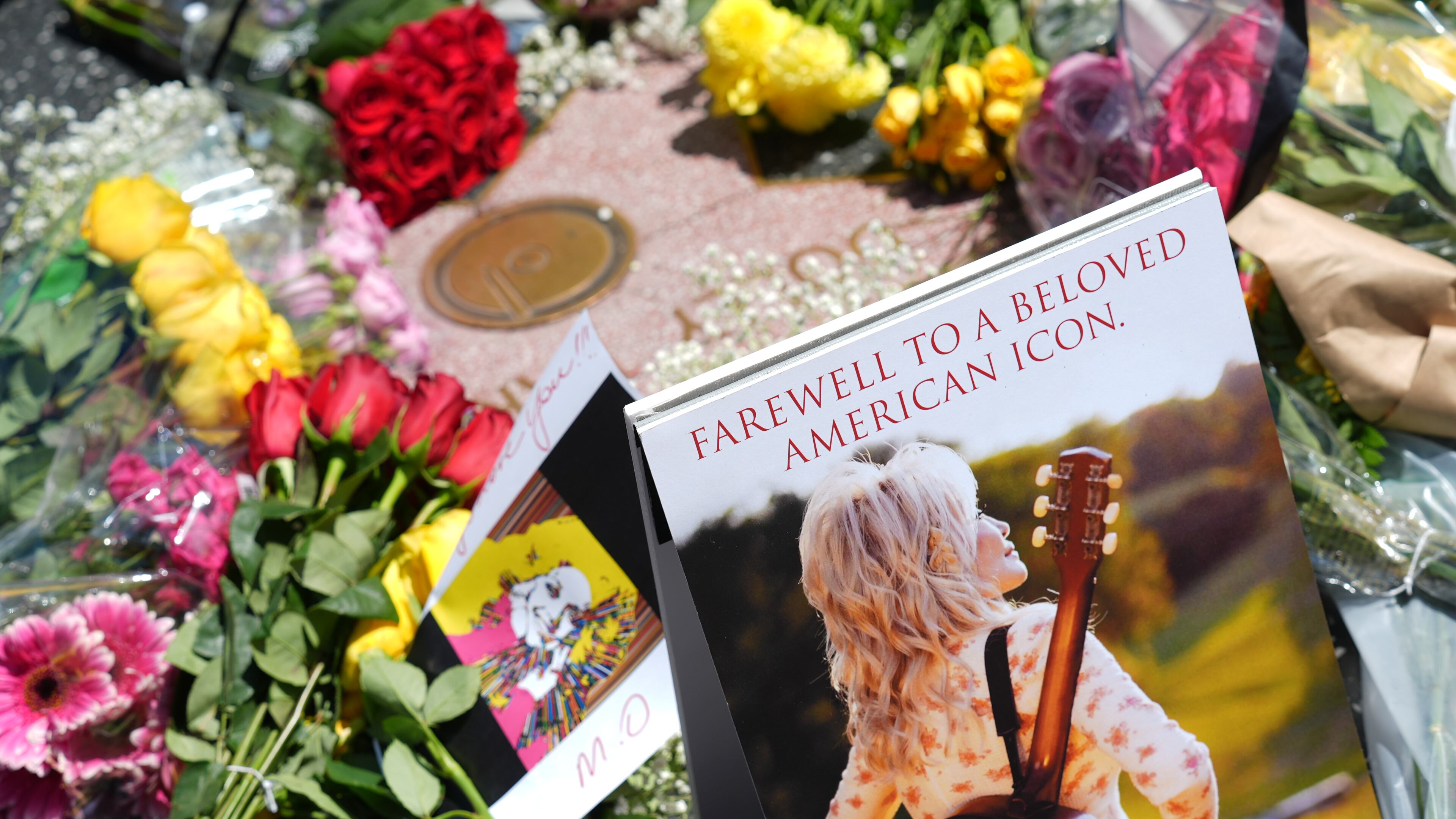
NEW YORK (AP) — There are few inalienable truths: Everyone was born, everyone will die, and everyone loved Dolly Parton.
Larger-than-life at 5-foot-nothing, the country star, actor, philanthropist, entrepreneur and theme park enthusiast who died Tuesday, transcended celebrity in rhinestones and fringe. She was embraced by fans across gender, race and class, embodying a mythology typically inaccessible to even the most influential historical figures.
It’s hard to name a more adored artist — one who could deliver a perfectly timed dirty joke seconds before a folk classic of her own composition. (This is where, if Parton were reading along, a self-deprecating quip would come in — lest anyone forget she was a whip-smart jokester, too.)
Throughout her endeavors, Parton worked to build a better world, while becoming inextricable from the American imagination. It is one of her greatest legacies: to take what you have and help someone with it.
One of the most beloved artists of all time
In 2015, when Parton returned to Nashville’s Ryman Auditorium, Grand Ole Opry announcer Bill Cody introduced her as “the most beloved artist of all time,” quickly amending it to “female artist.” As history has proven, he was correct the first time.
Parton’s legacy starts with the immortality of her music: songwriting as solace, an exercise in creativity and an unwavering ability to write experience into art. Across her career, Parton wrote and performed perennial hits (“Jolene,” “Coat of Many Colors,” “Little Sparrow,” take your pick) and others that took on a life of their own (most famously, “I Will Always Love You,” made immortal by Whitney Houston ).
Parton grew up in poverty, one of 12 kids in East Tennessee’s rural Sevier County, where she started writing songs as a toddler. By 10, she was on the radio and TV in Knoxville, Tennessee. By 13, she had made her debut at the Grand Ole Opry. At 21, she joined “The Porter Wagoner Show,” her star power quickly eclipsing its host.
The accomplishments — and the trials and tribulations that came with them, which she let roll off her shoulders with enviable resiliency — came fast and furious, as they do with once-in-a-lifetime talents. There are the 10 Grammys, the numerous Hall of Fame inductions, and the fact that she revolutionized the world of country music for women alongside Loretta Lynn and Tammy Wynette, creating a path for crossover artistry. But there are also her Hollywood forays. It’s telling that her first feature film, “9 to 5,” celebrated women in the workplace and messed with their devious bosses.
One of her superpowers was rooted in a kind of irony: Everything about Dolly Parton is truly Dolly Parton or else she wouldn’t partake — down to the false eyelashes and big wigs. She built an economic empire with down-home sensibilities. If authenticity is currency in popular culture, Parton showed the world how it was done.
An honest-to-goodness iconoclast
There’s a moment in her 1983 television special, “Dolly in Concert,” where Parton calls herself “the original punk rocker.” It’s a fitting description: Armed in a uniform of high heels, acrylic nails (the better to write songs with), tight clothes and a big blond beehive, the image of Parton was enough to scandalize. Jokes about her breasts were prevalent for decades; she wielded them like a weapon.
Her first big break came in 1967 with a single, ironically titled “Dumb Blonde.” It’s a clever admonishment of a man who calls a woman stupid. It was fabulously misunderstood and misconstrued, forecasting the wonderful hypocrisy inherent in many public appreciations of Parton: She had full autonomy; make a low-brow pass at her and she’ll have the last laugh. Always.
That spirit was inherent in her business ventures as well. Too poor to travel to Disneyland as a child, Parton opened her Pigeon Forge, Tennessee, amusement park, Dollywood, in 1986. Many thought it was a bad idea; it proved to be her most lucrative business venture. It’s also, crucially, a blessing for the local economy. According to a 2021 study by the Tennessee Aviation System Plan, Dollywood brings in $1.8 billion each year.
A great unifier
Parton’s career kicked off in the transformative ’60s, perfectly aligning with the emergence of the women’s liberation movement. Though she didn’t use the word herself, much of Parton’s career — and in particular, her songwriting — has been viewed as a kind of feminism. Take the early hit, 1968’s “Just Because I’m a Woman.” Parton’s sweet soprano and idiosyncratic tremolo are on full display as she reminds her male partner that he need not judge her for having previous sexual partners because he has done the same. “My mistakes are no worse than yours,” she sings, “Just because I’m a woman.”
Or consider 1970's “Down from Dover,” a tearjerker about a pregnant teenager abandoned by her family and the child’s father. She gives birth to a stillborn baby, alone, without medical treatment. “I guess in some strange way she knew she’d never have a father’s arms to hold her,” Parton sings. “And dying was her way of telling me he wasn’t coming down from Dover.” It’s evocative then and now.
Still, across political divides, Parton is welcomed with open arms. It may have something to do with the fact that, when it came to capital-P party line, Parton valued apoliticism. During the 2016 presidential election, she said a woman would do a great job in office. When it was viewed as an endorsement of Democratic nominee Hillary Clinton, she said her words were taken out of context. She never said who she voted for. And she declined the Presidential Medal of Freedom three times, twice from President Donald Trump and once from President Joe Biden so as to not appear biased. As a result, she was beloved by all — even in periods of unmitigated division.
A fantastic philanthropist
With the same resolve she exhibited in her performances, Parton was dedicated to charity work.
In 1988, she launched the Dollywood Foundation, originally designed to combat high school dropout rates. Its early '90s Buddy Program paired junior high students in Sevier County and gave $500 to each if they both finished high school. In 2016, when wildfires ravaged her native Great Smoky Mountains, the foundation announced it would give $1,000 each month for six months to families who lost their homes. The following year, it was revealed the foundation’s My People Fund helped 900 families with roughly $9 million in the first six months after the fires.
In 1991, she launched a sanctuary for bald eagles that couldn't survive in the wild; in 2000, she started a college scholarship giving $15,000 to five high school seniors in Sevier County. In 2020, she donated $1 million to COVID-19 research at Vanderbilt University, which helped fund Moderna’s vaccine.
Best known is her Imagination Library, founded in 1995. Parton’s father was illiterate; it inspired her to launch an organization providing books to those without resources. By 2025, she had given away over 200 million books to children in need.
Parton was truly one of one — a generous country music heroine from the small-town South turned global phenomenon.
“I hope I’ll be remembered as somebody that tried to do some good in the world,” she told The Associated Press in 2024. “And left, you know, a few good things behind.”