Traffic, noise and a Kirkwood mystery: Why doesn’t Pullman need event permits?

Late one Saturday night, as music blasted from Pullman Yards, a neighbor pleaded for relief.
“As I write this email to you,” Chantel Lanier wrote to Atlanta City Council member Liliana Bakhtiari, “my bedroom wall is vibrating due to the bass emitting from the Pullman Yard property on Rogers Street in Kirkwood.”
Kirkwood is 4 miles east of downtown, one of those evolving neighborhoods where you might see a new brick mansion next to a humble bungalow with bars on the windows. Pullman was once an industrial site, used for munitions and railroad operations, now renewed as an entertainment complex that has hosted presidents, film productions and Fan Controlled Football. What happens when the “South’s Premier Destination” springs up in a residential neighborhood with optimistic notions of tranquil city life? You can expect some strongly worded emails.
“Tonight’s event was unacceptable,” Lanier wrote in a message timestamped 11:20 p.m. March 7. She added that “the neighborhood was gridlocked. Residents couldn’t access or leave their homes. I witnessed cars going well over the speed limit down my dead-end street, and partially blocking driveways in order to park.”
Lanier was not the only neighbor who complained to Bakhtiari about ART, BEATS + LYRICS, a musical art exhibition presented by Jack Daniel’s Tennessee Honey. The Atlanta Journal-Constitution obtained the emails through an open-records request. DeKalb County Fire Capt. David Light warned of an “extremely dangerous situation” that could arise if emergency vehicles were delayed. A Wade Avenue resident called for a solution “before someone gives birth in their bathtub or dies in their home.”

Bakhtiari was familiar with these recurring complaints about late-night noise and traffic gridlock. She estimated the Pullman Yards drama had taken up more of her time in four years on the City Council than any other issue.
Lanier’s email had also been sent to the Mayor’s Office of Special Events. The following Monday, Lanier got a polite reply from city events manager Erin Walton.
“Please note that this property, Pullman Yards, is not under the Mayor’s Office of Special Events’ purview,” Walton wrote.
It was the kind of bureaucratic sentence that a reader might skim over and promptly forget. But it had real significance. Late at night, as her wall trembled from the noise, Lanier had opened the door to an enduring mystery.
Others in Kirkwood had tried and failed to solve this mystery. Bakhtiari herself had searched for an answer. This mystery had to do with the machinery of Atlanta City Hall and its implications for quality of life in Kirkwood. It pertained to rules, and their proper administration, and whether they applied to The South’s Premier Destination.
As time went on, one question led to another. They had the makings of a bad folk song. How many loud parties? How many traffic jams? How many emails must the committee chair send before she is no longer flummoxed?

‘Complete silence or vague responses’
That was her word, by the way. Flummoxed. It means bewildered or confused. Nicole Kibert Basler is chair of the zoning committee for the Kirkwood Neighbors Organization and has been trying for years to find out what rules apply to Pullman Yards.
“I am flummoxed,” she said. “And I am not flummoxed often.”
Many events at Pullman are indoors, including the ART, BEATS + LYRICS gathering that upset neighbors in March. But some, including Sweetwater 420 Fest, have been outdoors. And these events come with regulations.
Let’s say you want to have a large outdoor gathering in Atlanta. You may need to apply for a permit from the Mayor’s Office of Special Events. You may need to file a sanitation plan, a security plan, a plan for emergency medical services. You may need to notify the local Neighborhood Planning Unit. These regulations are about as fun as an office paper jam, but they exist for a reason. Large events should be orderly. They should not disturb the neighbors late at night. They should not trap people in their homes.

Certain residents of Kirkwood are convinced Pullman Yards should have to go through this process. And for years, they’ve been trying to get a satisfactory answer about it from the city of Atlanta.
Instead, they say, they’ve gotten the runaround.
On Feb. 26, 2025, about two months before Pullman hosted its second Sweetwater 420 Fest, Kirkwood Neighbors Organization president Mathew George emailed a city official regarding a comment from the previous night’s NPU meeting saying Pullman was “permitted as an event facility.”
George wrote, “Could you send us the document that shows this?”
Still awaiting an answer, George followed up the next month. Another city official amplified the request. Eventually, Leah LaRue, director of neighborhood planning units, said the question had been “answered in our Q&A document.” George pressed for an answer about why Pullman was exempt from permitting at the Mayor’s Office of Special Events. He followed up on March 13 and March 21, without success.
The local NPU leader chimed in.
“In the short time I’ve been Chair,” Joe Schleupner wrote, “every time Pullman Yards comes up, there’s either complete silence or vague responses from City representatives — particularly around issues like permitting, event scheduling, and the facility’s overall relationship with the City.”

George kept trying, rephrasing the question, adding others to the conversation. Nothing worked. George says he never got an answer.
Basler, the not-often-flummoxed zoning chair, said the Kirkwood organization hired a lawyer to look for the answer.
The lawyer could not find one.
One would think a City Council member might have the power to extract information from City Hall. But Bakhtiari says she also ran into one wall after another.
“I couldn’t get a clear answer,” she told the AJC in an interview. “I asked the law department, I asked the office of special events, I asked the mayor’s office.”
What she was told, she said, boiled down to this:
“The law is being followed, and there needs to be no additional scrutiny.”
Bakhtiari says she has helped direct traffic, made sure police officers had water, helped crack down on an illegal parking operation. She has spoken with the city’s planning and transportation departments. She organized a site visit with the mayor’s executive team. None of this has led to the definitive answer she and George and Basler have been seeking. In this case, she said she believes the city’s executive branch has fallen short.
“I view it as an operational failure,” Bakhtiari said.
The AJC sought answers from City Hall in late June. Michael Smith, deputy chief of communications for Mayor Andre Dickens, gave a statement Friday: “As has been discussed in years prior, at no point in time has Pullman Yards been considered an outdoor facility.”

The AJC also spoke with another player in this neighborhood drama: Adam Rosenfelt, co-owner of Pullman Yards. As far as he was concerned, the mystery had been solved long ago. Or perhaps it never existed.
“I don’t have the question,” he said. “They seem to keep asking the same question, maybe searching for a different answer.”
Rosenfelt: Answer was there all along
In 2016, Atomic Entertainment made an $8 million offer for the 27-acre Pullman site that had been owned by the state of Georgia since 1990. The state solicited bids. Five official bids came in, including one from Atomic. The Georgia Building Authority’s chairman was Gov. Nathan Deal. Its secretary was Secretary of State Brian Kemp, who is now governor. On April 19, 2017, Deal called the meeting to order.
According to the minutes, Atomic had placed the highest qualifying bid. Other bidders — including Kirkwood developer Atticus LeBlanc — seemed to think they’d get a second chance, because a flow chart included with the bid invitation indicated “there would be a best and final process.” In the event of a second round, a bidder from JoJo Investments said they could offer “substantially more than what Atomic Entertainment offered.”
But GBA Executive Director Steve Stancil recommended ending the process then and there, because Atomic’s bid was millions higher than the other qualifiers and it was expensive to keep the property secure. The abandoned buildings had become an attractive nuisance. The previous year, a young skateboarder had died after falling through a skylight. Kemp seconded a motion to accept the bid from Atomic. It passed by a vote of 5-to-1.
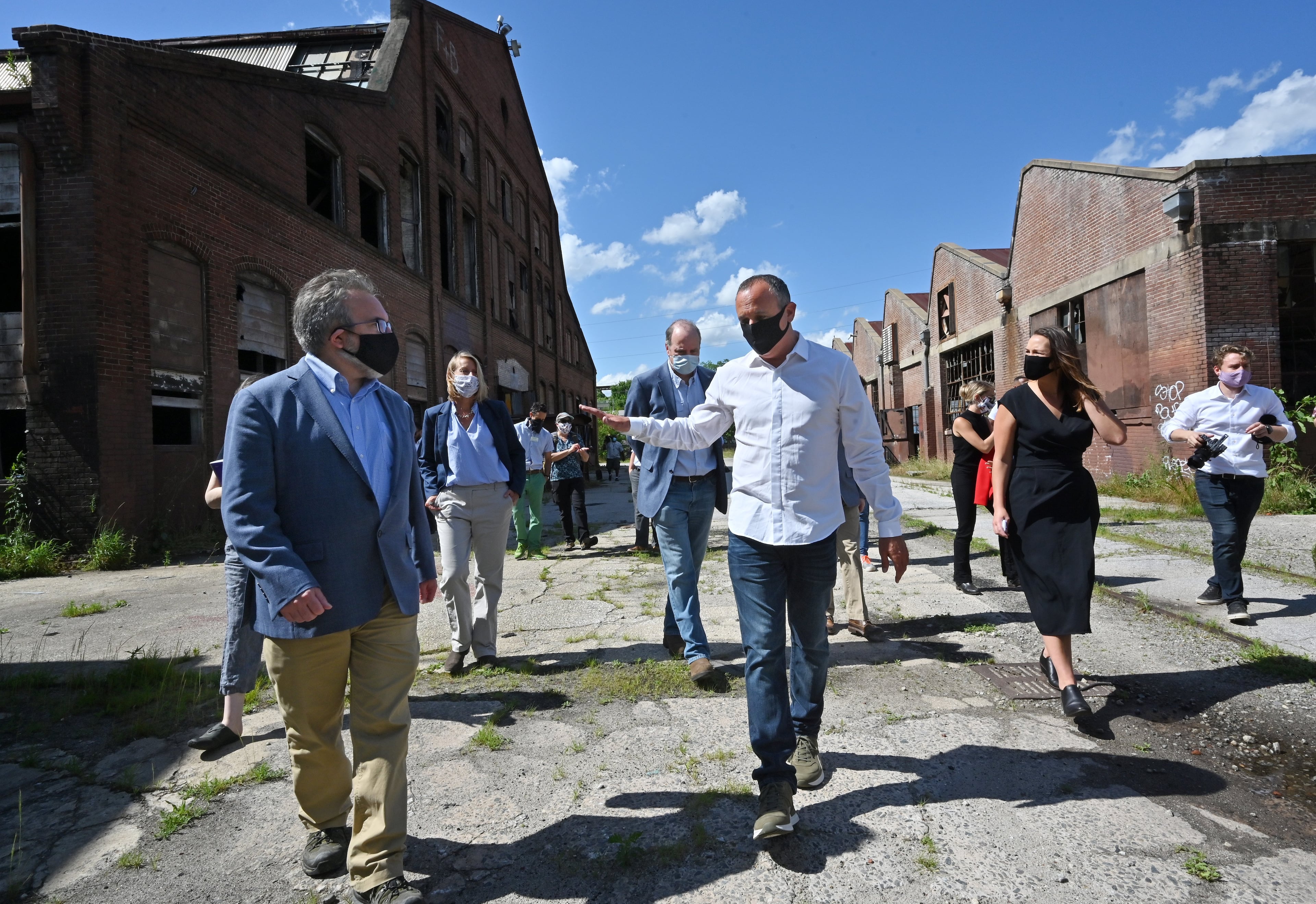
Atomic was a surprising winner in the long competition to redevelop the Pullman complex. It was a small company led by a Hollywood producer, Rosenfelt, whose credits included a 2007 film starring Kevin Costner as a serial killer.
Rosenfelt and his wife, Maureen Meulen, are partners in Atomic Entertainment. They have two daughters. As they made their plans to move to Atlanta, Rosenfelt said, he got an unexpected phone call. The property he’d just bought was going to become a Landmark District.
The city has 11 of these districts, including Oakland Cemetery and Castleberry Hill. They entail restrictions and requirements for historic preservation. Rosenfelt gave the AJC a copy of his regulations, which demand he “preserve the architectural history of the district.”
Naturally, this designation was something of a headache. Rosenfelt says he was advised to file a lawsuit challenging the restrictions. Instead, he cooperated.
“I entered into a deal that was not my request to enter into,” he said.
“And I’ve lived by that deal since it was put into ordinance in 2017.”
Rosenfelt highlighted something in the regulation document, under a section about permitted uses at the property. These uses included “convention halls, places of assembly, and similar uses.” To him, this answered the question the neighbors kept asking. Especially when combined with a 2024 email he’d obtained from a city official to then-KNO president Mathew George. Something George had received more than a year before his fruitless fact-finding mission of 2025.

The email was from Ebony Barley Carswell, director of the Mayor’s Office of Special Events, in response to some familiar questions from George about permitting at Pullman.
“This is definitely not the first time we’ve reviewed and addressed this property from the perspective of Chapter 142 (the city ordinance that governs outdoor events),” Carswell wrote. “So I decided to revisit this property again with our legal team and zoning experts. Regarding 142, which governs outdoor event permits, due to the configuration of the property, events taking place thereon do not qualify as outdoors such that they would fall under the jurisdiction of Chapter 142 of the City of Atlanta Code of Ordinances.”
In Rosenfelt’s view, this meant George had the answer all along.
In George’s view, it didn’t.
“That’s not a smoking gun in any sense,” he said. “It’s a vague nonanswer.”
To be more specific, he said, it was not an explanation. A phrase such as “due to the configuration of the property” did not identify the wellspring of authority from which the permit exemption flowed.
A tour of property — and new construction site
And so the mystery remained, or not, and the Kirkwood neighbors went about their lives, and Rosenfelt went about his business. He said more than 8 million people have visited Pullman Yards since it opened in 2021.
He said there were hundreds of events per year, and noise complaints were relatively infrequent. As for parking, there was reason to believe the situation would soon improve.
It was a hot Thursday afternoon in late June when he led a visitor on a tour of the property.
Here was the exhibit on serial killers. There were the pickleball courts. Here was the immersive experience that lets you pretend to walk in space like an astronaut. There was much more to see. His Nike Air sneakers made a crunching sound on the gravel outside. He led the way into Porter Hall, where former President Barack Obama spoke at a campaign rally in 2022. It felt old and dignified in there, with exposed brick and filtered sunlight giving it all a kind of echoing majesty.
“This is my favorite thing we did, creatively,” he said, walking into another building that took a moment for the visitor to comprehend.

The place had been abandoned for so long that trees had taken root and grown up in the ruins. They rose and rose, going up through the framework of what had been the ceiling. Rosenfelt had decided to leave some of them there. And now, between two large rooms of the same building, the trees stand tall in a kind of courtyard. Fresh air and natural light come in. The building almost seems alive.
Rosenfelt did not quote Theodore Roosevelt. He did not call himself the man in the arena, striving valiantly, knowing the great enthusiasms, willing to fail sometimes while daring greatly. But a similar feeling came across. The notion that sometimes a person of bold ambition must simply endure the critics and keep on building.
He walked outside to a place of deep excavation, a massive hole in the red clay. Workers were pouring concrete.
They were building a parking deck.