Top EU official visits Ukraine and pledges continued support against Russia's invasion
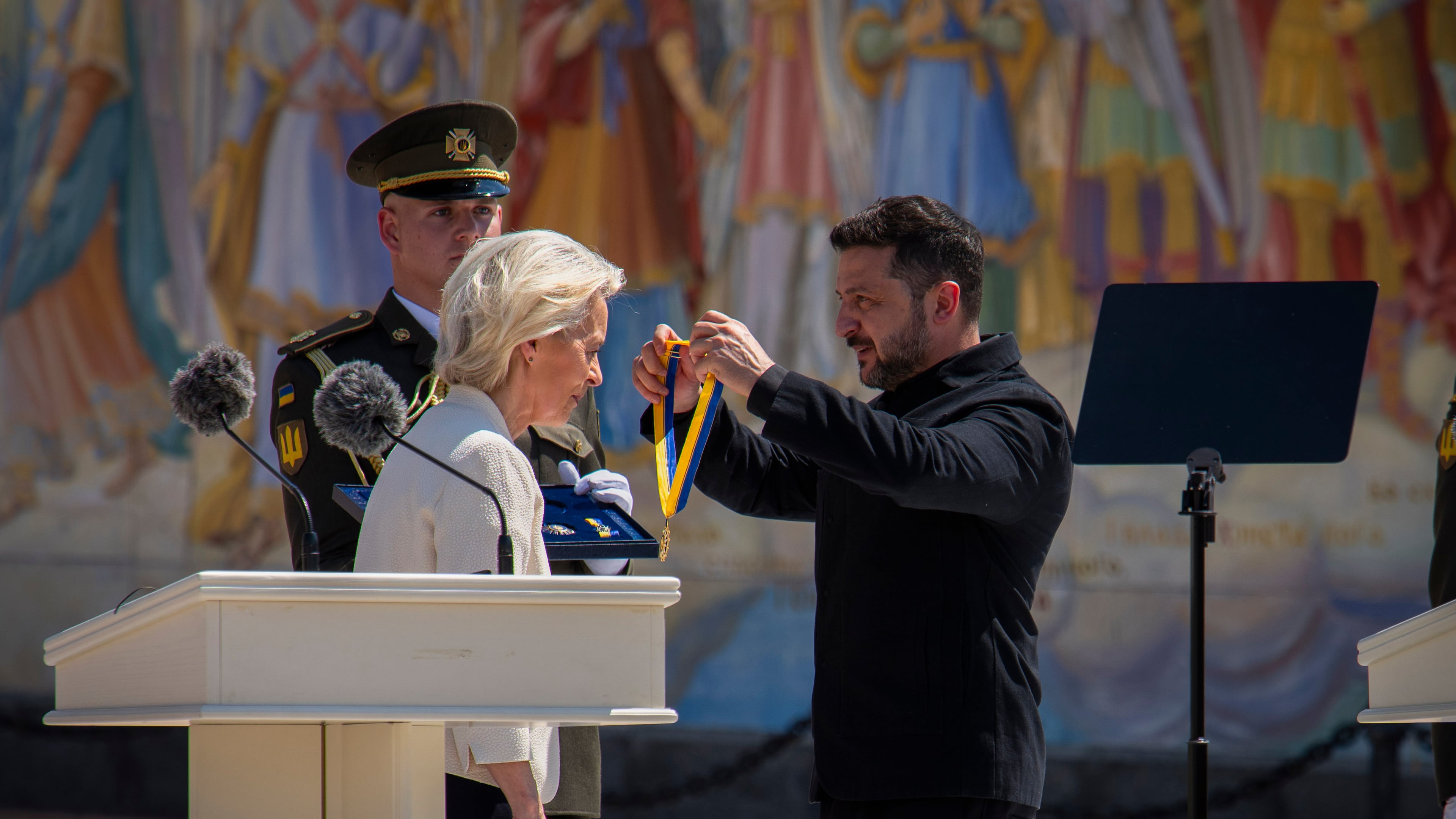
KYIV, Ukraine (AP) — European Commission President Ursula von der Leyen went to Kyiv on Wednesday to mark Ukraine’s annual Statehood Day, pledging continued military and financial support for the country's independence as it holds out against Russia’s 4-year-old full-scale invasion.
Ukraine’s sovereignty has been threatened since Russian forces occupied Ukraine’s Crimea in 2014 and Moscow illegally annexed the peninsula, followed eight years later by the all-out invasion of February 2022. Statehood Day, celebrating the country’s self-determination, is a public holiday in Ukraine.
The war has killed thousands of soldiers and civilians, forced millions to flee their homes, reduced Ukrainian cities to rubble and fueled fears the confrontation could slide into an open conflict between Russia and NATO, whose member nations have supported Kyiv. No peace settlement is in sight.
Senior officials from southeastern European countries also were expected in Kyiv on Wednesday for a periodic gathering focused on Black Sea and regional security. Last year’s meeting in the southern Ukraine city of Odesa reaffirmed the countries’ support for Ukraine’s sovereignty and territorial integrity.
Ukrainian President Volodymyr Zelenskyy has recently won important pledges of further support, including from the Group of Seven leading industrialized nations and the so-called Coalition of the Willing countries.
Top EU official says ‘tide is turning’ in the war
Von der Leyen, the European Union’s top official, said her trip to the Ukrainian capital was her 11th in wartime. Europe is watchful of Russia’s broader intentions on the continent and has provided billions of euros (dollars) to Ukraine as well as diplomatic support.
Von der Leyen said she would announce new steps toward integrating the European and Ukrainian defense industries as well as providing new help to prepare Ukrainian air defenses for next winter, when Russia usually tries to knock out the power.
Her visit came as Western officials and analysts say Ukraine’s increasingly frequent and accurate drone and missile attacks are hitting high-profile targets deep inside Russia, severely disrupting the Russian army’s supply lines and causing civilian fuel shortages.
“It’s a special moment,” Von der Leyen said of her visit on social media. “Ukraine has built a strong military momentum. The tide is turning.”
Meanwhile, Serbia’s Moscow-friendly president, Aleksandar Vucic, was taking part in the Southeast Europe Summit in Kyiv.
Serbia, which relies almost fully on Russia for its energy supplies, has refused to join Western sanctions on Moscow that were imposed after its invasion, although it officially supports Ukraine’s territorial integrity.
Russian attacks kill at least 8 Ukrainian civilians
Ukrainian officials said Wednesday that at least eight civilians were killed and 11 others were injured in Russian aerial attacks.
Russian forces dropped six powerful glide bombs mostly targeting infrastructure in Ukraine’s northern Sumy region, killing three people and wounding seven, the head of the regional military administration Oleh Hryhorov said.
Three people were killed and three others wounded in a Russian attack on Odesa, according to the head of the city’s military administration, Serhii Lysak.
Also, in Ukraine’s northern Chernihiv region, Russian drone attacks killed two people and seriously wounded an 18-year-old, regional military administration head, Viacheslav Chaus said.
In Moscow, the Russian Defense Ministry said its air defenses overnight intercepted 93 Ukrainian drones over several Russian regions, as well as over Crimea and the Sea of Azov and the Black Sea.
___
Hatton reported from Lisbon, Portugal. Associated Press reporter Justin Spike in Budapest contributed to this story.
___
Follow the AP’s coverage of the war in Ukraine at https://apnews.com/hub/russia-ukraine