'The show must go on,' Trump says at White House correspondents' dinner rescheduled after shooting
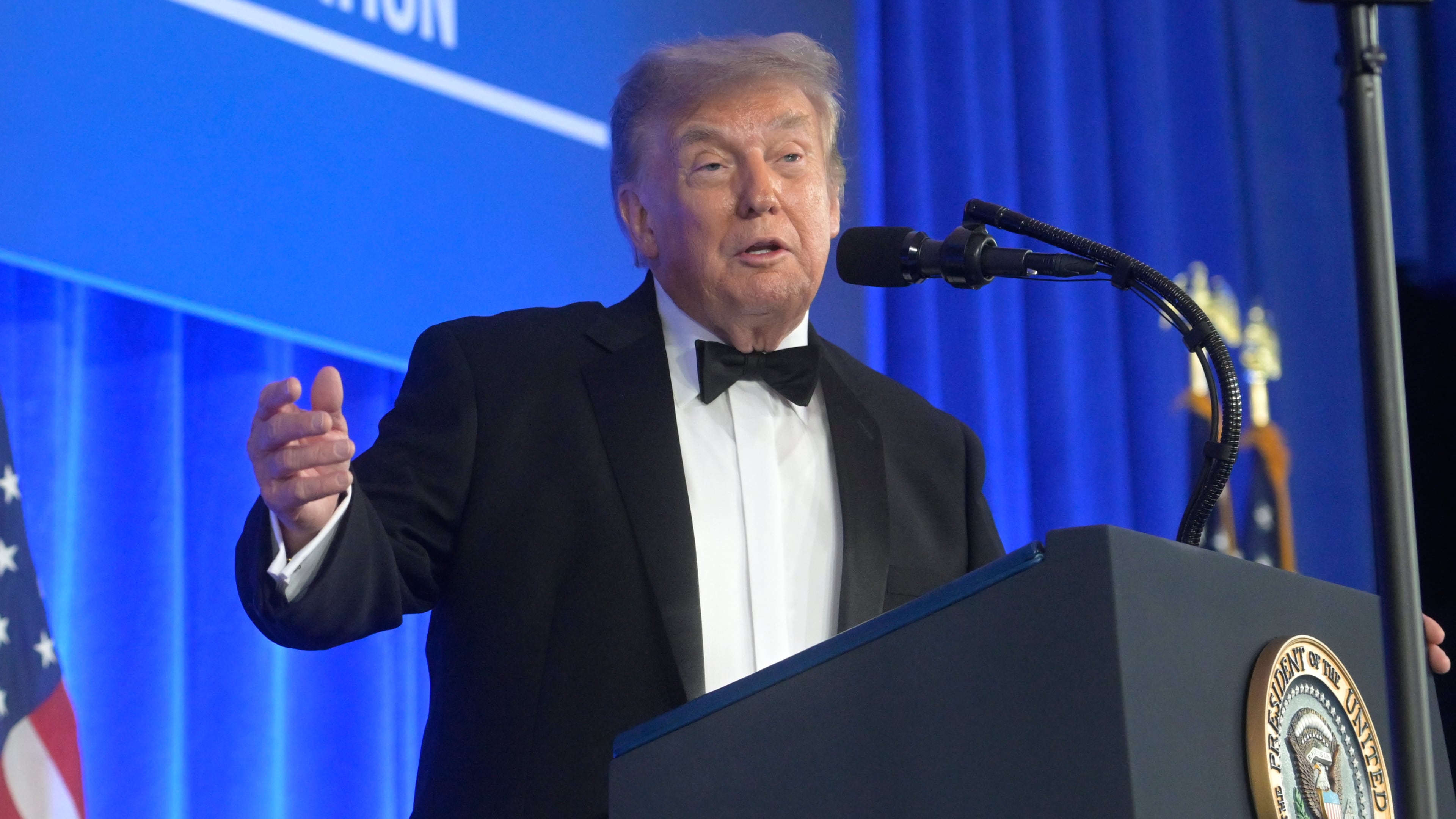
President Donald Trump addressed a huge roomful of journalists Friday night at a correspondents' dinner rescheduled from April after a shooting upended the first edition. Said the president: “As I said three months ago, the show must go on."
Trump entered the ballroom to polite applause, and was thanked for his support by White House Correspondents' Association president Weijia Jiang of CBS News. After dinner, he then sat through more than an hour of awards presentations — including many for journalists who had done pointed stories about him and his administration during the previous year.
“Let’s try this again,” Jiang quipped, welcoming the crowd. The White House press corps, she noted, “always has a follow-up.” Turning serious, she referred back to the trauma and confusion of the original dinner in April.
“Tonight our message is this: We are back,” she said. “We will not be intimidated. We refuse to let an act of violence have the final word.”
The rescheduled dinner was taking place in the ballroom of the Waldorf Astoria hotel, a smaller venue that held only about 700 people. Guests entered via a single entrance, through two ID checks and past a detection dog, armed officers and security guards. There was no red carpet and no separate cocktail receptions preceding the dinner.
He was widely expected to bring the fighting words — “rather nasty,” he said — against the press that he’d planned to deliver in April before the event descended into chaos when a gunman stormed a security checkpoint, forcing an evacuation of the room. But early in his speech, Trump signaled that he had scrapped his planned remarks and was going to deliver a mix of things.
“This is really the largest group of ‘Trump Derangement Syndrome’ people put together at one time,” the president said.
Trump has been coy about what he might say
As for Trump himself, he indicated last month he wasn’t sure. “I don’t know whether or not I will give the same rather nasty statements, at least as it concerns certain people, but we will soon find out," the Republican president wrote on his Truth Social platform. “In any event, it will be a ‘HOT’ ticket!”
Besides the pared-down approach, there was another change at Friday’s dinner: two additional awards. One presented to Victor Gonzales, the Secret Service agent who was staffing a security checkpoint in April and was struck in his protective vest.
“Officer Gonzales … ran toward danger so that thousands of others could make it home safely," Weijia Jiang, WHCA president, said in a statement. “His courage stemmed from a dedication to service, which we are looking forward to honoring this week.”
A second award was to be presented to the staff of the Washington Hilton hotel, site of the first dinner.
The dress code this time was a looser “black tie optional," and dinner includes grilled peach and burrata salad, lobster and beef Wellington. The evening, as at the last dinner, had entertainment by mentalist Oz Pearlman, along with the awards presentations and Trump's remarks.
Jiang and her fellow board members worked hard to bring about this WHCA dinner 2.0, not wanting to let a violent act — or the image of colleagues hiding under tables — remain the final thought. Announcing the rescheduling, she emphasized the dinner’s stated purpose: “a celebration of a free press and the vital role of journalism in our democracy for over a century.”
“We will not allow an act of violence to have the last word, especially during a year when we are reflecting on the 250th anniversary of America and everything we stand for,” Jiang said.
There's still lots of criticism of the event
But it’s also clear that some people felt the dinner should not be rescheduled at all.
Many never thought it was much of a good look in the first place, with the sight of journalists in formal wear cozying up to their sources, or the objects of their reporting.
“It undermines the public faith in how the press does its work, and it makes it look like we are pals with the people we cover,” Kelly McBride, an ethics expert at the Poynter Institute, a journalism think tank, said when the deliberations were taking place.
The new dinner comes during a time of fast-increasing tension between the media and a president who, in his second term, has tried to exert pressure on media outlets he is unhappy with in a variety of ways. That pressure has ranged from sanctions against members of the White House press corps to regulatory actions through the Federal Communications Commission to outright lawsuits.
Those tensions have only escalated since April, with the latest example reaching a New York courtroom on Thursday. There, criticized by a federal judge for sloppy legal work, the government withdrew subpoenas that would have compelled three New York Times reporters to testify about their sources for articles about Trump’s Qatari-gifted Air Force One jet.
That escalation was the impetus behind a letter from a coalition of press freedom groups and hundreds of former journalists, urging the WHCA to stand up to Trump forcefully at the dinner.
“We believe it is hypocritical to celebrate the First Amendment in front of the man who relentlessly attacks it,” the letter says. “We urge the WHCA to condemn the administration’s actions from the podium and pledge to fight all attempts by his administration to undermine this core pillar of a functioning democracy.”
___
Jocelyn Noveck covers the intersection of media and entertainment for The Associated Press.