Far-right Alternative for Germany party reelects leaders as protesters and police clash
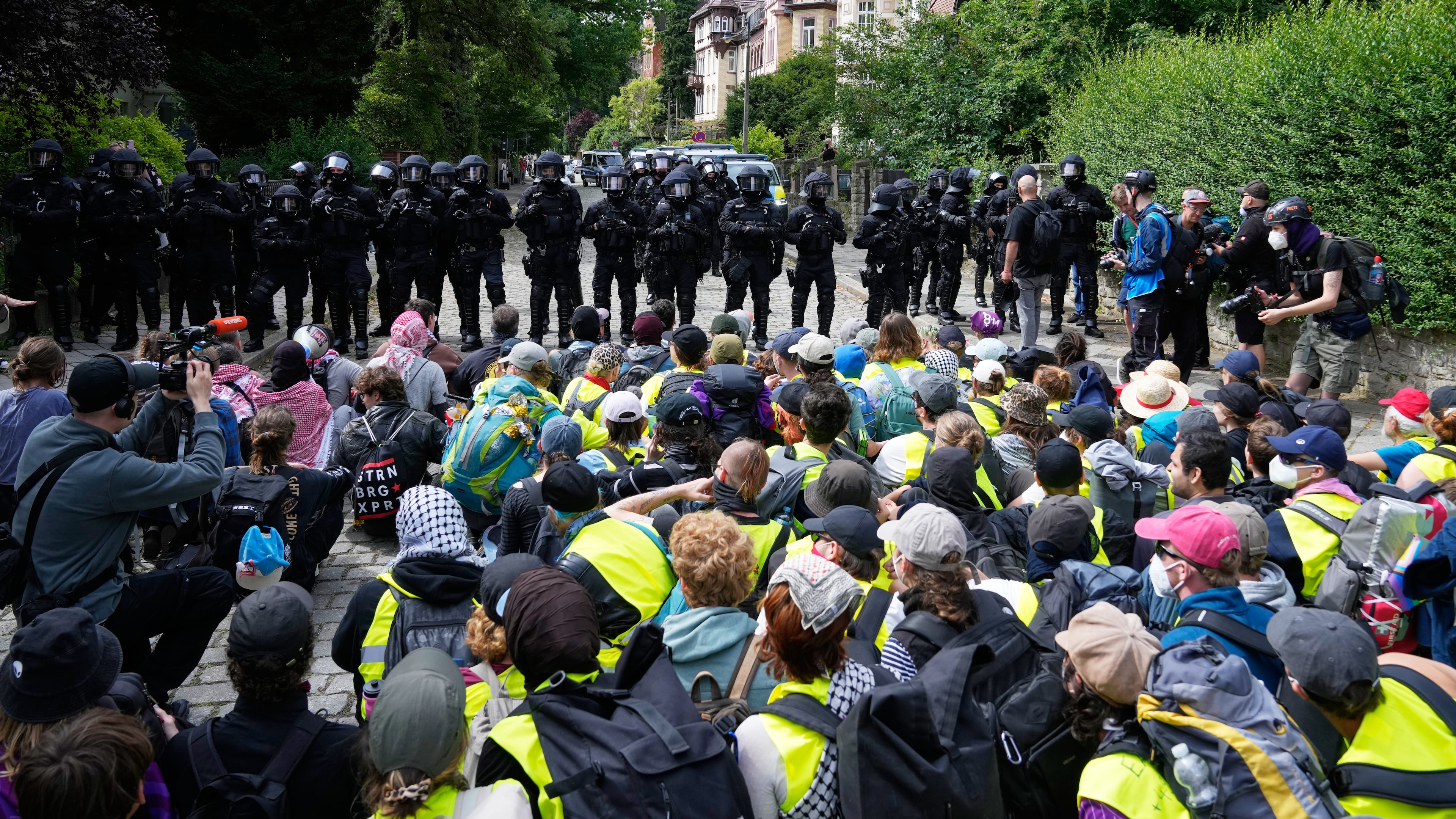
ERFURT, Germany (AP) — Delegates at the national convention of the far-right Alternative for Germany party on Saturday overwhelmingly reelected its leaders, including Alice Weidel, as tens of thousands of protesters aimed to disrupt the meeting and some clashed with police.
Alternative for Germany, or AfD, sought to show unity as it voted to extend the terms of Weidel and Tino Chrupalla, who have headed it for four years as co-leaders and ran unopposed Saturday. Weidel was reelected with 81% of the vote, while Chrupalla earned 70%. German parties elect their leaders every two years.
The demonstrations outside the convention in the eastern city of Erfurt reflected how AfD has divided Germany even while becoming the biggest opposition party nationally and the strongest political force in Germany’s formerly communist east.
Saturday's event was able to start on time despite the protests, which party officials hailed their “fundamental, legally guaranteed right to hold party conventions.”
“There are no peaceful seated blockades. There are no democratic roadblocks. Nor are there any gangs of thugs who deserve the harmless label ‘civil society.’ These troublemakers are the last resort of our political rivals,” Chrupalla said.
The weekend convention drew additional controversy by coinciding with the 100-year anniversary of a Nazi Party meeting held nearby that consolidated Adolf Hitler’s power over the fascist movement. Historians and political opponents say the timing carries powerful symbolism, an accusation the AfD rejects.
AfD fights ‘firewall’ as its support rises
AfD achieved second place in the February 2025 national election with 20.8% of the vote, the best showing by a far-right party since World War II. Since then support has risen to first among the nation's political parties.
Despite the growing support, some want to see the party banned and protesters this weekend are likely to underline those calls. But Germany’s supreme court previously has set a very high bar for banning parties.
Although Weidel said recently that “2026 is a year of destiny for AfD,” mainstream parties say they won’t work with AfD in a stance often referred to as a “firewall” against far-right parties.
Police said some 31,000 people attended Saturday's protest rallies, German news agency dpa reported. The demonstrations were largely peaceful, with protesters holding signs such as "Stop AfD Nazis” and "For Diversity, Against Nazis.”
Lena Raupach, spokesperson for widersetzen, an anti-fascist alliance whose name translates to “resist,” said the group had hoped to block the convention.
“The AfD pursues fascist policies: It wants mass deportations and terror on the streets. At the same time, however, it doesn’t solve a single real problem," she said. “It pursues policies that benefit the rich, not ordinary citizens. And we at widersetzen want a society in which all people have equal opportunities and equal security. We want a society based on solidarity.”
The Federal Office for the Protection of the Constitution, Germany’s domestic intelligence agency, announced last year that it had classified AfD as a proven right-wing extremist group, but suspended the designation after a legal challenge. In February, a Cologne court said the agency can’t use the designation while the court evaluates the party’s lawsuit.
AfD vehemently rejects accusations of extremism and argues the agency is being used as a political instrument by mainstream parties.
Upcoming state election could bring a major win
AfD is capitalizing on the unpopularity of a government that is trying to reform the sluggish economy. The party has become adept at harnessing discontent with issues well beyond its signature theme of curbing migration, which powered its rise in the mid-2010s.
AfD hopes to win 40% or more of the vote in a Sept. 6 state election in the eastern region of Saxony-Anhalt. That could put the party on course for an absolute majority or in a position where it might try to attract defectors from other parties, paving the way for its first state governor.
“We will win. Maybe we’ll be able to govern alone soon,” Chrupalla said. “That would send the right message to the enemies of democracy out there who wanted to prevent our party convention from taking place.”
The party, which has long called for lifting sanctions against Russia and opposes weapons deliveries to Ukraine, also has supported the general approach of U.S. President Donald Trump while criticizing the war in Iran launched by the Trump administration and Israel.
Björn Höcke, one of the party’s regional leaders, repeatedly said in his speech Saturday that AfD wants to make Germany great again, a reference to Trump's MAGA platform, and at least one attendee wore a hat with a “Make Germany Great Again” logo.
___
Associated Press writers Stefanie Dazio and Philipp Reissfelder in Berlin contributed to this report.