Rebound in tech shares pushes world markets higher, while oil prices fall
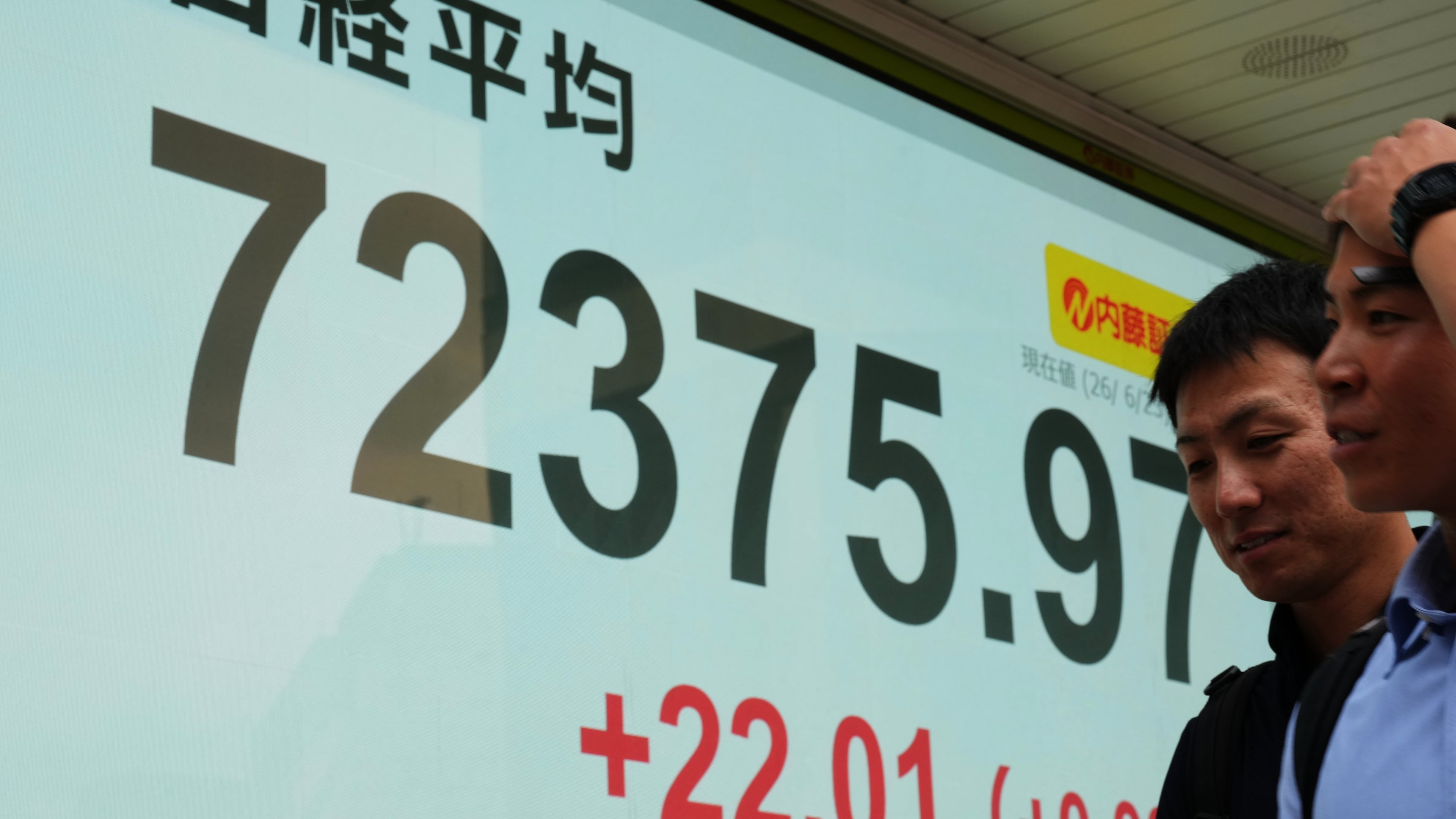
BANGKOK (AP) — World shares were mostly higher Thursday, led by tech-driven gains in Japan and South Korea as major computer chipmakers’ stocks surged following upbeat earnings reports from U.S. giants like Qualcomm and Micron Technology.
Oil prices slipped closer to where they were before the war with Iran began.
Qualcomm’s share price surged 11.5% in pre-market trading after the company announced it had raised its forecast for revenue this year to $40 billion from $22 billion. It also announced a new computer chip for data centers called Dragonfly C1000 CPU that Meta plans to use.
Micron Technology's shares jumped 17% in premarket trading after it upgraded its forecast and exceeded analysts' estimates.
The future for the S&P 500 gained 0.8%, while that for the Dow Jones Industrial Average was up 0.3%.
Germany's DAX advanced 0.7% to 24,904.98. The CAC 40 in Paris was up 0.5% to 8,429.37 and Britain's FTSE 100 added 0.3% to 10,495.81.
Tokyo's Nikkei 225 index surged 4.6% to a record close of 72,366.34 as traders snapped up shares in technology companies. Chipmaker Tokyo Electron's shares gained 7.8%, while chip testing equipment maker Advantest's shares soared 15%.
South Korea's benchmark, the Kospi, hit a new record, surging 5.4% to 8,930.30 after briefly topping 9,000. Samsung Electronics' shares gained 5.3% and SK Hynix leaped 13%.
Elsewhere in Asia, gains were more modest.
Taiwan's Taiex climbed 0.5% and the Sensex in India was up 0.7%.
The Shanghai Composite index picked up 0.2% to 4,120.28, while Hong Kong's Hang Seng dropped 1.4% to 23,076.91.
Australia's S&P/ASX 200 shed 0.7% to 8,748.70.
On Wednesday, stocks wavered to a mixed close on Wall Street as losses for several tech giants including Microsoft weighed on the market. The S&P 500 fell 0.1% and the Dow Jones Industrial Average, which is less weighted with tech stocks, rose 10.4%.
The tech-heavy Nasdaq composite fell 0.4%.
Microsoft lost 2.3% and Oracle slumped 4.6%.
Many large tech companies have been behind Wall Street’s record-setting run throughout the year, but analysts have warned their valuations may have become stretched.
Google’s parent company Alphabet slipped 0.2%. The company is replacing Verizon in the Dow on Monday. Its inclusion in the S&P 500 means more to investors, however, because 401(k) accounts are much more likely to include an S&P 500 index fund than anything tied to the Dow.
Alphabet will become the fifth Magnificent 7 tech company to join the Dow. The others are Apple, Amazon, Microsoft and Nvidia.
Oil companies had some of the biggest losses as prices fell while the U.S. and Iran negotiate a possible end to their war. Exxon Mobil fell 2% and Chevron lost 2.6%. Brent crude, the international standard, fell 3.8% to $73.87 a barrel. It has been trading below $80 in recent days but is still above the roughly $70 per barrel it was trading at in late February before the war began.
U.S. crude prices fell 3.9% to $70.34 a barrel.
Early Thursday, Brent was down 1.2% at $72.97 a barrel, while U.S. benchmark crude lost 1.2% to $69.51 a barrel.
Some of the bigger winners on Wall Street included homebuilders following approval of legislation beneficial to the industry. KB Home surged 16.7% and D.R. Horton jumped 6.7%.
The Federal Reserve will get an update on inflation later Thursday, when its preferred measure for prices is released. Economists expect the Personal Consumption Expenditures price index, or PCE, to show that prices rose 4.1% in May. That would be the highest level in three years.
Inflation has been rising as tariffs raise costs for many goods. It worsened as the war pushed energy and shipping prices higher and that impact is expected to linger even as oil and gasoline prices fall.
In other dealings early Thursday, the U.S. dollar rose to 161.83 Japanese yen from 161.79 yen. The euro fell to $1.1354 from $1.1359.