Gender-bending is now part of menswear. Paris runways show how mainstream it has become
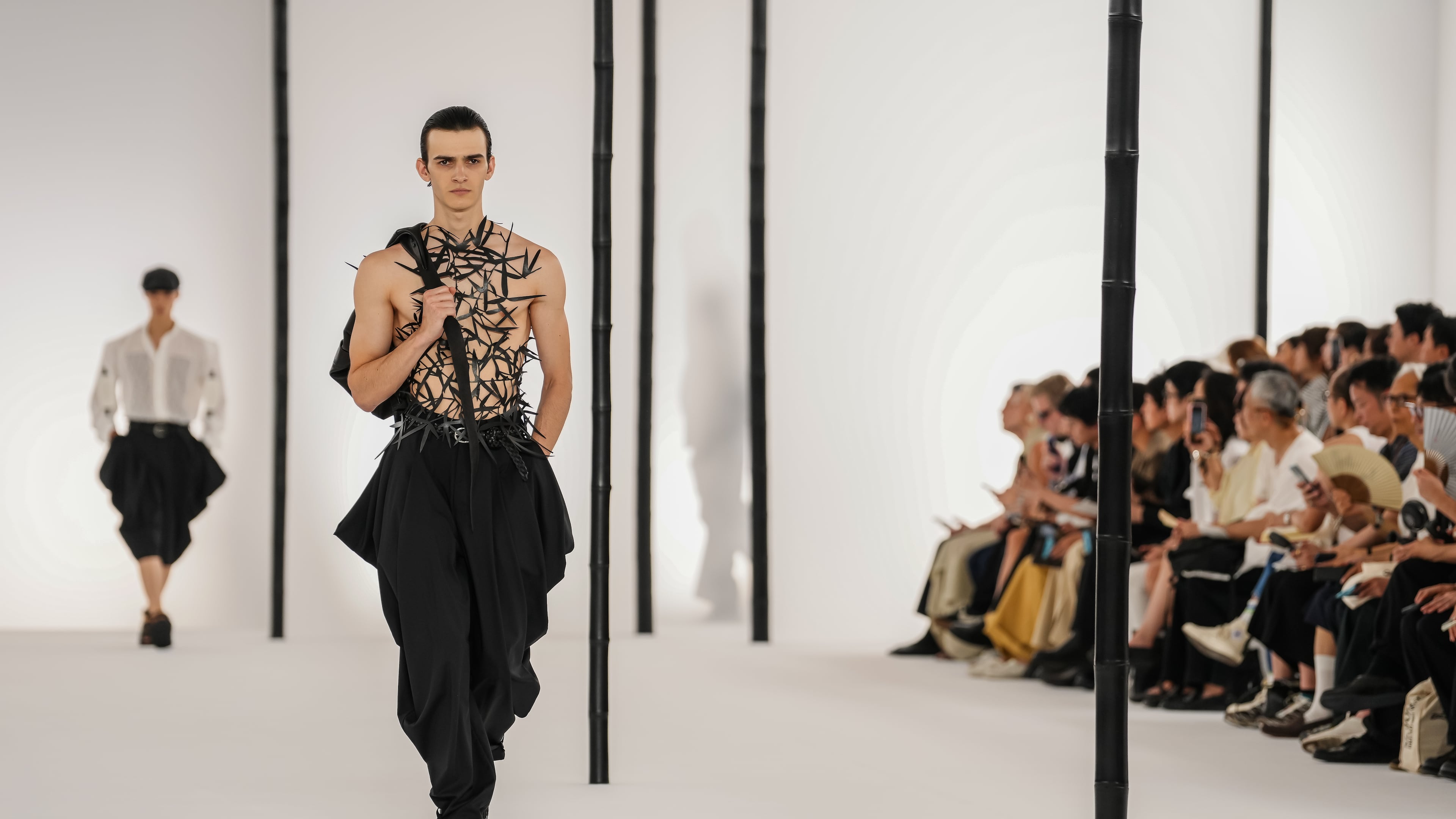
PARIS (AP) — This was men’s fashion season. The women were everywhere.
They walked the coed Paris runways at Amiri and Ami. At Vetements, women modeled many of the “menswear” looks, and Sharon Stone closed the show in thigh-high boots.
Inside fashion, none of this was eyebrow-raising.
The gender blur was not happening on the margins. It was built into Paris Men’s Fashion Week, which ended Sunday, where a multibillion-dollar luxury industry shows what it thinks men will want next.
It has reached menswear advertising, too.
A pregnant Rihanna became the face of Pharrell Williams’ first Louis Vuitton men’s campaign in 2023, appearing on a giant Paris billboard with her baby bump exposed and arms full of Vuitton bags.
“It’s not something completely new,” said Joseph McBrinn, art historian at Ulster University.
Women have paraded through menswear collections for so many seasons that it barely registers with fashion insiders anymore — even as a Gen Z mainstream, only now catching up to the gender-bending David Bowie flaunted in the ’70s, treats it as the cutting edge.
In recent decades, he said, fashion has moved “from very binary understandings of gender and fashion to something which is today very fluid” — reflective, he added, of how younger people now think.
The deeper confusion: They do not always travel together.
At Issey Miyake’s IM Men, by the brand’s account, the cast was entirely male — yet the show still read as androgynous.
The border between his and hers keeps eroding, on the body and on the calendar. It has not vanished, and its erosion owes as much to money as to gender.
“Androgyny only works because people understand what is being crossed,” said Andrew Groves, menswear systems professor at the University of Westminster.
The real story is not that menswear has escaped its rules, but that designers are finding new freedom inside one of fashion’s narrowest rule books, Groves added.
The runways look like they are erasing gender; the categories are exactly what make the gesture legible.
This season's men's clothes borrowed freely from womenswear
For Jonathan Anderson, Dior’s first ever designer to oversee both its men’s and women’s lines, models wore pearls, pink and sheer blouses with soft bows at the throat; the collection, he told reporters, was about how he "connects with the feminine.”
At Saint Laurent, men bared their chests in second-skin tops, wore briefs cut from leather and walked in transparent shoes lifted from the women’s runway.
The house opened Paris Men’s Week, and its menswear push is not only aesthetic: Saint Laurent has reportedly set a target of doubling men’s sales by 2030.
Many houses have folded men’s and women’s collections into one coed runway. Once provocations, such shows became a calendar strategy by the late 2010s — part creative, part convenient, mostly commercial.
When Anthony Vaccarello took over Saint Laurent in 2016, he scrapped its separate menswear show and sent men down the women’s runway, restoring a men’s show only in 2018; Vetements and Balenciaga merged theirs around then too.
“I don’t think having men and women on the same runway means a greater belief in nonbinary genders,” said Valerie Steele, director of the Museum at the Fashion Institute of Technology. “That’s really more of an economic thing.”
One show costs less than two
A mixed approach consolidates the media moment and lets a designer tell a single story. That matters in a luxury market under pressure – it’s been a weaker period for the sector in the last couple of years.
Women already buy menswear, which helps explain why Ami, founded in 2011 as a men’s brand, added womenswear.
The blurring of the clothes is the older story. Long before “nonbinary” was common usage, Yves Saint Laurent put women in men’s tailoring in 1966, Bowie smudged the line in the ’70s and Jean Paul Gaultier sent men out in skirts in the ‘80s. Fashion ran years ahead of the language.
Suzy Menkes, the veteran fashion critic, sees the history stretching even further back. Men once wore “the most dramatic, precious, glamorous and priceless jewels,” she noted, without doubting that they were suitable for men. The 20th century, she said, narrowed that idea of male dress before fashion began reopening it.
The exchange has never been equal: A woman in a man’s suit is, 60 years on, unremarkable; a man in a skirt or heels still reads as transgression.
“Women’s bodies are still consumed in ways that men’s bodies are not,” McBrinn said.
Men, he added, “can still be seen as deviant” when they cross the line.
Off the runway, the moment is volatile: combative online masculinity, “manosphere" influencers like the Tate brothers, a wave of anti-trans laws.
Last year, J.Crew set off a conservative uproar by marketing a pink sweater to men — even as Dior, Paul Smith and Willy Chavarria sent pink down their own runways. The fight was cultural, but not only: reports said pink apparel sellouts rose 17% year-on-year in spring-summer 2025.
Menkes said color is part of the same story. Postwar Europe helped harden the idea that some colors were “suitable” for men, she said, and it took “a surprisingly long time” for shades such as lilac or pale pink to be accepted as male choices.
Steele said openness to androgyny crested in the 1920s, the ’70s and the ’90s, then receded each time.
“Everything is moving to the right,” McBrinn said. “Fashion may go back to being much more entrenched within gender binary” — perhaps, he warned, within five to 10 years.
The stakes run past the runway
After years of expanding legal protections for LGBTQ+ people, progress is reversing in many countries, with transgender people at the center of the fight.
“We are seeing tremendous backlash internationally against trans people,” Steele said.
In the end, Steele said, the runway matters less than the office and the dinner table. People shift when they see androgynous clothes on friends, colleagues or men around them.
Increasingly, they are just clothes.