A ‘secure zone’ stops Knicks fans from gathering outside MSG, rankling die-hards and the team owner
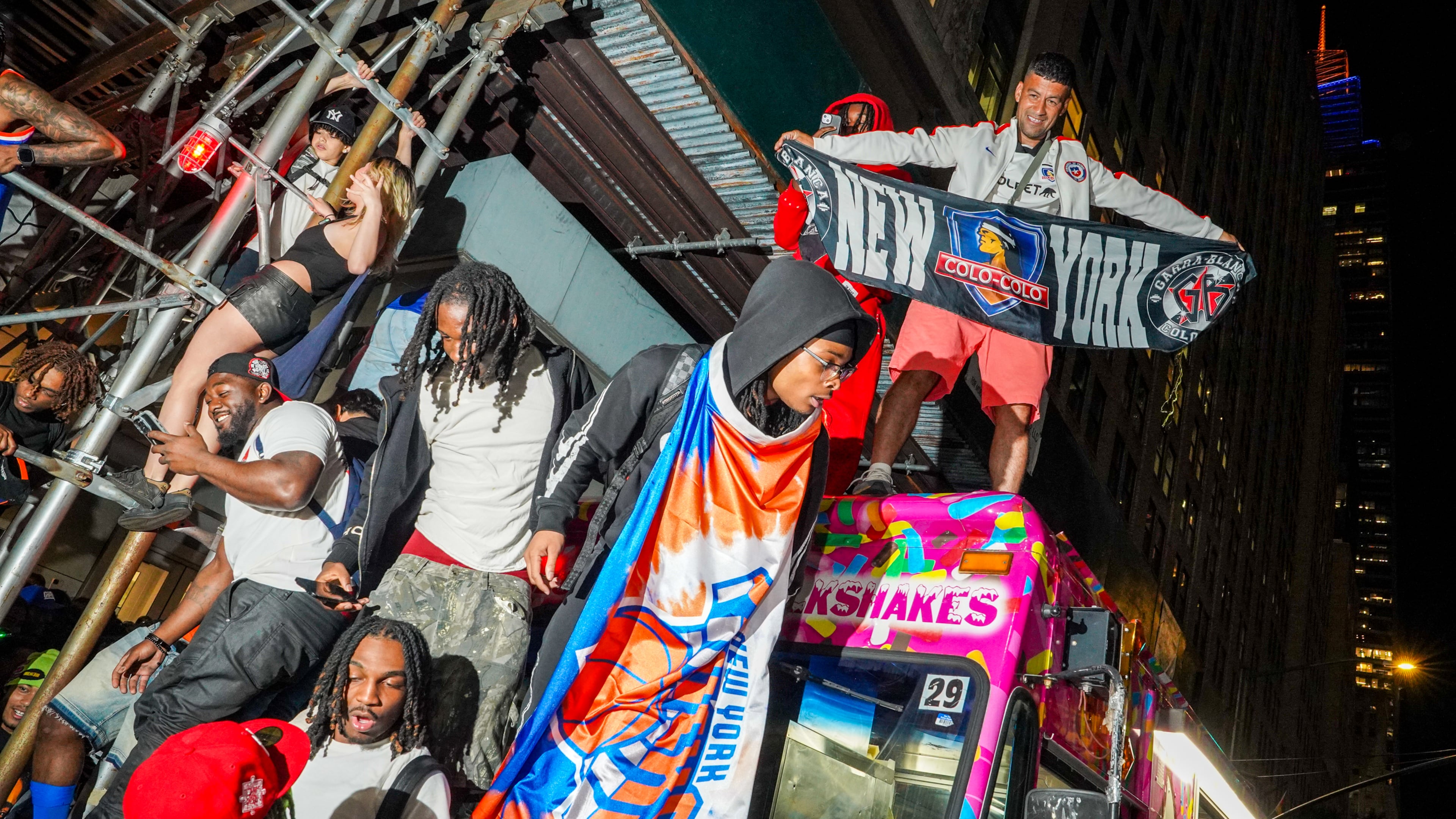
NEW YORK (AP) — Throughout the New York Knicks’ playoff run, thousands of deliriously happy fans have flooded the streets outside Madison Square Garden, often invoking a two-word rallying cry: “We outside.”
But as the team hosts its first NBA Finals games in 27 years, the city is restricting spontaneous gatherings outside the famed arena.
New York City Mayor Zohran Mamdani and his police department have cited a range of reasons for the ban, including President Donald Trump’s attendance at Monday’s game.
Ahead of Game 4 on Wednesday, the NYPD announced it would again prevent fans from gathering around MSG, unless they were going to the game or had “business specific to that area.”
Instead, the city said it had approved a permit to allow 1,000 fans access to a watch party outside the Garden — a scaled-down version of previous viewing parties, which the NYPD had sought to have canceled for rowdiness, before later reversing course.
Otherwise, fans need an “authorized reason” to be inside a security perimeter that stretches for several blocks around the arena. While bars and restaurants will stay open, they were subject to “strict capacity limits,” police said.
Hours before the game on Wednesday, Knicks owner James Dolan indicated the watch party wouldn’t go forward, saying that he had never agreed to the city’s restrictions.
A statement released by the Madison Square Garden Co. also accused Mamdani of transforming the streets around the arena into a “police state” in order to “freeze out fans from celebrating.”
The measures have also enraged nearby restaurants and bars, as well as civil liberties groups.
“It’s ruining my business,” said Angela Reilly, the owner of Molly Wee, an Irish pub near the arena. “I haven’t seen anything like this level of security in 46 years.”
Molly Biklen, the legal director of the New York Civil Liberties Union, agreed the tactics seemed heavy-handed. “Crowd control for major events is reasonable, but historic moments are not carte blanche for overpolicing or excessive NYPD responses,” Biklen said.
The conflict has also focused attention once again on the shaky alliance between the mayor and his police commissioner, Jessica Tisch. To some, the security restrictions appeared at odds with Mamdani's broader agenda, which included improving access to public spaces and limiting how the NYPD polices major events.
“The NYPD is historically extremely risk-averse to disorderly behavior by crowds, whether they be celebratory or protesting,” said Jeffrey Fagan, a law professor at Columbia University who studies policing. “The mayor now faces a difficult calculus between the strong emotions of Knicks fans and the political risks if crowd control isn’t airtight.”
In recent days, members of Mamdani’s administration have pressed Tisch to allow some version of the watch parties to go forward outside Madison Square Garden, according to two people familiar with the meetings, who spoke with The Associated Press on condition of anonymity because they weren’t authorized to discuss the meetings.
Tisch, meanwhile, has advocated for the security perimeter, citing the need to control against crowds that have at times become violent and unruly. Some recent fan gatherings in Manhattan have led to dozens of arrests and several injuries to police officers.
Following the Knicks′ loss Monday, at least 21 people were taken into custody. The NYPD also said it is currently searching for members of a group that ripped a San Antonio Spurs jersey off a man while punching and kicking him.
Shaun Geddes, a Knicks fan who runs a popular podcast about the team, said he had celebrated multiple series-clinching victories outside the arena and found the vast majority of fans were respectful.
“Then there’s a small group of people out there cosplaying as Knicks fans and doing performative things to go viral on TikTok,” Geddes added. “But being passionate as a Knicks fan doesn’t mean assaulting anyone.”
In response to criticism about the closure, city officials have noted there isn’t a recent precedent for the position in which they now find themselves. The Knicks have not been to an NBA Finals since 1999. Most of the city’s other major sports teams play in the less-crowded outer boroughs or in New Jersey.
But when the New York Rangers — who also play in the Garden— last won the Stanley Cup, in 1994, the NYPD took another approach to managing elated fans.
Ahead of the game, police announced they would clear the area around the arena of potential projectiles, like metal trash cans or debris, but would allow fans to move freely.
“We expect the fans to be extremely vocal,” Allen Hoehl, an NYPD chief at the time, said at a 1994 news conference. “If they want to go from here to there, we’ll escort them in any direction.”