Why your co-worker might be listening to music tuned to 432 hertz
NEW YORK (AP) — Yoselin Sanchez has been in chronic pain since she was born with cervical scoliosis. While little eases the discomfort, she’s found ways to distract herself from hurting.
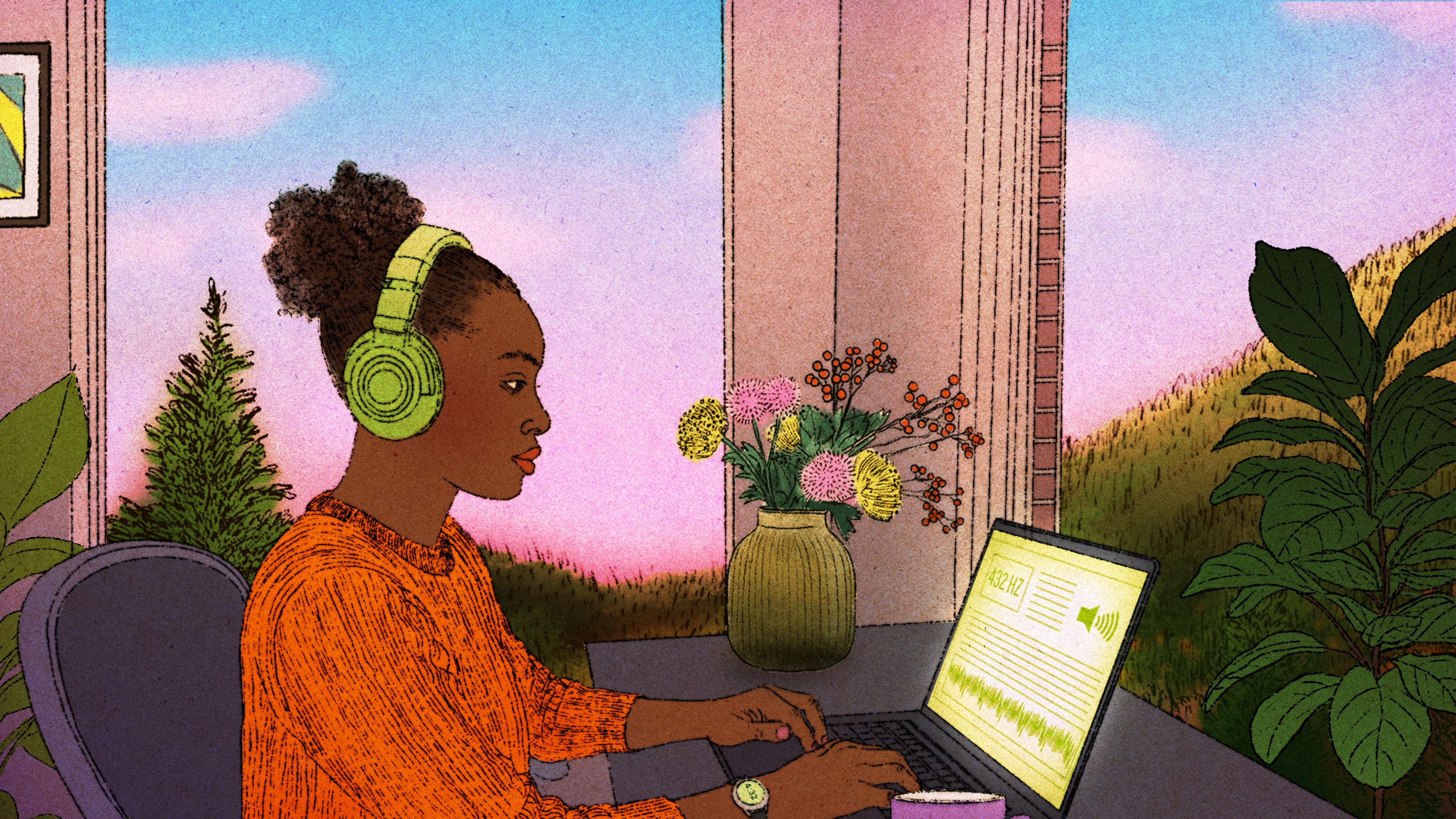
She practices yoga. She performs free flow dance. And while she works, she frequently listens to house music tuned to 432 hertz, a frequency lower than typical concert pitch.
“Music is medicine. Sound is medicine,” said Sanchez, who provides telehealth services for a healthcare management organization in California. “It helps me focus and be engaged with the patient I’m assisting, and it also helps me relax."
Music recorded in 432 hertz (cycles per second) is taking off on social media platforms and music streaming services, where users can find an increasing number of tracks and playlists employing the alternate tuning, everything from meditation soundscapes to reggae songs recorded by Ziggy Marley.
Many proponents assert that 432 hertz is aligned with nature. Others assign the frequency healing properties or the power to reduce blood pressure. So far, there's no robust scientific evidence to support those claims.
“There are frequencies going on right now that are higher than what we can hear and lower than what can hear. And they’re not special because they’re one of the billions and billions of frequencies that we’re receiving right now,” said Susan Rogers, a Berklee College of Music professor emeritus who worked as Prince's sound engineer during the 1980s. “To set one aside and say that it is the frequency of the universe is, as far as the science community is concerned, nonsense.”
To Sanchez, it doesn't matter if the pain relief and emotional benefits she ascribes to 432 hertz music have a scientific explanation.
“When it comes to music, it could activate different feelings in people, the vibrations of it. It’s not like a one-size-fits-all,” she said.
The story behind 440 and 432 hertz
Throughout history, as people sang or played music together, they tuned their instruments to the same pitch to create a harmonious sound. Singers and musicians often chose a musical note — typically the A above middle C on a piano — as a reference point.
The music genre known as “432 Hz” is characterized by its tuning, in which the A above middle C is pitch-adjusted to vibrate at 432 hertz instead of the standard 440 hertz. The lower frequency is noticeable to the naked ear, sounding like slightly lower notes. Some people feel the alteration produces a warmer, more harmonious sound that resonates with the human body and the natural world.
Many orchestras and musicians now tune their instruments to 440 hertz. But that wasn't always the case.
Until the 19th century, musicians tuned instruments according to local standards, which varied from one country to the next, said Fanny Gribenski, a music historian at New York University. “For most of music history, people are just singing within their own vocal range,” she added.
Eventually, there were orchestras and musical groups tuning to higher frequencies, and some composers became concerned that singers would be unable to perform music from the past, Gribenski said.
“The idea that it should be mainly a lower frequency than the ones that were in use at the time is really the cultural concern for protecting music from the past, protecting the voices of singers,” she said.
At the same time, as international travel became more widespread, the desire for a common tuning frequency grew. In 1939, representatives from multiple European countries and the U.S. agreed to accept 440 hertz as the international standard.
Artists continued to experiment with pitch over the decades that followed. In the 1980s and ’90s, sound engineers sometimes took a recorded song and sped it up or slowed it down to achieve a brighter or slower sound, moving away from the frequency of 440 hertz, Rogers said.
But Rogers doubts that retuning a whole band or orchestra to 432 hertz would improve its sound since many modern instruments were designed sound prettiest while tuned to 440 hertz.
“Some of those instruments might sound a little sweeter, but it’s likely that most won’t,” she said.
Higher pitch generally means more brilliance, or perhaps a little more power in some instruments, Gribenski said. For those listeners who appreciate the lower 432 hertz music, “I wonder if there is a sense of deceleration, slowing down slightly, and also taking one step down from the bright sounds of modernity,” she said.
Working and 432 hertz music
Fans of working while accompanied by a 432 hertz soundtrack cite a variety of reasons.
Amelia Beamer, who handles marketing at the North Carolina pharmacy her parents own, Andrews Apothecary, says she thinks taking work breaks to listen to music tuned to 432 hertz helps with her attention deficit hyperactivity disorder. She's noticed that she feels more focused if she listens before she starts a project.
Beamer works for 25 minutes, takes a five-minute listening break and then returns to the task at hand. She also listens to other frequencies, such as music tuned to 528 hertz.
“It definitely helps me feel more grounded and more centered,” Beamer said of 432 hertz music. “It helps me slow down and to take some intentional space and time for myself.”
Diana Wolf Torres, who creates videos and writes a newsletter about robots, frequently gets migraines and is sensitive to noises. If a gardener is using a leaf blower next door, she has difficulty ignoring it. Listening to music tuned to 432 hertz or other sounds such as white noise while wearing noise-canceling headphones helps.
“I just want to be there and get it done and feel like I’m doing my best writing possible, and anything that keeps me in the zone is a fantastic tool,” Torres said.
Torres doesn't think there's any science or special properties behind 432 hertz music but that “maybe some people find this lower tuning more soothing.” She noted that most listeners won't know if music labeled 432 hertz on social media is labeled accurately.
“What does it matter? If you're getting an effect, are you really going to check the resonance? Do you care?” Torres asked.
Sanchez, the telehealth worker, also enjoys listening to tunes fixed to other alternative frequencies, such as 528 hertz and 963 hertz.
“It’s something worth exploring and finding out for yourself whether it has any benefits or not,” Sanchez said. “For me, I find that grounding is beneficial to my overall wellbeing, so I see how it helps my livelihood."
___
Share your stories and questions about workplace wellness at cbussewitz@ap.org. Follow AP’s Be Well coverage, focusing on wellness, fitness, diet and mental health at https://apnews.com/hub/be-well
More Stories
The Latest