Trump weighs Taiwan arms package after summit aimed at steadying US-China ties
BEIJING (AP) — U.S. President Donald Trump said Friday that he has not made a decision on whether to move forward with a major arms package for Taiwan after hearing concerns about it from Chinese President Xi Jinping.
Trump's comments on Taiwan — a self-ruled island that China claims as its own territory — came as he flew back to Washington after wrapping up critical talks in which both leaders said important progress was made in stabilizing U.S.-China relations even as deep differences persist between the world’s two biggest powers on Iran and Taiwan.
“I’ll be making decisions," Trump said. "But, you know, I think the last thing we need right now is a war that’s 9,500 miles away.”
Trump’s Republican administration in December authorized a record-setting $11 billion weapons package for Taipei, but it has yet to move forward. Lawmakers also approved a $14 billion arms sale to Taiwan in January, but the sale cannot advance until Trump formally sends it to Congress. China opposes such sales and has suggested that Washington’s relationship with the self-governing island is the key factor in U.S.-China relations.
Trump said Xi also reiterated China's strong opposition to Taiwan’s independence. “I heard him out,” Trump said. “I didn’t make a comment.”
Trump's consultation with Xi about arms sales to Taiwan may violate the so-called Six Assurances, a set of nonbinding U.S. policy principles formulated in 1982 under President Ronald Reagan that have helped guide the U.S. relationship with Taipei, according to analysts.
The second of the Six Assurances states that the U.S. “did not agree to consult with the People’s Republic of China on arms sales to Taiwan.”
Trump said the issue of the 1982 assurances came up in the talks with Xi.
Trump says Xi is ‘very positive’ about a potential nuclear deal
Trump also said he raised a potential three-way nuclear deal that would involve the U.S., Russia and China. He wants each of the three countries to sign a pact that would cap the number of nuclear warheads in their arsenals. China has previously been cool to entering such a pact.
Beijing’s arsenal, according to Pentagon estimates, exceeds 600 warheads and is far from parity with the U.S. and Russia, which are each estimated to have more than 5,000 warheads. But Trump suggested Xi was receptive to the idea.
“I got a very a positive response,” Trump said. “This is the beginning.”
The last nuclear arms pact, known as the New START treaty, between Russia and the United States expired in February, removing any caps on the two largest atomic arsenals for the first time in more than a half-century. As the treaty was set to expire, Trump rejected a call by Russia to extend the two-country deal for another year and called for “a new, improved and modernized” deal that includes China.
The Pentagon estimates China will have more than 1,000 nuclear warheads by 2030.
Trump was impressed by Chinese presidential residence
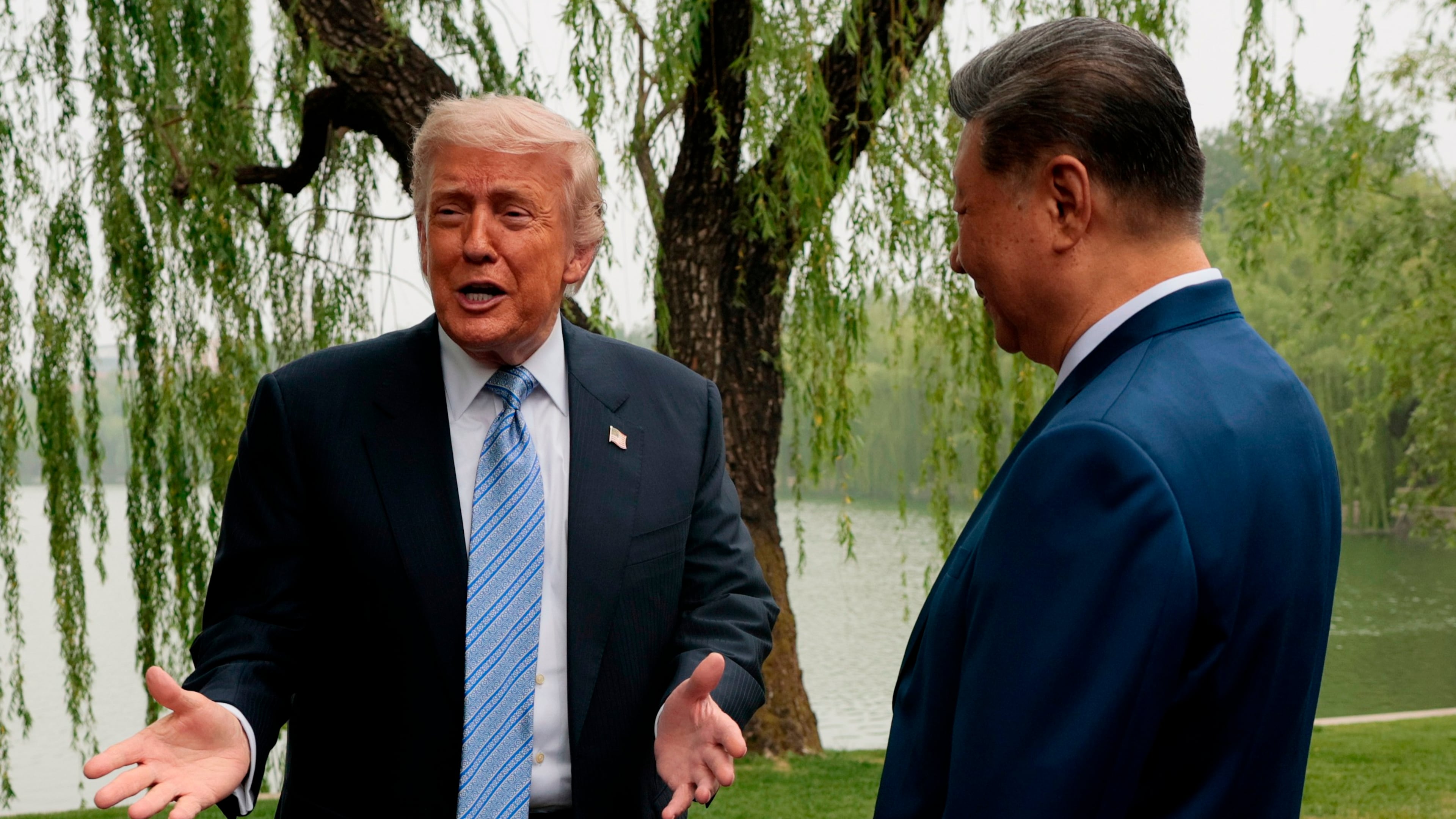
Xi welcomed Trump at his official residence, Zhongnanhai, on Friday for their final engagement of the summit before the U.S. leader’s return to Washington. The leaders took a short walk through the grounds that feature ancient trees and Chinese roses, and they strolled through a covered passageway with green columns and archways painted with birds and traditional Chinese mountain scenes.
Over tea and lunch, Trump and Xi — with top aides and translators in tow — huddled for nearly three hours of talks before the U.S. leader completed his three-day visit to China.
Trump appeared impressed by the bucolic grounds, remarking that the roses were the most beautiful he had ever seen. Xi promised to send him some rose seeds.
“It’s been really a great couple of days,” Trump told reporters.
Xi, for his part, called it a “milestone” visit. “We have established a new bilateral relationship, or rather a constructive, strategic, stable relationship,” he said.
But the optimistic outlook collides with some difficult truths about the thorniest issues between the two superpowers.
Beijing has shown little public interest in U.S. entreaties to get more involved in solving the conflict in Iran, even though Trump said in an interview with Fox News' Sean Hannity that Xi had in their conversations offered to help.
In recent weeks, the U.S. State Department has accused Chinese firms of providing satellite imagery to the Iranian government, and the Treasury Department has moved to target Chinese oil refineries accused of buying oil from Tehran, as well as shippers of the oil.
Xi on Thursday warned Trump during private talks that their differences on Taiwan, if handled poorly, could hurtle the world's dominant powers toward “clashes and even conflicts,” according to Chinese government officials.
But Trump, as he made his way home, said he was not concerned that the U.S.-China relationship was in danger. “I think we will be fine," he said.
Taiwan remains the most important issue for China
Xi's sharp language on Taiwan loomed large over the visit, with Chinese government officials amplifying his view that differences on the island pose the biggest risk to U.S.-Chinese relations.
But Secretary of State Marco Rubio told NBC News that U.S. policy toward Taiwan was “unchanged” and cautioned that it would be “a terrible mistake” for China to try to take Taiwan by force. He also framed Xi's comments as standard practice.
“They always raise it on their side. We always make clear our position, and we move on to the other topics,” said Rubio, who was among senior aides to join Trump for the talks.
Some Republicans in Congress expressed displeasure at Trump's pronouncement that he has not decided whether to move forward with the arms package for Taiwan.
“We have to support Taiwan, just like we have to support Ukraine,” said Rep. Brian Fitzpatrick, a Pennsylvania Republican. “These are the fortresses of democracy, and they’re on the front lines, and we have to protect and defend them.”
Republican Rep. Michael McCaul said he was not surprised that Xi came out with an aggressive posture on Taiwan.
“We’ve got to arm Taiwan so they can defend themselves for deterrence,” McCaul said.
China wants the Strait of Hormuz opened
Trump said he and Xi also spoke at length about Iran.
The leaders agreed that the critical Strait of Hormuz — effectively closed since the start of the Iran conflict — needs to be reopened to support global energy demands. About 20% of the world’s oil flowed through the strait before the war started on Feb. 28.
“We feel very similar about (how) we want it to end,” the president said. “We don’t want them to have a nuclear weapon.”
White House officials said Xi was also opposed to any implementation of tolls on vessels crossing the strait and expressed interest in China potentially purchasing U.S. oil to reduce Chinese dependence on Gulf oil in the future.
Trump earlier this week downplayed the importance of talks with Xi on the 11-week-old Iran war that has led to surging energy prices and threatens to plunge the global economy into recession if the conflict does not conclude soon.
___
Mistreanu reported from Bangkok. Associated Press writers Huizhong Wu in Bangkok and Darlene Superville, Stephen Groves and Josh Boak in Washington contributed to this report.