It may not be ‘sexy,’ but Roger Holmes stands by his cultivation of the Wing-T
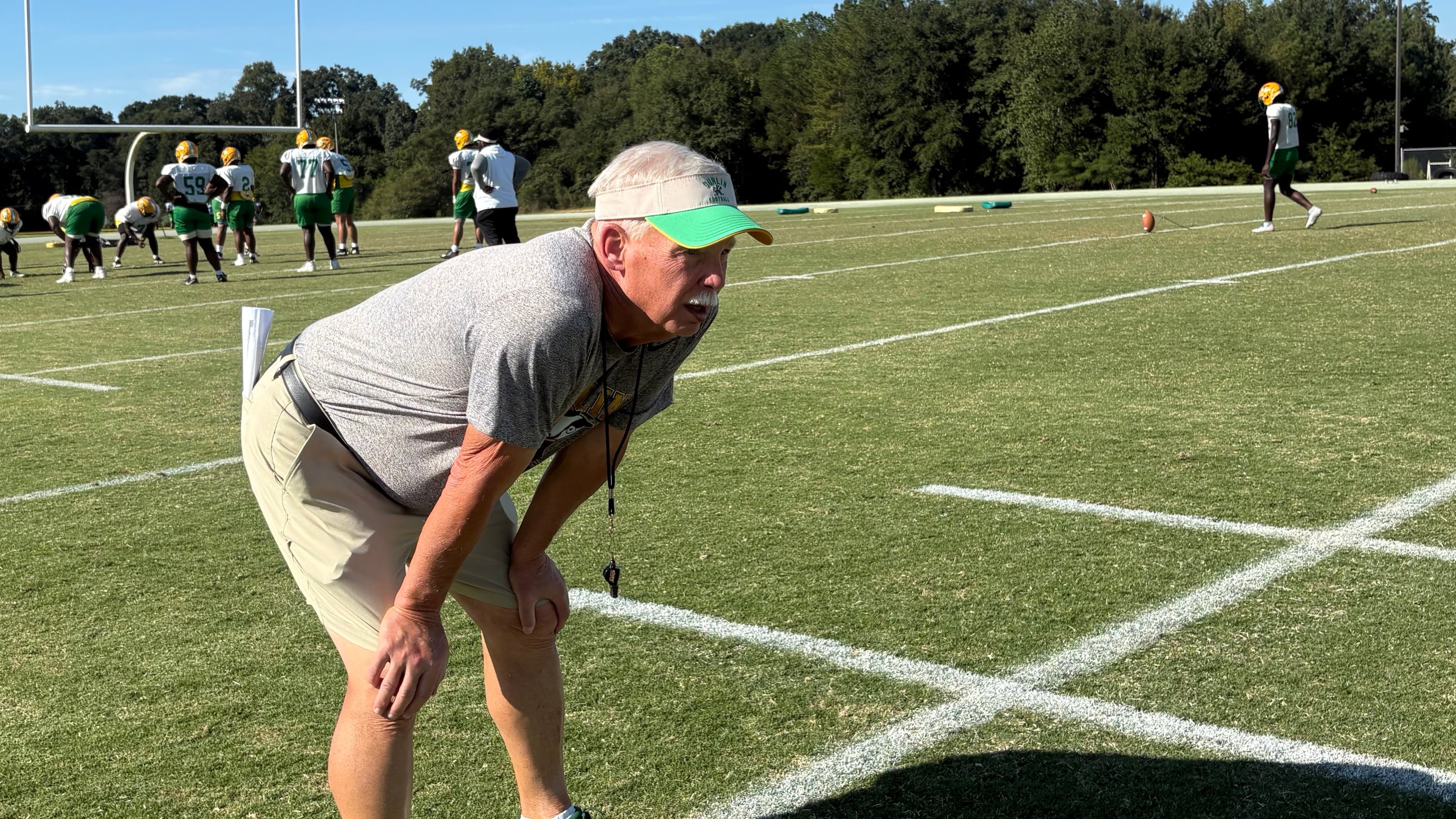

DUBLIN — Football practice at Dublin sounds, looks and feels different.

There’s no music. Hustle is emphasized, but coaches rarely scream as players move from drill to drill.
There’s an urgency, but the meticulous tone appears calmer than the average high school football practice.
Being different has never bothered Dublin coach Roger Holmes.
“You’re not going to see a lot of rah-rah,” Holmes said. “You’re going to see small groups of guys being instructed and being coached on what to do.”
Holmes has led Dublin to 220 wins, 10 region titles and two state championships since he took over in 2002. And he’s won every game with a scheme that many consider a relic of high school football: the Wing-T offense.
The run-heavy attack — recognized by its three running backs in a “T” formation surrounding a quarterback under center — was a common scheme from its popularization in the 1960s until the late 20th century. Many high schools have since established offenses that throw the ball more, but not Holmes.
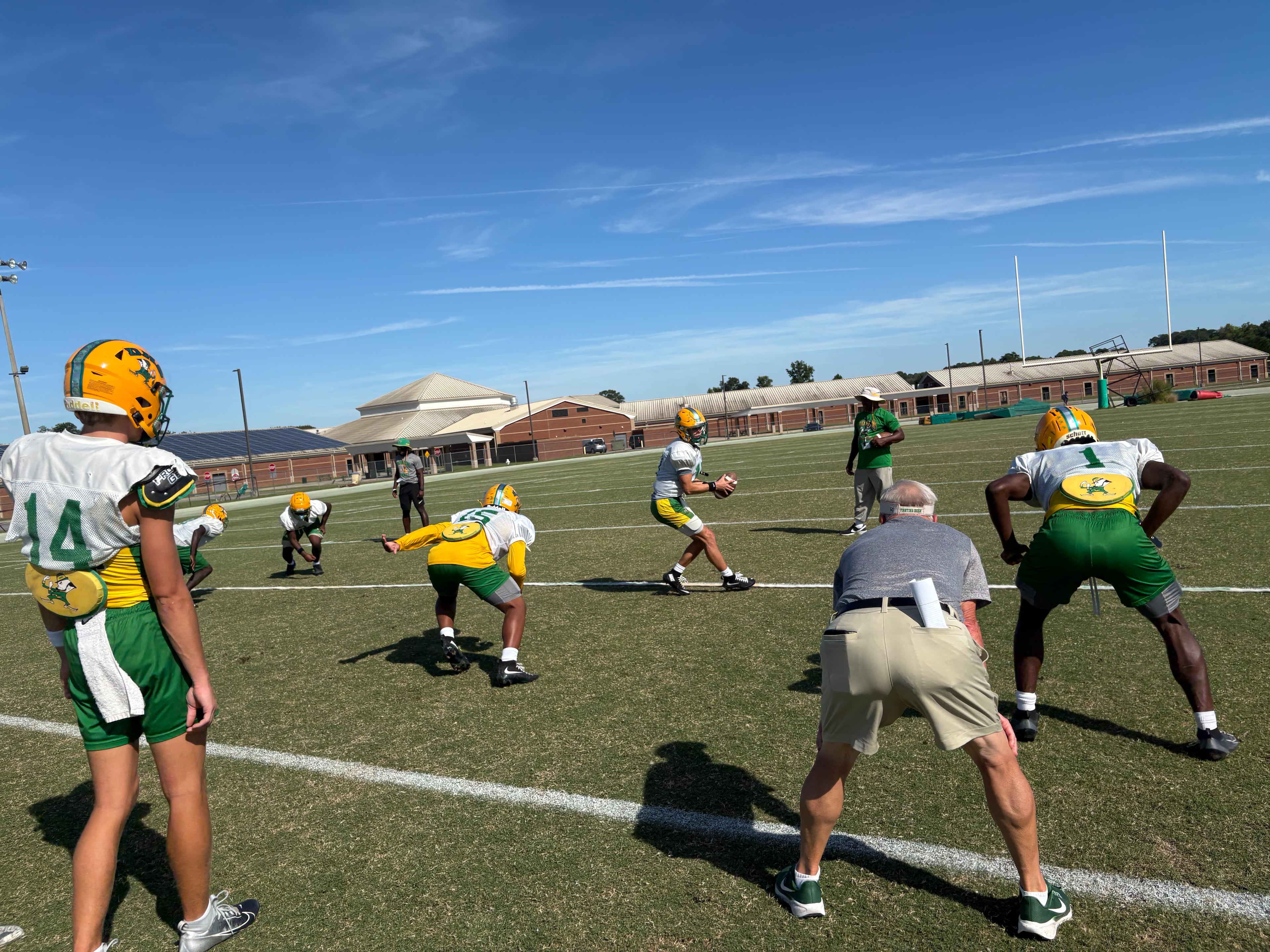
Widely viewed as one of Georgia’s best Wing-T coaches, Holmes has preserved the same general scheme through 25 years at Dublin. It broke the GHSA single-season scoring record in 2006 with 682 points and helped Dublin win a state title as recently as 2019 when it beat Brooks County 42-32 without attempting a pass.
It’s working again this season — the Fighting Irish are 5-1, undefeated in region play and ranked No. 5 in Class 2A.
The heavy dosage of run plays can make Holmes’ offense appear simple to the average observer, but he disagrees. The complexities are found in details and split-second decisions.
Holmes has never abandoned the Wing-T at Dublin, but the coach says he’s constantly adapting. Every offense looks slightly different depending on the abilities of its personnel.
“I don’t think you can win a state championship in Georgia with ... the basic Wing-T offense and score enough points to win,” Holmes said. “To us, you either have to be able to run the option or throw the football.
“Now, when you have a quarterback that is capable of doing both, that’s the years that we’ve set the state scoring records in Georgia.”
Holmes has completely instilled Wing-T culture into Dublin football, down to its roots. Dublin players start learning the offense in middle school, creating a mindset of toughness and enjoyment in running the football.
Senior center and defensive lineman Mandarian Stanley grew up in the system. Many youth football players want to be the kid scoring touchdowns, but Stanley said he always enjoyed the Wing-T’s physicality.
“That’s the whole point of football is hitting somebody,” Stanley said. “It’s a man’s game. You don’t want to just be out there getting thrown around. It’s only fun when you’re doing the hitting.”
When executed at its best, the Wing-T has proved to be virtually unstoppable under Holmes.
It’s not just Dublin, Holmes pointed out — some of Georgia’s greatest offenses over the last 20 years have been built around the Wing-T. Holmes named Camden County under former coach Jeff Herron and Lowndes under former coach Randy McPherson.
“There is something to be said about the fact that it’s never gone away totally,” Holmes said. “If it weren’t successful, nobody would do it.”
So why don’t more teams run it these days?
“It’s just not sexy,” Holmes said. “But to me, I guess the reality of it is, I thought that as a coach, your job is to win games for the place that employs you. It is an offense that you have to coach, and you have to have quality coaches to run it.”
Indeed, the scheme isn’t as flashy as today’s more-popular spread offense, which attempts to create explosive plays in the passing game.
Some believe high school players are less likely to earn college football scholarships in the Wing-T offense because very few college teams run the system. Holmes has a response for that, too.
“How many people are running the spread, and how many quarterbacks are signing?” Holmes said. “At the end of the day, if you don’t have the height, the speed, the arm strength, if you don’t have all of that, you’re not getting recruited anyway. It doesn’t matter what offense you’re in.”
Holmes said high school coaches will also try to use his scheme against him with his players.
“Coaches will tell kids that if you want a chance to play in college, you need to be in our offense,” Holmes said. “They use it for recruiting. They’re talking to a young kid, ‘Hey, you need to come jump into this offense. If you want a chance to play at the next level, you need to be running the spread.’”
Holmes acknowledges that the Wing-T prepares some positions for college football better than others. For instance, his offensive linemen start behind the curve in pass protection but are ahead as run blockers.
Of course, that’s true for the spread offense, too.
“If I’m recruiting a running back, I’d be wanting him from a Wing-T offense,” Holmes said. “You know why? Because he’s got to be able to block, he’s got to be able to run, and he’s got to be able to catch the ball. To be successful at the next level, you need all of those skills.”
Holmes has had three quarterbacks sign college football scholarship offers. One played at Navy, which ran the Wing-T. Another played wide receiver and defensive back for North Carolina State.
Holmes said 154 Dublin players have gone on to play college football since he started in 2002. That’s an average of over six players per season.
“The running joke was as long as I’m here, we are not going to be a shotgun team, and if people want somebody to run the shotgun, they need to hire somebody else,” Holmes said. “This is what we do, and our kids know that.”
Holmes’ journey with the Wing-T started 26 years before he took over at Dublin. He was a quarterback at Westmoreland High School in Tennessee when the school implemented the Wing-T after a 1-3 start to the season.
Holmes and the Eagles won 18 straight games after that.
Holmes returned to coach his alma mater for two seasons after college before taking an offensive coordinator job at nearby Beech, led by Herschel Moore, a mentee of Wing-T architect Tubby Raymond.
“I had the No. 1 access to information in this Wing-T system on a daily basis for seven years, and that’s kind of where it got going,” Holmes said.
Moore left Beech to coach Cumberland University in 1991, and Holmes took over. He added his own ideas to the same system and led Beech to its first state semifinal appearance in program history.
“I kept 90% of what (Moore) was doing, and I added 10 or 15% of the stuff I wanted to do,” Holmes said. “We incorporated the inside veer and the midline option into our offense. We had to continue to tweak what we do because defenses are different now than they were 20 years ago.”
Holmes started looking into jobs in Georgia shortly after the semifinal run in 1995. He interviewed for 14 jobs over five years before Dublin took him on.
And he wasn’t exactly the school’s first choice.
The Fighting Irish had struggled through the first two years of the 21st century. Dublin had not won a playoff game in eight years when it hired Kevin Sullivan, a coach from Florida, in 2002.
“They go to spring practice that year, and the word is from some of the guys that were on my staff that next year, they had 11 kids show up for practice that day,” Holmes said. “And (Sullivan) went in, dropped his keys on the desk and told the assistants, he said, ‘Tell the principal in the morning that I’m going back to Florida.’”
Holmes had never heard of Dublin before he sent the school his resume. Desperately needing a head coach before the season started, Dublin invited Holmes and one other coach back for a second interview.
The other candidate never showed up.
“So at the end of the day, they were hung,” Holmes said. “They had to hire me.”
Results were immediate. Dublin went 14-1, losing in the state final to Screven County in Holmes’ first season.
Dublin became home to the Tennessee native right then. Holmes has been interested by other jobs over the last 25 years, but none would have allowed him to run his offense.
Dublin parents and boosters still push back on the Wing-T sometimes, but Holmes appreciates the place that allows him to coach the way he wants.
“The people in Dublin are passionate about Dublin football,” Holmes said. “Do they agree with everything that I do? No, but I think they do respect how we run the program and how we deal with our young men.”
Senior running back and cornerback Travion Bostic knows Holmes’ loyalty and consistency is rare. Bostic remembers watching his older brother play for Holmes as a child and dreaming about the day he could do the same.
“It’s really a blessing just to have a loyal coach like that that’s willing to stay and rebuild, no matter what,” Bostic said. “No matter what team he’s got, he’s just going to rebuild. That’s what he does.”