
Tragedy and triumph: Falcons’ Xavier Watts has learned from father’s journey
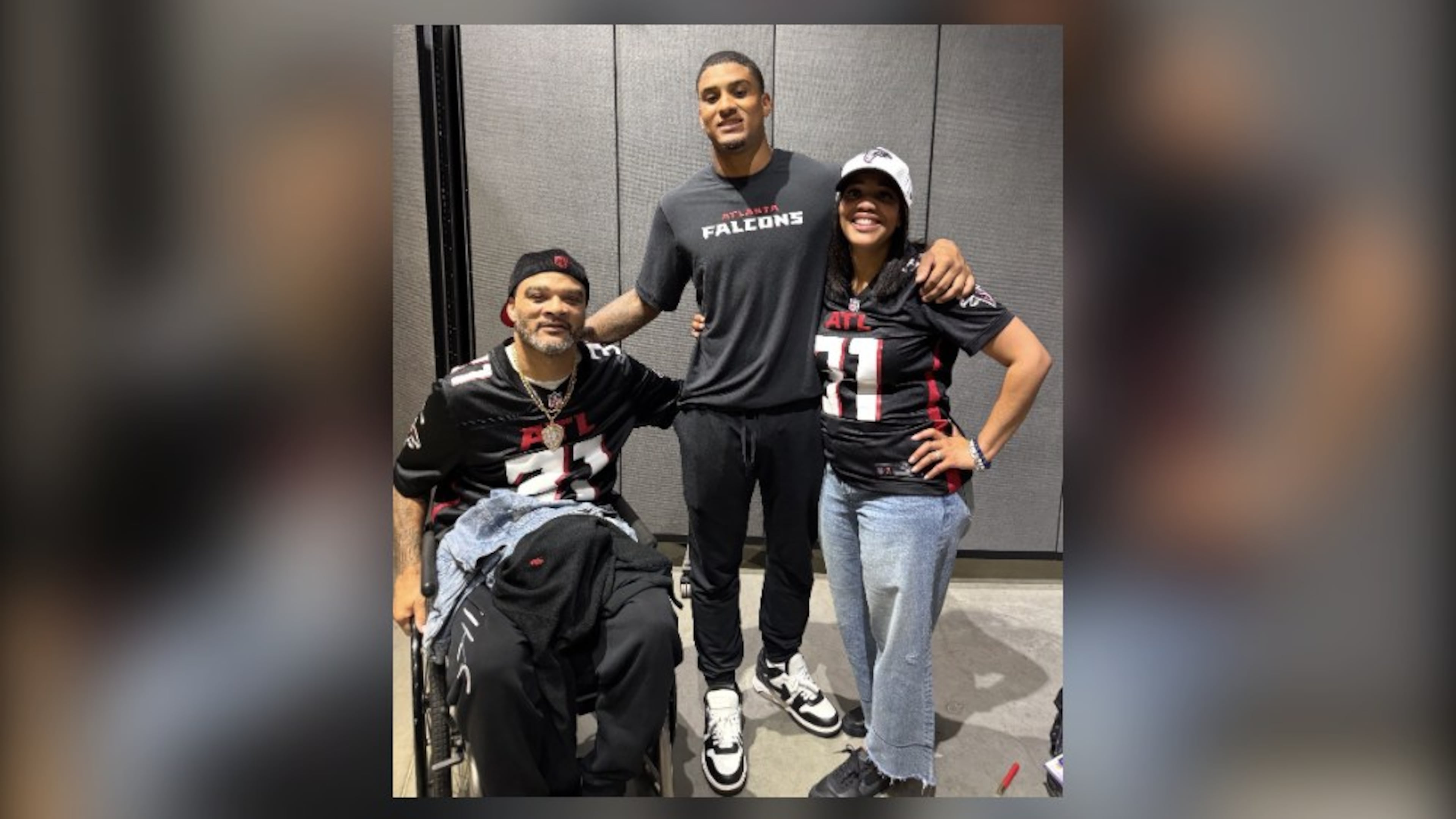
He was 21 years old, just trying to spend a Thursday night with his friends in downtown Minneapolis, when his life changed forever.
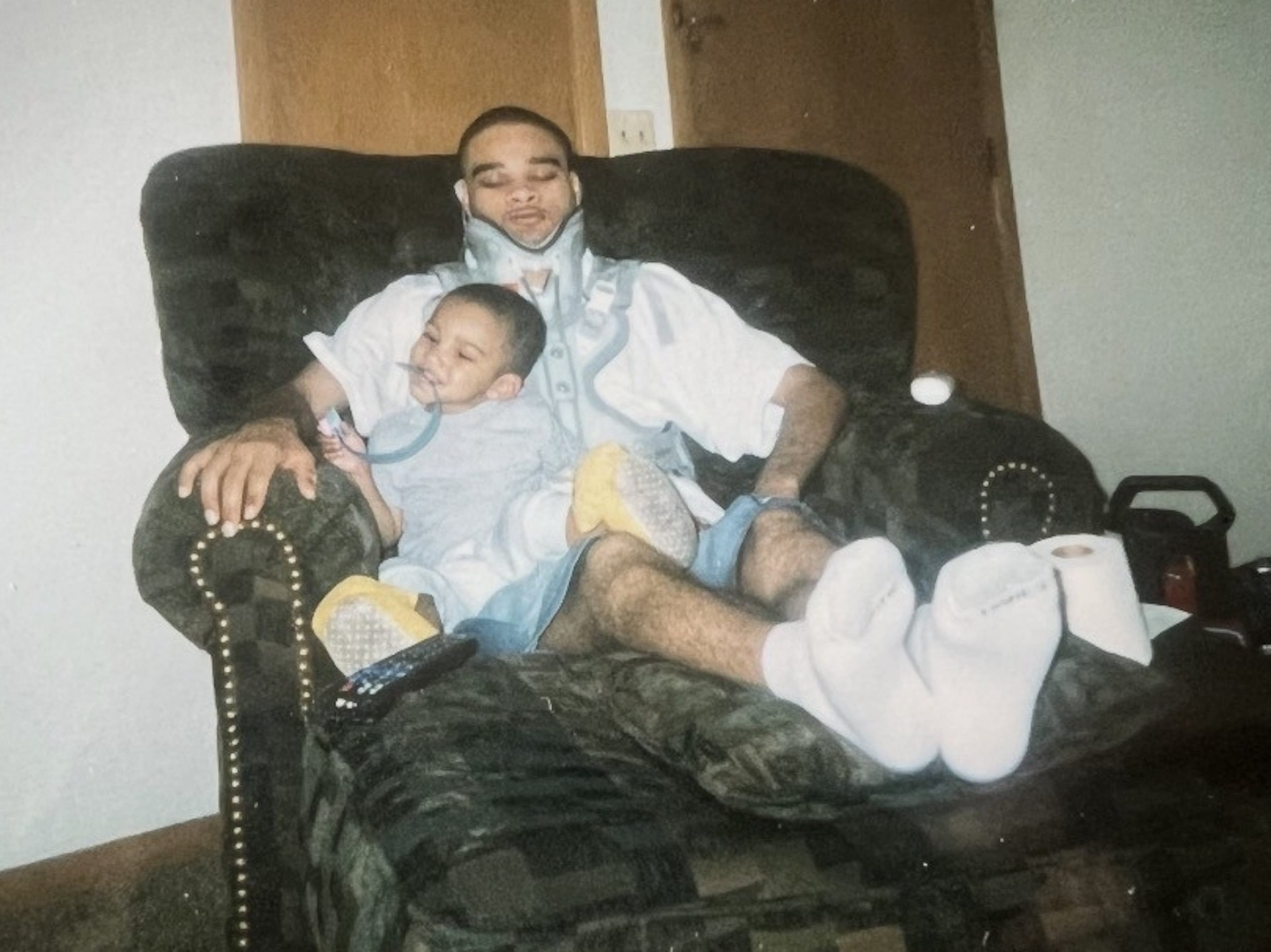
Jeff Watts looked back and realized he had no business being there. A few hours earlier, he was at home, resting in bed with his 1½-year-old son, Xavier. But suddenly, there he was, a bystander as his friends ran into another group where preexisting tension lingered.
Words were exchanged. Soon, too, gunshots.
One stray bullet hit Jeff’s spine. He fell. He was rushed to the hospital. He called his then-girlfriend (now-wife), Fallon, and told her to bring Xavier. Jeff wasn’t sure where the bullet hit him or what his outcome would be.
He just knew it wasn’t good.
On June 5, 2003, Jeff Watts became paralyzed from the waist down. He spent the next three months in the hospital, then another year and a half in a rehab center.
Not a day passed without a visit from Fallon and Xavier. They’d bring food and hang out. Nearly a month after the shooting, Jeff’s mindset shifted from focusing solely on walking again to taking care of Fallon and being present for Xavier.
When Jeff was allowed to leave medical care, the family moved from Minneapolis to Omaha, Nebraska. He was done messing with trouble — as much for his own well-being as Xavier’s.
“The biggest thing on my mind was, ‘I want to make sure I’m there to raise Xavier,’” Jeff told The Atlanta Journal-Constitution.
And boy, was he.
Jeff spent his second Father’s Day in a hospital and his third in a rehab center. He’ll spend his 24th at home, a staple within Omaha’s high school athletic community and the doting father of one of the Falcons’ starting safeties.
Here’s a story about a man whose worst night — and worst decision — changed his life but also served as a springboard for his son to reach unthinkable heights.
Xavier Watts didn’t fully understand what happened to his father until the end of middle school, preparing for high school, when Jeff started sharing life lessons. The two held mature conversations when Xavier was still young, in large part because he grew up faster than his peers.
Jeff’s situation forced Xavier to step up. He was an only child, so he had little choice. He’d carry groceries. He’d pick up the many random things Jeff dropped. He’d bring supplies from the basement to the living room.
Jeff still remembers days where he’d wake up at 7 a.m. and realize he needed medical supplies downstairs. He couldn’t get them himself, so he woke up Xavier, “ruined his sleep” and asked if he’d retrieve them.
“He never showed he was upset about it, or like I’m getting on his nerves,” Jeff said. “It was more so just like, ‘Oh, I know you can’t do this, and I’m going to make sure I can do it for you real quick.’”
Xavier learned right from wrong at a young age. Jeff didn’t want his son repeating the same mistakes he made, so he and Fallon raised Xavier in a way where following the right path became the only option.
“I definitely moved a lot smarter,” Xavier told the AJC. “I wasn’t trying to do dumb things that would put me in harm’s way or get me in trouble or do something that I know my parents wouldn’t want me doing.
“Because I know he made that mistake, so I didn’t want to kind of do the same thing.”
Xavier’s biggest lessons from his father came from watching him firsthand.
Jeff taught Xavier how to work, how to keep his head down and take care of the little things. If there was a negative moment, Xavier didn’t pout — how could he? He grew up watching his dad burn the midnight oil just to be present.
Showers can be a “couple-hour process,” Jeff said. Before he’s ready to leave the house, he leaves his bed, gets into his regular wheelchair, scoots to the bathroom, changes into his shower wheelchair, does his bathroom routine, spends 10 to 20 minutes showering, transfers from the shower chair to the regular chair, dries off, gets back in bed and puts on his clothes.
Follow all that?
Jeff would then get in his 2006 Dodge Caravan, work an eight-hour shift, hit the gym and, at last, come home. But often, nights didn’t end there. Jeff would either play a video game with Xavier or do a workout with him. Xavier played soccer and baseball for brief time periods, but basketball and football captivated him.
So, Jeff would get in that Dodge Caravan and drive Xavier to practices, AAU basketball tournaments and, eventually, college visits. If Jeff wasn’t rebounding, setting up drills and serving as a dummy defender for Xavier on the hardwood, he’d be playing catch in the front yard.
Subconsciously, Jeff’s work ethic and ability to function from a wheelchair instilled valuable lessons about attitude and drive within Xavier.
“I know some days, he’s probably really frustrated with certain things, but from what I’ve seen, he never let it hinder him or bring him down,” Xavier said. “So it just showed me there’s nothing for me to really complain about.”
Xavier, using what his father showed him about hard work, never looked for excuses. He’d find ways to deal with his problems constructively. Accountability in the Watts household never waned, because fate held Jeff accountable for his decision that night for the rest of his life.
“He was the type of father that wanted his son to earn things,” Paul Limongi, Xavier’s high school football coach, told the AJC. “He was there to be supportive, but he was also a guy that believed in tough love and wanted Xavier to work for everything he got and didn’t want anybody to give him anything.
“And that’s, I think, a big reason why Xavier is who he is today.”
Following dad’s master plan
When Limongi holds his annual parent meeting before the start of the football season at Burke High School in Omaha, the first topic of conversation always starts with culture.
Parents directly contribute to it. Having buy-in from family members is as important as getting it from players. Parents can fuel fire, with routine questions about how coaches are helping their sons, why he isn’t receiving college offers or why he isn’t getting more touches.
Jeff Watts is rare. Incredibly rare, even.
Limongi offered Jeff a spot on his coaching staff, not because he made such a compelling argument about playing time or offensive involvement or recruiting assistance, but because he did the exact opposite.
They’d talk about basketball, about life, about anything but football.
“That was never a conversation,” Limongi said. “Not once. All our conversations and visits have been about other things.”
Jeff, naturally, loved the culture aspect. He appreciated Limongi’s focus on development, teaching kids to be men and understanding that football is a tool to be successful.
And much of what Limongi told Xavier at practice mirrored what Jeff told him throughout his life.
“I think that’s why Xavier is just the perfect student-athlete to coach,” Limongi said. “Because he was getting it at home and he was getting it at football. So, it was like a perfect marriage. I wish it was always like that.”
Jeff declined the position because he worried the team would have to devote too much time to him getting around the facility. He didn’t want to be a burden. Xavier thinks his dad would’ve been a good coach — he was quite the athlete in his day, be it football, basketball or track.
And Jeff already has one proven star within his development tree: Xavier.
Natural talent and athletic genes are key reasons why Xavier played college football. Jeff and Fallon’s parenting is why he went to a prestigious school, Notre Dame, and why his habits were strong enough to start all 17 games for the Falcons and finish fourth in NFL Defensive Rookie of the Year voting last season.
Throughout his athletic upbringing, Xavier was always the best player on his team. Highlights of Xavier scoring three or four touchdowns in peewee football are still in the family’s archives. Eventually, Jeff asked his only son how serious he wanted to be with sports. Xavier decided he wanted to be a professional.
So, Jeff made him work like a pro. In junior high, Xavier played for his school’s team and in a select league. He’d practice at both, sometimes on the same day. He occasionally complained to his father about being tired, but he’d go anyway. When Jeff told him to eat more protein and bulk up, Xavier listened.
Xavier trusted his father’s guidance — and master plan — at each step, in large part, because of Jeff’s paralysis. Together, they’ve watched the blueprint blossom.
“I know he wouldn’t steer me wrong,” Xavier said, “because he did some wrong. So, I knew in the back of my head, whatever he’s telling me to do, whatever he wants me to do, is probably for the best. And that’s why I just stuck to the plan and followed along.
“When I look back at it, he really did help me set up for the future.”
‘As good of a father-son relationship as you can have’
Jeff Watts is an oldest son, one who entered the world when his father was 17 and freshly removed from dropping out of high school. His father, Jeff Sr., and grandfather, John, ran Watts Trucking and Central Waste, a garbage company in Omaha.
Jeff Jr. grew up watching his dad juggle four kids and a job in his mid-20s. It taught him a lesson in work ethic, but also decisions. He’s passed both down to Xavier.
Whenever Xavier, 24, makes a big life decision, he calls his father. Buying an Audi RS Q8? Definitely. Getting a Doberman? Sure thing. Purchasing his first house? Absolutely. Any financial decision, or even if he’s going to try a new food, comes with a call and a question: What do you think?
“I know he’s going to want the best for me,” Xavier said, “and he’s just a person I trust.”
Xavier talks to his parents every day. He doesn’t always listen to their advice on his expenditures, but if nothing else, he values their opinion because of the strength of their relationship.
Jeff and Xavier talk anywhere from once or twice to five or six times a day. They send each other TikTok posts or Instagram reels, mostly funny videos or things about cars, food and sports. They trade music recommendations and songs from their own generation.
There’s nearly 1,000 miles sitting between Atlanta and Omaha, but distance can’t separate Xavier from the father who never let him slip from the road to glory.
“I think it’s as good of a father-son relationship as you can have,” Limongi said.
Jeff was always present, always visible, in Xavier’s life, but never overbearing. He rewarded good behavior and never mistook Xavier’s personal value with his athletic achievements. Xavier grew up around stable, unconditional love, Limongi said, and it generated positive reinforcement that directly aided his growth.
The secret? Jeff didn’t let the wheelchair slow him down.
“You wouldn’t know he’s in a wheelchair,” Limongi said, “because he does everything.”
Jeff still has bad days. He still has moments where he thinks to himself, ‘Dang, I wish I could walk.’ But he refuses to sit in his house and pout, dwelling over a bad decision 23 years ago. He’s spent the rest of his adult life trying to make up for it.
“No matter what you’re doing in life, once you have a kid, your whole life is supposed to change for the betterment of your child,” Jeff said. “They didn’t ask to be here. And even though you didn’t ask to be here, you happen to be here.
“So now it’s like, ‘OK, you need to make your kid’s life better because you brought a kid into this world. All the decisions you’re making need to be based around your child.’”
That’s why the family moved from Minneapolis to Omaha and why Jeff told a young Xavier he’d get “pretty much whatever you ask for” so long as he locked in on school work and practice. It’s also why he pushed Xavier to do extra practices and never complained about driving him to them.
And perhaps most important, Jeff’s selflessness is why Xavier views him as a great father — and a significant reason the Falcons have one of the league’s brightest young safeties.
“Everything I can remember from him teaching me and giving me these types of lessons as a young kid definitely helped me mold into the man and athlete I am today,” Xavier said. “So, he definitely got me to where I am.”
Jeff Watts is an example, not only for fathers but everyone else on this planet, that our lowest and darkest moments don’t define our lives. What matters, truly, is the response.
One bullet — one bad decision — robbed Jeff of the ability to walk, but it didn’t snatch the joys of fatherhood or his chance to raise a son. And that, by all means, is all Jeff Watts desired when he found himself in that hospital bed on June 5, 2003.
“I wasn’t going to let the wheelchair or anything stop me,” Jeff said, “from making sure Xavier was straight.”