Why Democrats are pressing Republicans to talk about abortion


Democrats in competitive races are working to remind voters of Georgia’s restrictive abortion laws, while Republicans are largely sidestepping the issue that they have historically used to energize their base.
It’s a change in tone from past election cycles, where GOP candidates running for higher office promised to crack down on abortions, then later touted the state’s 2019 abortion law, also known as the “heartbeat bill.”
The Republicans’ toned-down rhetoric on an issue important to their base may be indicative of the state’s narrowing margins in high-stakes statewide races.
With the exception of Democratic U.S. Sen. Jon Ossoff — who is eight points ahead of his Republican opponent U.S. Rep. Mike Collins in The Atlanta Journal-Constitution’s latest polling — candidates from both parties are in neck-and-neck races in key races and eying wins that have the potential to shift the balance of power under the Gold Dome.
Former Atlanta Mayor Keisha Lance Bottoms, the Democratic candidate for Georgia governor, used her one question during the recent debate to press Republican opponent Rick Jackson on abortion, choosing the issue over other potential targets. Jackson — who declined to participate — wasn’t there to defend his stance.

Georgia’s law bans abortions after fetal cardiac activity is detected — around six weeks of pregnancy. Critics argue that’s often before a person knows they’re pregnant.
The law garnered national attention and faced increased scrutiny following the deaths of two Georgia women, Amber Nicole Thurman, 28, and Candi Miller, 41, who died from complications related to attempted abortions.
“There’s almost no more dangerous place to be a woman seeking abortion than in Georgia because of that bill,” said Sarah Standiford, executive director of Planned Parenthood Votes.
Ahead of the midterm elections, the organization launched a sweeping voter outreach campaign across battleground states, including the Peach State. The group says it’s on track to spend $1 million in Georgia this cycle to keep abortion rights front of mind for voters.
That includes money spent on a targeted ad campaign with a focus on state legislative districts where the Republican incumbents played a role in passing the state’s law or voiced support for restrictions. All four are fending off Democratic attempts to flip their seats.
“Abortion has always been and will be a deal breaker for voters,” Standiford said.
But Republicans argue otherwise and point to previous unsuccessful attempts by Democrats to focus on the issue, like Stacey Abrams’ bids for governor in 2018 and 2022 and the recent Georgia Supreme Court races.
“This is an issue that Georgia Democrats have spent hundreds of millions of dollars with very little politically to show for it,” said Stephen Lawson, a veteran Republican strategist.
Abortion in top races
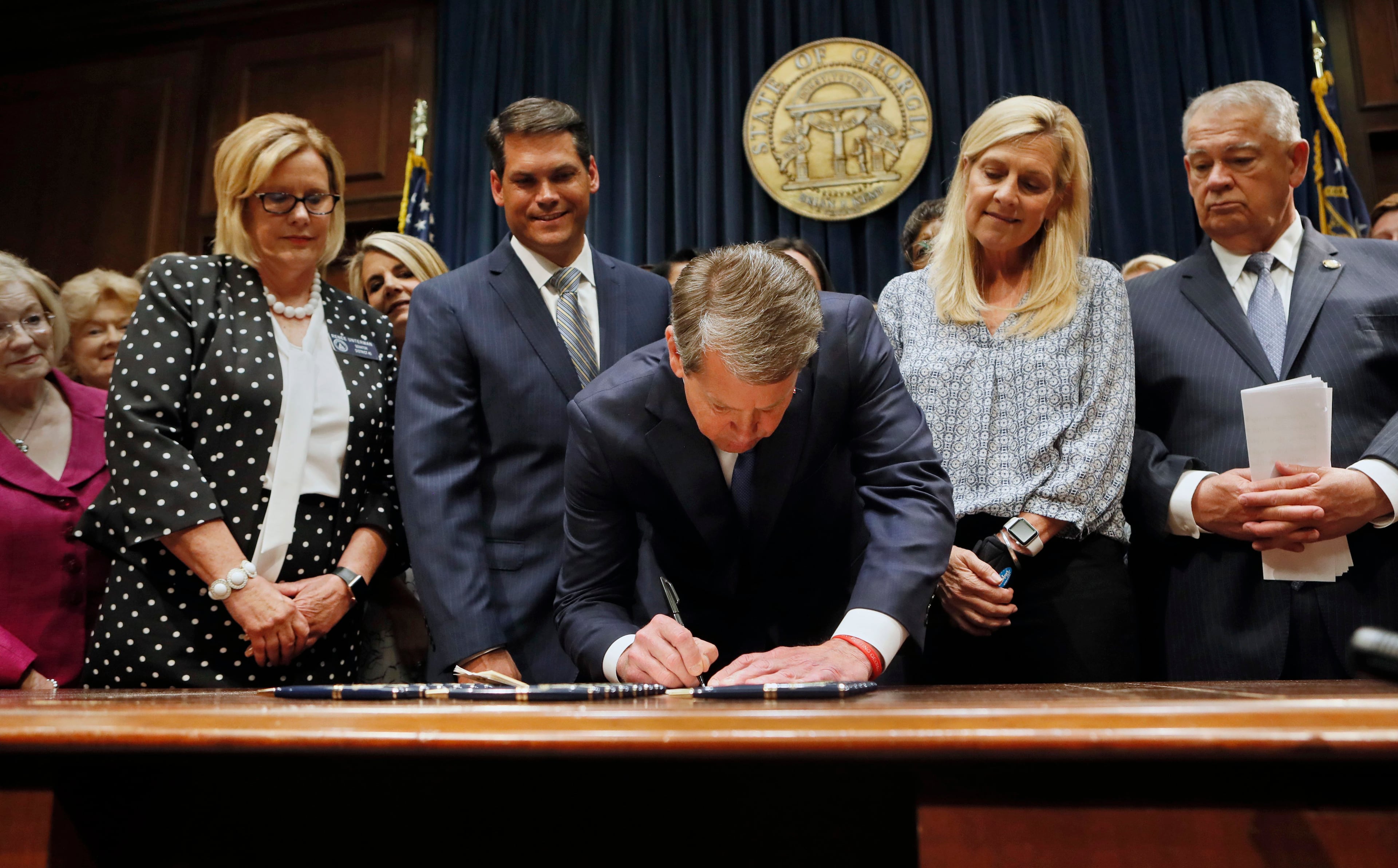
The successful passage of Georgia’s strict abortion law in 2019 was a resounding success for Republicans like Gov. Brian Kemp, who promised to crack down on abortion on the campaign trail in his first bid for governor.
“I campaigned on signing the toughest abortion bill in the country,” Kemp said as the bill was being debated under the Gold Dome. “This is the toughest one we’ve got in the Legislature now.”
In 2022, as he faced Democrat Stacey Abrams for a second time, he softened his messaging around the law but praised the U.S. Supreme Court’s decision to overturn 50 years of abortion protections under Roe v. Wade.
Jackson, a political newcomer whose story about his upbringing is rooted in his Christian faith, hasn’t touched the topic.
“Republican opponents to abortion are trying to run away from the issue because it is a losing issue for them, and they know it,” said Standiford.
Earlier in the campaign, Jackson raised eyebrows after a recording surfaced of a conversation between him and a voter at a campaign stop in Walton County in which he appeared to be open to additional limits.

But Jackson’s campaign has said the Republican candidate supports Georgia’s abortion law as it stands — which includes exemptions for rape, incest and saving the life of the mother if medical complications arise.
Bottoms has used key moments throughout her campaign to highlight the audio and Jackson’s position on the issue — like her shot at the empty podium during the recent Atlanta Press Club debate.
And she echoes the allegations in major rallies alongside Ossoff that have garnered national media attention. Speaking with reporters after her most recent event in Cobb County, Bottoms argued abortion will always be a top issue.
“We have to remind people what’s on the ballot this year,” she said. “Not just for the governor’s race, but the importance of those down-ballot races, so that we can reverse the six-week abortion ban.”
Lawson said that, with affordability a key issue this midterm cycle, it’s surprising to see Democrats resurface abortion in their closing message.
“It’s not an issue that’s top-of-mind for Georgia voters right now,” he said. “Georgia voters are talking and wanting lower property taxes, cheaper groceries, more affordable healthcare, better opportunities — that’s what Rick Jackson has been focused on.”
The high-stakes governor’s contest isn’t the only race where abortion restrictions showed up in the final weeks leading up to the election.

In the Atlanta Press Club’s U.S. Senate debate, Collins appeared to walk back an earlier stance on abortion.
“This is a congressman who supports a total ban on abortion with no exceptions, even if the mother will die for lack of healthcare,” Ossoff challenged. “And I bet he’ll try to change his position right now.”
Collins shot back that he has been “pro life, all my life, forever” and that he has supported the Georgia law that bans abortion at six weeks of pregnancy, with several exceptions.
In his 2022 congressional campaign, Collins declared he had always been “100% pro life. Period. No exceptions.” He now says he meant that he has supported abortion restrictions throughout his life.
Legislative districts targeted

Planned Parenthood Votes’ ads have targeted State Sen. Ed Setzler and State Reps. Don Parsons, Matt Reeves and Scott Hilton for backing the state’s law or expressing support for abortion restrictions in the past.
Setzler — who represents portions of Bartow and Cobb counties — argued that out-of-state groups are spending major money to paint Georgia Republicans as far-right extremists.
He called the attacks over abortion restrictions a coordinated effort to “overcome the very strong, common-sense record of Georgia Republicans,” pointing to Kemp’s popularity throughout his two terms.
All four Republican state lawmakers with ads against them are in legislative districts that Democrats are hoping to flip this election cycle. Democrats have a chance in the Georgia House of Representatives but need to pick up 10 seats to secure the majority for the first time in more than two decades.
Reeves, who represents Gwinnett County, also cited voters’ concerns around the cost of living that have dominated this election cycle.
“I think those generic ads are falling flat,” he said. “People in my area care about affordability and public safety.”

Polling released in July from KFF — an independent health policy research organization — found that 57% of voters said it’s “extremely” or “very important” for candidates to talk about their abortion policies.
About 30% of voters who support abortion access said abortion stances are “extremely” important for them in the upcoming midterm elections versus about 22% of anti-abortion voters.
But Democrats were unsuccessful this spring when they attempted to harness frustration over abortion restrictions in Georgia’s Supreme Court justice races.
The usually sleepy, nonpartisan contests pitted left-leaning challengers Jen Jordan and Miracle Rankin against incumbent Justices Charlie Bethel and Sarah Warren — both backed by Republican Gov. Brian Kemp.
Democrats looked to make the races a referendum on abortion rights after the state Supreme Court sided with the state in a legal challenge against the 2019 law. Ultimately, Jordan lost to Warren by 18 points, and Rankin lost to Bethel by 2.