Georgia board asks Trump administration to investigate voting machines
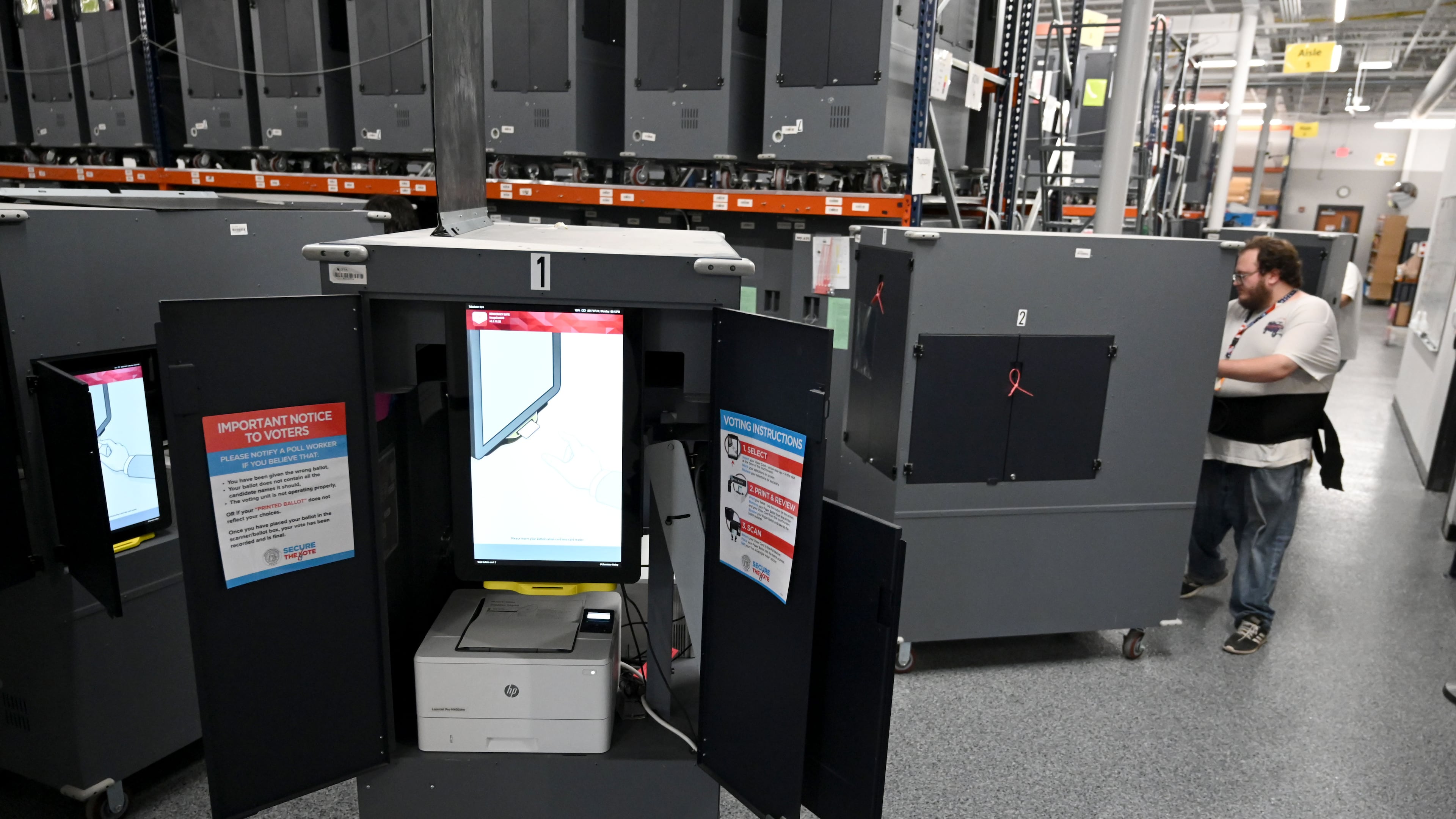

The State Election Board’s Executive Director James Mills has asked the Trump administration to examine Georgia’s voting machines that are deployed statewide and prohibit QR-code vote counting, according to letters obtained by The Atlanta Journal-Constitution.
In letters to U.S. Attorney General Todd Blanche and other top federal officials on Wednesday, Mills asked the U.S. Justice Department to put additional security measures in place before the midterm election and give the state a six-month deadline to eliminate the use of QR codes on ballots to tally votes.
The demand would require Georgia to revamp its in-person voting process, which relies on scanners reading QR codes on ballots to count votes.
It is the latest salvo in a long-running feud between the Republican-controlled State Election Board, which is often in lockstep with the Trump administration, and the secretary of state’s office, which administers elections.
By appealing to the Trump administration, Mills is seeking to force changes to Georgia’s voting system less than two weeks before early in-person voting starts, escalating disputes over vote tallying and security upgrades that election officials and voting experts say can’t be done this close to the midterms.
Sara Tindall-Ghazal, the State Election Board’s sole Democrat, questioned how, after years of use, Georgia’s current voting system is out of compliance with federal law.
“This is clearly a bad-faith attempt to set up a contest to election results that Republicans do not like,” she said.
A spokesperson for the Justice Department did not indicate whether it would act on the request.
“Any decision on whether to take action is made independently by the Department, based on the facts and the law,” the spokesperson said in a statement.
While most jurisdictions across the country use hand-marked ballots, in Georgia, all of the state’s 159 counties primarily use voting touchscreens to select candidates. Those machines were the subject of false claims from Trump supporters that manipulation of machines tainted the vote in 2020.
The letters also seek to compel security upgrades to the voting system before the midterms that critics say would address long-known flaws, made easier to exploit with artificial intelligence.
Among those is a privacy flaw that security experts say allows someone to connect a voter with their ballot and identify how they voted with a high degree of confidence using various public election records. The concerns have become more urgent with the proliferation of AI and are the latest flashpoint in a long-running debate over Georgia’s voting technology.
The flaw, however, does not alter election results.
To mitigate the vulnerability, state officials have said they are working with vendors to scramble records before making them public. They also have directed county officials to redact some publicly available information, deny requests for other information and route some requests to the secretary’s office.
Secretary of state officials have said that those steps are adequate to address any potential harm without funding for implementing upgrades, but some advocates say such actions don’t go far enough to protect ballot secrecy.
Robert Sinners, a secretary of state’s office spokesperson, called the letter “disingenuous,” saying that it ignores previous requests to the state Legislature for funding upgrades. He said in a statement that the board is “trying to cause chaos at the 11th hour.”
Mills’ letters, which were also sent to Assistant U.S. Attorney General for the Civil Rights Division Harmeet Dhillon and U.S. Homeland Security Director Markwayne Mullin, also asked for investigations into alleged “alteration, destruction, or withholding” of various election records.
He did not provide specifics.
There’s no indication the state’s voting machines have been tampered with during an election. Security experts, however, have identified vulnerabilities in the electronic voting system that election security advocates say could potentially be exploited to hack machines.
Georgia’s reliance on QR codes on ballots has been an ongoing controversy. In 2024, state legislators enacted a law that would outlaw the use of QR codes on printed on ballots by July 1, 2026. But the state failed to meet that deadline after the Republican-controlled Georgia Legislature failed to provide ways to implement the change.
During a rare special session in June, they punted that deadline to Jan. 1, 2028.
Trump and critics of the technology have long advocated for moving to hand-marked ballots. The president told The New York Times earlier this year that he regretted not sending in the National Guard to seize Georgia’s voting machines — machines that will still be in use this year.