7 counties that could shape Georgia’s race for governor
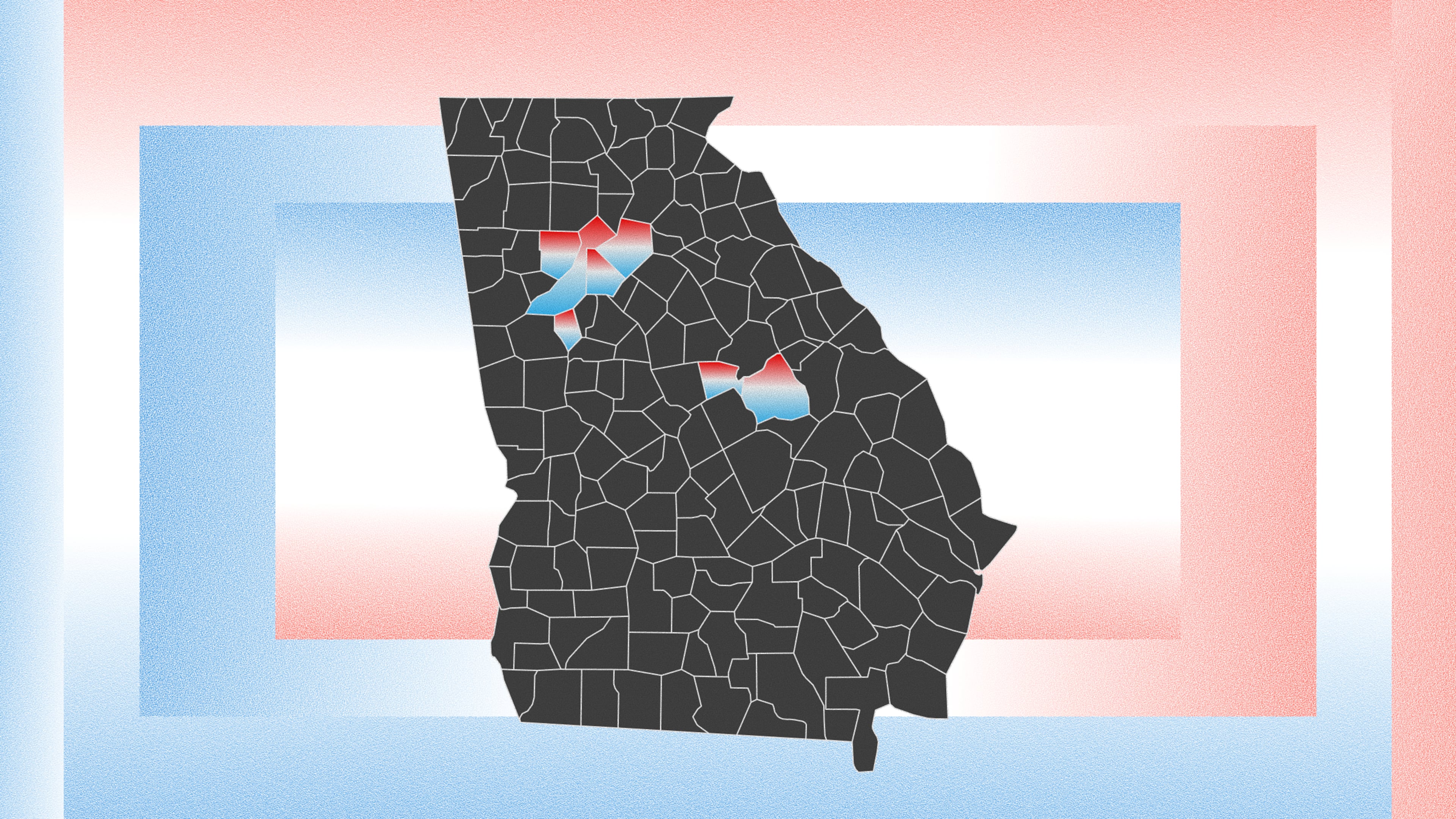

In a tightening race for governor, the path to victory could wind through the margins of some densely populated metro Atlanta counties and the leftward trends of previously reliable Republican areas.
Recent polls show a toss-up between Democrat Keisha Lance Bottoms and Republican Rick Jackson. The latest AARP poll revealed the race is effectively deadlocked, with Bottoms and Jackson within the poll’s margin of error.
That puts a disparate group of counties at the center of the November contest. Baldwin and Washington counties in Middle Georgia have moved between Republicans and Democrats in recent presidential elections while the longtime Republican advantage in Fayette County just south of Atlanta has narrowed.
Meanwhile in metro Atlanta, Cobb, DeKalb, Fulton and Gwinnett counties offer a different kind of opportunity: huge pools of voters where even a small change in turnout could translate into tens of thousands of votes. Let’s look at these seven counties in more detail.
Competitive counties
Since 2016, Baldwin County has seen a slight Republican shift, but it remains competitive. Democrat Stacey Abrams narrowly carried the county in the 2018 governor’s race, beating Republican Brian Kemp by less than half a percentage point in a race Kemp ultimately won. Kemp went on to win the county by 7 points in their 2022 rematch.

Presidential elections have also been close. Democrat Hillary Rodham Clinton carried Baldwin by less than 2 percentage points in 2016. Democrat Joe Biden won the county by just over 1 point in 2020. But in 2024, the county flipped to Republican Donald Trump, who beat Democrat Kamala Harris by just over 2 percentage points.
Washington County tells a similar story. Kemp won the county by less than 2 percentage points in 2018 and just 5 points in 2022. In the past three presidential elections, the margin between the Democratic and Republican candidates has been less than 2 percentage points. Clinton narrowly carried the county in 2016, and Biden won it by less than 1 point in 2020. But in 2024, the county flipped to Trump, who beat Harris by nearly 2 points.
From 2016 to 2024, Fayette County has seen its share of Republican voters shrink by 7 percentage points and its share of Democratic voters increase by 9 points. Republican candidates still consistently win the county, but by smaller margins. It’s in counties like Fayette — farther out in Atlanta’s suburbs and with an increasingly diverse electorate — where the candidates will be fighting it out on Election Day.
From 2016 to 2024, Democrats in Fayette County increased their total votes by 54%, compared with a 9% increase among Republicans. Fayette County Republican Steve Brown called the Democratic shift “alarming,” but said he remains confident that Jackson will carry the county come November.
Brown said the Fayette County Republican Party is relying on a strong ground game to turn out their voters. That includes knocking on the doors of people who voted in the Republican primary to make sure they return to the polls in November.
“I think the fear of where people within the Democratic Party are heading and this new (Democratic Socialists of America) movement … scares Republicans into saying I’m voting for whoever has got the ‘R’ behind their name,” he said.

Metro Atlanta targets low-propensity voters
Cobb County, once a Republican stronghold, flipped Democratic a decade ago. But the size of Democrats’ advantage varies depending on the election. In the 2018 and 2022 governor’s races, Democratic turnout outpaced Republican turnout by up to 30,000 votes. In the past two presidential elections, that gap grew to nearly 60,000 votes.
That makes lower-propensity voters — those who may turn out for presidential elections but skip midterms — particularly important. Cobb County Democrats and Republicans are working to reach those voters this year.
Cobb County Republican Party Chair Mary Clarice Hathaway said enthusiasm for Jackson is growing, even among those who voted for Lt. Gov. Burt Jones, who lost to Jackson in the Republican primary.
You need more than Republican voters to win a general election. Hathaway said she’s also targeting independents who feel “politically homeless” and Republicans who feel disillusioned with the party.
“And quite frankly, I think Rick Jackson has that kind of message,” she said. “I think he appeals to people all across the board because of his story … He removes a lot of excuses for people.”
Jackson appeared with Trump when he visited Wheeler High School in Cobb County last month. But Cobb County Democratic Party Chair Essence Johnson said the visit has energized Democrats, who protested the event and later flooded a Cobb County School Board meeting to complain about the visit.
“This election is a little bit different,” Johnson said. “It’s not just about what political affiliation you are — people can’t afford to eat, they can’t afford housing.”
Although Bottoms will likely carry Cobb, Hathaway said Republican success in the county will depend on Jackson cutting into Democratic margins as much as possible, something she said she is confident he can do.
“That makes Cobb, in my opinion, one of the most important counties in the entire state,” she said. “We actually have the capacity to almost determine what direction the election goes.”

The pattern is just as pronounced in Gwinnett County. In recent governor’s races, Democrats have outperformed Republicans by roughly 30,000 to 40,000 votes. During presidential elections, that advantage grows to roughly 70,000 to 80,000 votes.
Gwinnett County Democratic Party Chair Curt Thompson said coordination with the campaign is more frequent and organized than previous years. But the challenge remains reaching those low-propensity voters.
“I think that Gwinnett is the bellwether county for the state of the metro counties,” he said. “If we are No. 2 in percentage of turnout of all the ‘big urban-ish’ counties, because of our sheer raw numbers, you can win statewide.”
The key for both campaigns will be closing the turnout gap. If Bottoms can bring Democratic presidential-year voters back to the polls, she could significantly expand her advantage in two of the state’s largest counties. If Jackson can mobilize lower-propensity Republican voters and cut into those Democratic margins, he could limit the votes Bottoms gains in two counties critical to a path to victory.
The Jackson campaign strategy mirrors that of Kemp’s in 2018 and 2022 by using a targeted data-and-analytics to grab nontraditional voters. On top of that, Jackson can pour millions of dollars of his fortune into the operation.
“Everybody saw what our side was able to accomplish in 2022 under Gov. Brian Kemp,” Jackson campaign spokesperson Garrison Douglas said. “I think Democrats and those in the Keisha Lance Bottoms campaign are going to long for those days based off of the ground game that we’ve put together and are executing.”
Bottoms’ campaign spokesperson TaNisha Cameron said Bottoms has offices statewide and is running an aggressive ground campaign, making a specific effort to visit counties where Democratic margins have increased.
“Keisha has traveled across the state — to red and blue counties alike — to talk to Georgians about her plans to expand Medicaid and protect Georgia’s hospitals, bring down costs, and invest in education,” she said.
Correction
September 2, 2026This story has been updated to correct Mary Clarice Hathaway’s name.