Trump’s speech threatens to disrupt Georgia’s midterms
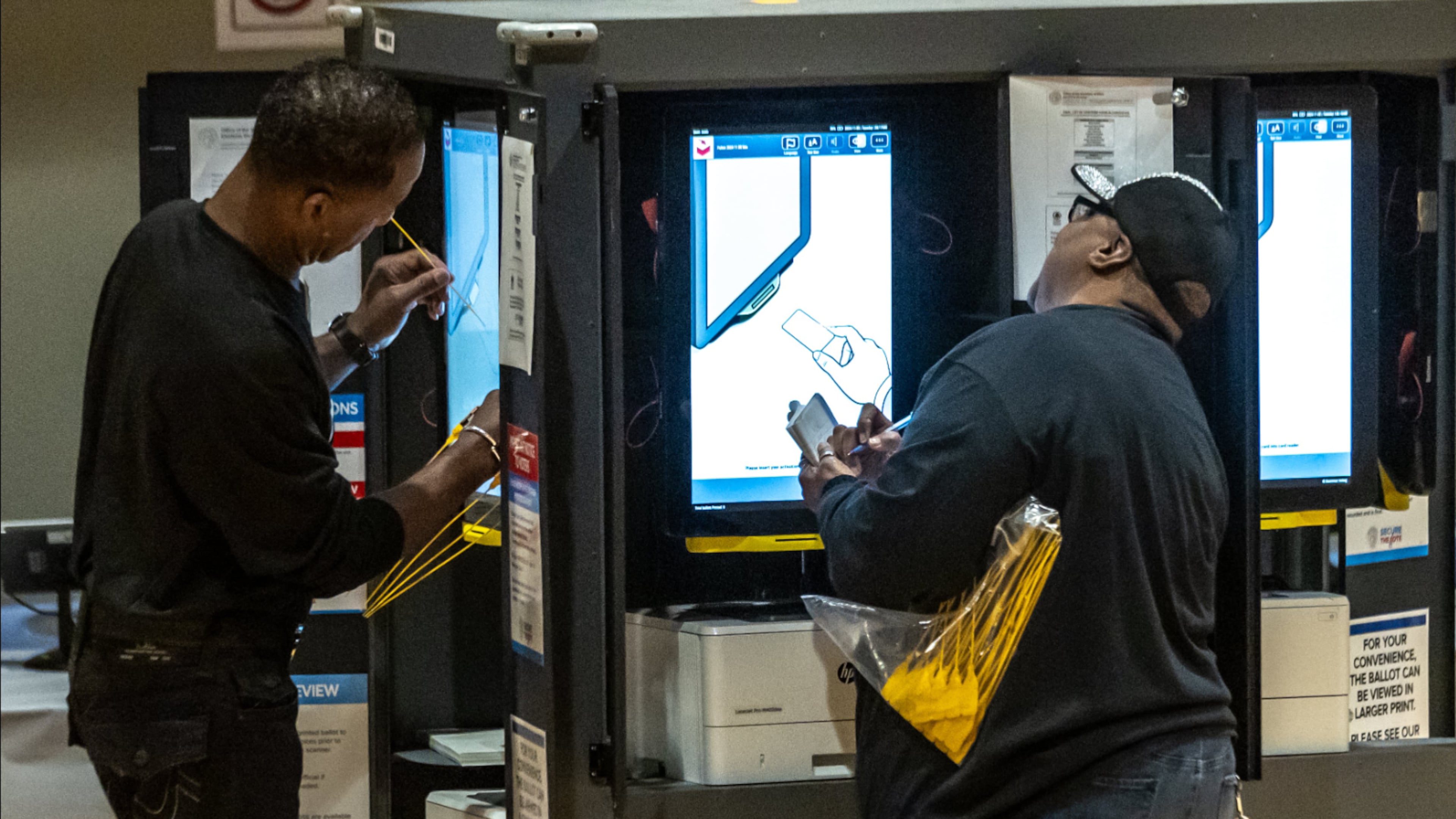

In a planned primetime address Thursday, President Donald Trump is expected to air his concerns about election security and voting machines — potentially making new accusations about the security of Georgia’s voting machines months ahead of the midterm election.
Trump has been vague about his speech. He said it will concern voting machines but didn’t elaborate during a Tuesday news conference in the Oval Office.
“What we’re going to be talking about Thursday, it doesn’t get bigger,” the president said. “Because without free and fair elections you don’t have a country.”
What Trump says might matter most in places such as Georgia, which has been in the administration’s crosshairs over the 2020 election and where the fight over its touchscreen voting system has simmered since its rollout six years ago. As one of the few states with a single, statewide electronic touchscreen voting system, Georgia is especially exposed if Trump uses the speech to level new accusations against the machines just months before the midterms, the outcome of which could influence which party controls Congress.
Multiple national reports say the administration is weighing the declassification of a large number of intelligence documents on voting machine security and foreign influence on U.S. elections. MS NOW, citing two anonymous sources, reported that Georgia’s 2020 results and the Senate runoffs that followed are among the documents that are under consideration.
Election experts and voting rights groups have been wondering how Trump might use allegations of fraud and wrongdoing as a pretext for aggressive actions ahead of the midterms.
Rick Hasen, a law professor at University of California, Los Angeles, and director of the school’s Safeguarding Democracy Project, said he’d be skeptical of any claims Trump makes Thursday. Pointing to the criminal investigation into Fulton County’s 2020 election, Hasen said Trump’s “Justice Department is not above discredited conspiracy theories.”
“So far, the courts have been quite skeptical of Trump’s attempts both to overreach and engage in a kind of fishing expedition related to 2020,” he said. “That doesn’t mean he won’t keep trying.”
Last week, a federal judge in Atlanta quashed a subpoena seeking the identities of thousands of Fulton’s 2020 election workers, calling the demand an “arbitrary fishing expedition.” The U.S. Department of Justice has sued 30 states for their unredacted voter rolls, but every federal judge that has ruled on the DOJ’s efforts has sided against the Trump administration. A case in Georgia is pending.
The president’s speech comes as the administration has pressured states to comply with a sweeping set of demands, including submitting plans to phase out machines in favor of hand-marked ballots or lose tens of millions of dollars in federal Homeland Security funding — part of Trump’s campaign to transform American elections.
Few states show what the fight over voting technology looks like better than Georgia, where the debate over the state’s touchscreen voting machines has cast a shadow over elections since their implementation. Tensions intensified after Trump’s failed attempt to overturn his 2020 loss. Nearly six years later and months before another important election, that fight is far from over.
There’s no evidence of the state’s voting machines being hacked during an election, but for years, security advocates have been concerned that the system’s vulnerabilities identified by experts could be exploited to alter results and that the touchscreens don’t protect ballot secrecy. Some conservatives aligned with the president have cast doubts about the 2020 election, including pushing unsubstantiated claims of vote flipping and foreign interference. State election officials have insisted the machines are accurate and secure.
The Republican-controlled State Election Board has considered rule proposals aimed at switching to hand-marked ballots, but none have passed.
And in a rare June special session, Georgia’s Republican-controlled Legislature ensured the bitter debate fueled by attacks from Trump and his allies over voting technology would continue after punting a July deadline to stop counting votes with machine-readable QR codes from Georgia ballots to 2028. The move quelled fears among many local election officials who warned a switch months before the midterms could create chaos.

Secretary of State Brad Raffensperger, who leaves office after this year, has doubled down on the machines and made another pitch for them ahead of the last election in which he will serve as Georgia’s elections chief — touting the touchscreens and Georgia elections as accurate after a recent audit of ballot images.
“We will continue to conduct audits after every election,” Raffensperger said in a statement last week. “We run elections with nearly perfect accuracy, and we will never stop reminding the public their machines are accurate, their counts are accurate, and that elections in Georgia are accurate.”
The audit he was pointing to found that the only identified “discrepancies” in the more than 1.11 million ballot images from the June primary runoffs were from about two dozen hand-marked ballots and not machine-marked ballots.
Raffensperger resisted Trump’s pressure to find enough votes to overturn the 2020 election and became a villain to election skeptics. And he has, at times, had a strained relationship with his fellow Republicans in the General Assembly.
There’s no indication Georgia will voluntarily move away from the machines for the midterms. But Rokey Suleman, an election consultant and former county election official in South Carolina, said he fears Trump will raise national security concerns in his speech Thursday to justify ordering the U.S. Election Assistance Commission to decertify voting systems.
Last week, Trump fired the remaining two Democratic members of the commission that supports states in administering their elections. The sole remaining Republican member resigned.
“The political worry is what’s a voter going to do in Georgia if the president announces that there’s a national security issue with its voting equipment?” Suleman said.
David Becker, executive director and founder of the Center for Election Innovation & Research, a nonprofit that works with election officials to build voter confidence, said any effort to decertify or change voting system standards by the EAC shortly before an election would be blocked by courts.
The equipment was originally manufactured by Dominion Voting Systems, which was purchased by Liberty Vote last year. Previous legal efforts to challenge the state’s use of the touchscreen voting system in Georgia have failed. Experts say that, as with many previous efforts from the president to assert control over elections, any new ones would likely be challenged in court.
“Anything the president does is not going to have any lasting effect,” Becker said. “It’s going to be blocked immediately by the courts, just like everything else they’ve done.”