Russia hosts a Taliban delegation, others for consultations on Afghanistan
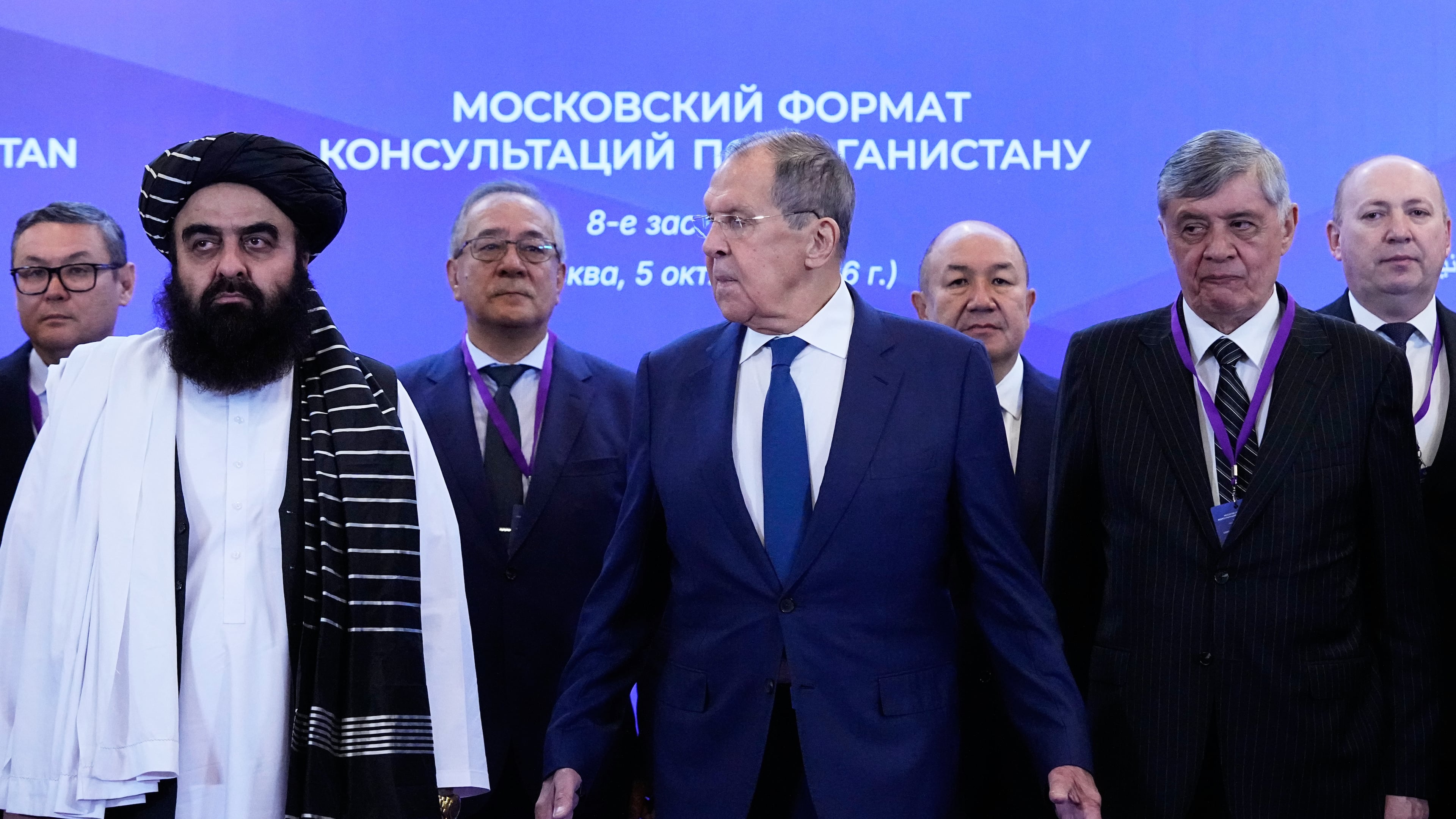
MOSCOW (AP) — A delegation from Afghanistan’s ruling Taliban government joined representatives from China, India, Iran, Pakistan and other nations for talks in Moscow on Monday.
While Russia has sought to bolster its regional clout by hosting the annual consultations, they were marred by the spiraling tensions between Afghanistan and Pakistan, which traded blame for cross-border attacks in strongly worded statements.
Russian Foreign Minister Sergey Lavrov welcomed the Taliban’s Foreign Minister Amir Khan Muttaqi to Moscow by congratulating him on “the fifth anniversary of Afghanistan’s liberation from the NATO contingent.”
“Five years is a short time to overcome the consequences of many decades of occupation, yet your government’s achievements are evident, and we welcome them,” Lavrov said. He hailed the Taliban's successes in combating the Islamic State group and other extremists, and its efforts to eradicate drug trafficking.
Since the Taliban took control of Afghanistan in August 2021 after the pullback of U.S. and NATO forces, they have sought international recognition while also enforcing their strict interpretation of Islamic law.
In July 2025, Russia became the first country to recognize the Taliban’s government after removing the group from its list of outlawed organizations.
Speaking during Monday’s talks, Lavrov said that “the powerful military machine of the United States and their NATO allies was broken by the fighting spirit and resilience of the Afghans.”
The former Soviet Union fought a 10-year war in Afghanistan that ended with Moscow withdrawing its troops in 1989. During the past decade, Moscow has sought to bolster its influence in the region by hosting regular consultations on Afghanistan involving senior representatives of the Taliban and neighboring nations.
Lavrov noted that the Taliban's “successes in the fight against narcotics and terrorism are to a significant extent linked to the ongoing military-technical cooperation between our countries.”
Russia's top diplomat reaffirmed that Moscow views the deployment of any NATO military infrastructure on the territory of Afghanistan and neighboring countries as “categorically unacceptable.”
“Historical experience shows that such a presence is fraught with destabilization and escalating conflict,” Lavrov said.
He emphasized that Russia will continue to provide humanitarian assistance to Afghanistan.
Officials from China, India, Iran, Kazakhstan, Kyrgyzstan, Pakistan, Tajikistan and Uzbekistan also took part in the talks.
Russia’s envoy for Afghanistan, Zamir Kabulov, said that Moscow was ready to help defuse the tensions between Afghanistan and Pakistan. “Russia stands ready to help end this conflict using all possible means and acting independently or together with other partners if both parties ask for it,” Kabulov told reporters.
Cross-border fighting between Afghanistan and Pakistan has continued to rage despite international mediation efforts, with Pakistan launching airstrikes across several Afghan provinces and Afghan fighters carrying out raids into Pakistan.
Pakistan has long accused Afghanistan’s Taliban government of sheltering militants responsible for cross-border attacks, particularly the Pakistani Taliban, or TTP.
Pakistan’s envoy Mohammad Sadiq argued Monday that “terrorism remains at the core of Afghanistan’s problems, with roots in the nexus between the Taliban Regime and terrorist groups,” including the TTP and others.
“Over the last three years alone, more than 4,700 innocent Pakistanis have lost their lives to terrorism emanating from Afghanistan,” Sadiq said at the talks, declaring that the “Taliban regime is complicit in this” and describing Pakistan’s counterstrikes as “precise, intelligence-based and defensive in nature.”
In his turn, Muttaqi, the Taliban foreign minister, denounced Pakistan's attacks, which he said had killed Afghan civilians, including women and children.
“In all the attacks or bombing that Pakistan has carried out, there has been no evidence to date that anyone who was dangerous to them (Pakistan) or anyone else has been killed by them,” he said at a briefing after the talks.
While Russia was the first country to recognize the Taliban administration, the group had engaged in high-level talks with many nations and established some diplomatic ties with countries including China and the United Arab Emirates.
Still, the Taliban government has been relatively isolated on the world stage, largely over its restrictions on women.