Venice Film Festival opens with Danny Boyle's Murdoch film, an award for Clooney and geopolitics
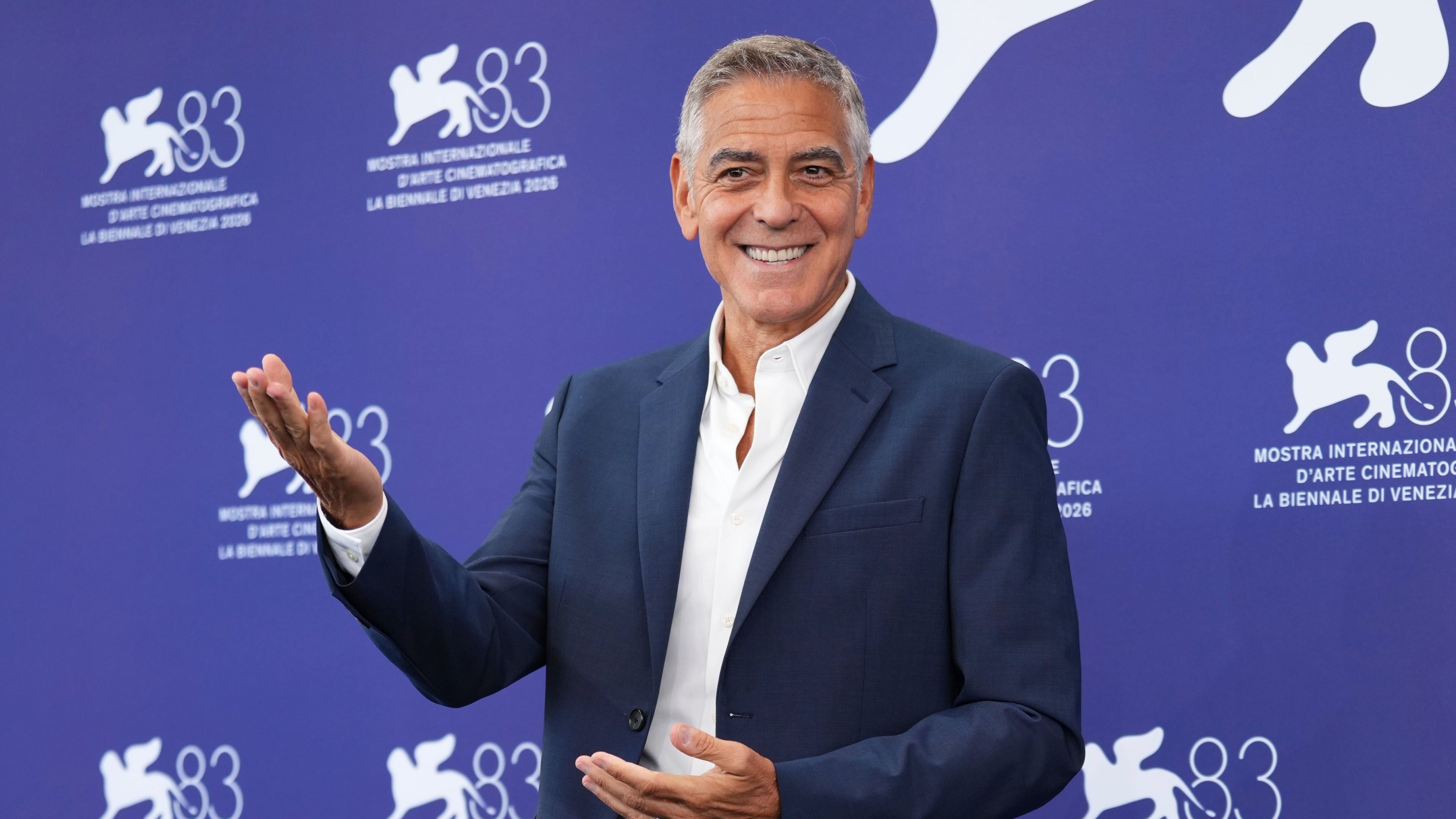
VENICE, Italy (AP) — George Clooney may be at the Venice Film Festival to receive a lifetime achievement award, but he didn’t dwell just on memories and nostalgia on Wednesday.
Before the award ceremony, which he plans to attend with his wife Amal Clooney, the 65-year-old actor and director addressed issues such as the artificial intelligence revolution in Hollywood and the Paramount-Warner Bros. merger, and the state of journalism and power in America.
“There’s a great word, kakistocracy, which is a country run by the least qualified people,” Clooney said. “I think maybe we have a kakistocracy right now. But we’ll get through it.”
Of artificial intelligence, Clooney said that his industry is going to have to find ways to survive, and that he would “like to avoid being in a tampon commercial 20 years after I’m dead.” He bemoaned the fact that some of the world's richest men own The Washington Post and X and said that the proposed merger of Paramount and Warner Bros. was “a complicated thing because I don’t know how this works out, I don’t know how it goes through."
Current events take center stage
Over the course of 11 days, the 83rd edition of the festival will see many stars from Hollywood and beyond grace the red carpet, from Robert Pattinson to Noel and Liam Gallagher of Oasis, but the focus this year seems to be more on geopolitics than movie star moments.
The sprawling lineup includes documentaries about the conflict in Gaza ( “NAZA” ), Elon Musk (“Musk”) and independent Russian journalists covering the war in Ukraine (“My Undesirable Friends — Part II: Exile”) as well as Palestinian films and a short about U.S. Immigration and Customs Enforcement in Minneapolis.
Jury president Maggie Gyllenhaal spoke about the fact that many of the films in the slate are about current events and conflicts.
“Look, we could say how are we possibly here talking about movies right now when the world is in a state of emergency,” Gyllenhaal said. “To me the answer has something to do with empathy.”
When asked if she thought films should be political, she said that she thinks they are “fundamentally, unavoidably political.”
Festival director Alberto Barbera told The Associated Press that most of the films they saw during the selection process dealt with “contemporary problems.”
“We didn’t really have a choice,” he said. “We are in a space open to everybody for discussion, for confrontation. Everybody is completely free to express themselves. And I’m, in a way, really happy that this kind of film could help the viewers, the critics, everybody to have a better understanding of what is going on in our contemporary, difficult world.”
Lack of female directors is a ‘systemic issue’
Gyllenhaal also addressed the dearth of female directors in the competition lineup. When the slate was announced in July, there was much attention on the fact that there was only one film directed by a woman. The documentary “NAZA,” which was added to the lineup just last week, was also co-directed by a woman.
“I guess it’s just finally become clear that men make better movies than women do,” Gyllenhaal quipped, before speaking about the systemic issues facing female directors, like financing and preconceived notions about high art.
Earlier, Barbera called it “a big problem,” adding: “There is a lot to do to give women the place that they deserve in cinema.”
He explained that while the organizers saw many interesting films from women, and programmed many in the festival’s sidebars, they didn’t find films that were strong enough for the main competition.
Danny Boyle's ‘Ink’ spurs debate on journalism and AI
The festival is also known for being a launch pad for Oscar contenders.
Barbera said one such possibility could be the opening-night film “Ink,” a competition title starring Guy Pearce as Rupert Murdoch and Jack O’Connell as tabloid newspaper editor Larry Lamb. An adaptation of James Graham’s acclaimed play, the Danny Boyle-directed film dramatizes Murdoch’s acquisition of the British tabloid “The Sun” in 1969 and explores how Lamb transformed a failing paper into a bestselling one.
Pearce said Murdoch's daughter, Elisabeth, told him: “‘Dad’s very happy that you are playing him.’ But he hadn’t seen the film at that point."
As in the stage play, Boyle said the point was not to “monsterize” Murdoch, who at the time was seen as a breath of fresh air in a rigid British society and media landscape.
The filmmakers and the cast spoke about “Ink's” themes and the cost of sacrificing morals, standards and decency for profit and sensationalism.
Boyle's thoughts also turned to AI and how it might impact journalism.
“The danger is with the tech giants and their AI is they’ll be able to replace journalists,” he said. “Will that AI journalist speak truth to the power that’s created it?”
___
For ongoing coverage of the 2026 Venice Film Festival, visit: https://apnews.com/hub/venice-film-festival