Trump's Board of Peace proposes $2.45 billion blueprint to begin Gaza reconstruction
NEW YORK (AP) — The U.S.-backed Board of Peace is proposing a six-month, $2.45 billion plan to begin reconstruction and governance in Gaza as President Donald Trump’s ceasefire plan struggles to stay afloat.
At a meeting of the group’s board in New York on the sidelines of the U.N. General Assembly on Wednesday, the governors unveiled a 66-project blueprint to get things started while acknowledging enormous hurdles that must still be overcome. The projects include ambitious infrastructure, education and health initiatives that are designed to support Trump’s 20-point plan to end the Israel-Hamas war.
“The need is immense,” the board said, noting that full reconstruction from the physical damage across Gaza will cost roughly $35.2 billion over the medium term and another $71.4 billion in the next 10 years.
The proposal is largely aimed at potential donors who will be asked to foot the bill for reconstruction of the war-devastated territory.
The ceasefire, which took effect on Oct. 10, was meant to clear the way for a broader process to rebuild Gaza under the guidance of the Board of Peace. The plan included additional Israeli military withdrawals from Gaza, the disarmament of Hamas, the arrival of an international peacekeeping force and a new apolitical Palestinian government to administer the territory’s day-to-day affairs. It also envisioned an ambitious program for rebuilding war-ravaged Gaza.
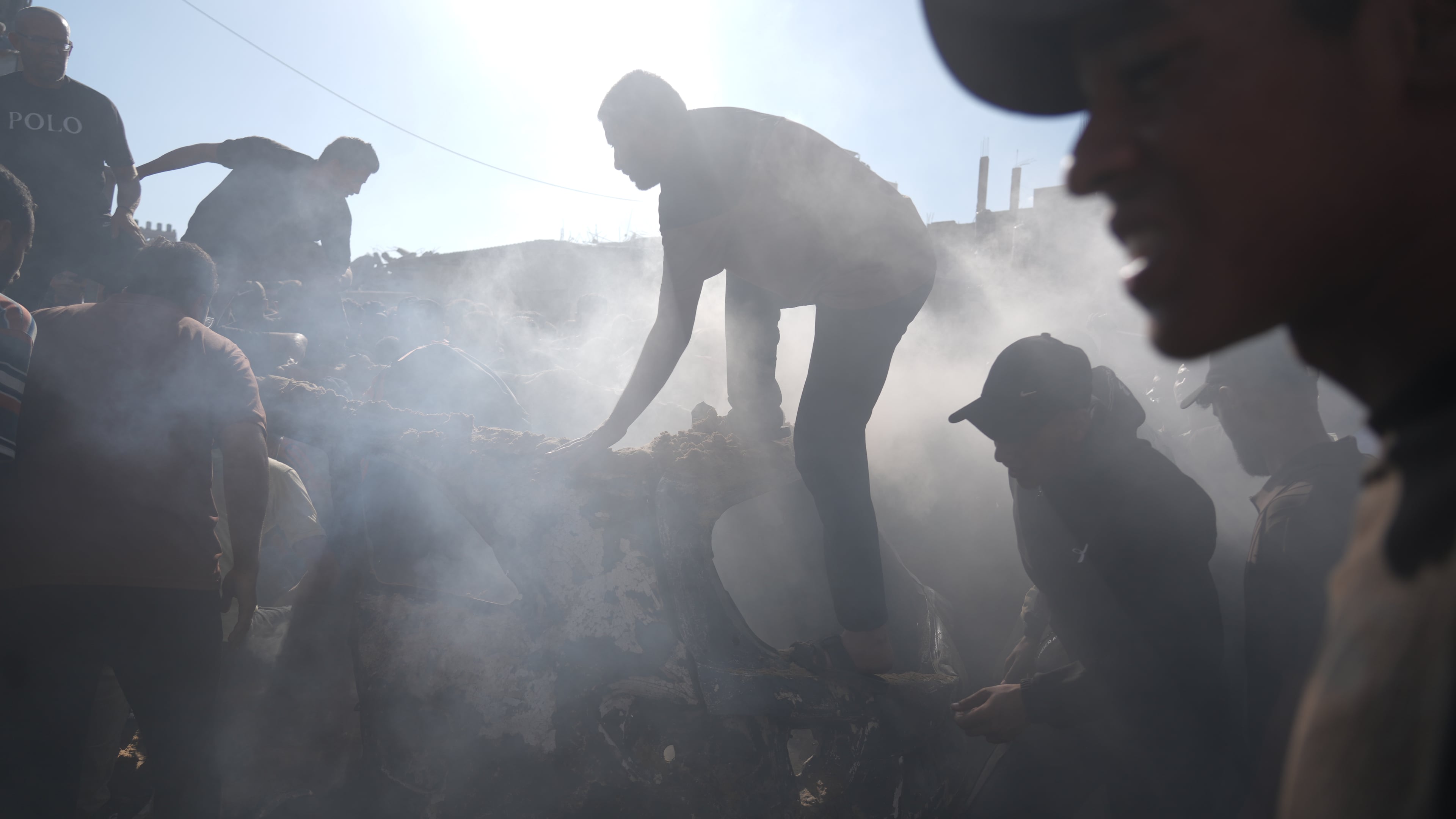
But the U.S.-backed plan has largely stalled. While the ceasefire halted the heaviest fighting and humanitarian conditions have improved, the Israeli military has expanded its control of Gaza and now occupies some 60% of the territory. Hamas has not given up its weapons. The international military force and new government still have not entered Gaza, and reconstruction has not begun. The vast majority of Palestinians continue to live in tent camps or ruins of their former homes.
The board’s high representative, Nikolay Mladenov, has said progress hinges largely on Hamas disarming — a step the group has refused to take. But he also has pressed Israel to scale back its military operation.
“I want to be very clear that we are not bound by a calendar,” he said. “We want to make sure that this works.”
Key questions that the board faces are not only laying out plans for reconstruction but also a timeline for the deployment of the international force meant to provide security in the territory and a new government, plans to disarm Hamas, and bringing in badly needed building materials.
U.S. Gen. Jasper Jeffers, commander of the international stabilization force planned for Gaza, outlined a five-step approach to dealing with the thorny issue of demilitarizing Hamas. It begins with the first wave of the multinational unit being deployed with troops from Kosovo and Morocco, to be followed by additional personnel from Albania and Kazakhstan.
Their task will be to demilitarize the territory and decommission all of Hamas’ military infrastructure.
The goal, he said, is to gradually turn security control over to the interim government, after which Israel will be expected to withdraw its forces.
___
Associated Press writers Josef Federman and Julia Frankel in Jerusalem and Ben Finley in Washington contributed to this report.