Trump and Xi Jinping head into Washington summit with both leaders thinking time is on their side
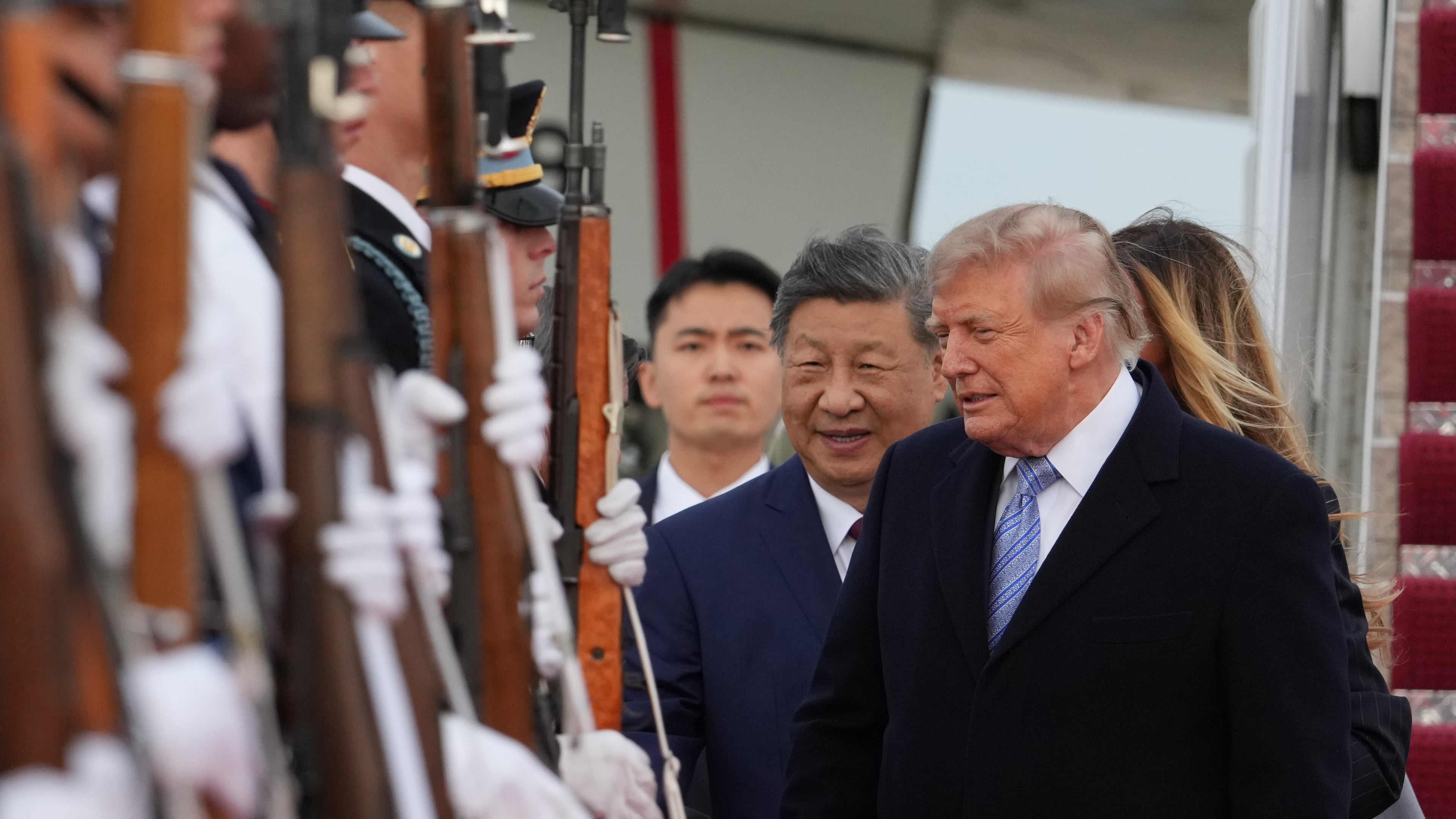
WASHINGTON (AP) — Presidents Donald Trump and Xi Jinping have no shortage of difficult issues to cover when they sit down for talks on Thursday at the White House.
China has resisted the Trump administration's urgings — and economic threats — to use its considerable leverage to prod Iran to agree to U.S. terms to end the nearly seven-month war. Xi wants to see Trump permanently halt arms sales to Taiwan and loosen export restrictions on cutting-edge advanced chips. And the two sides on Wednesday agreed to extend a one-year trade truce set to expire Nov. 10 for two months, kicking the can on finding a more durable agreement.
All the while, both leaders seem to believe that time is on their side as they look to outmaneuver the other in what is expected to be the world's most significant economic and national security competition for years to come.
“The president very much believes that over time the U.S. economy is going to grow, the U.S. will get stronger, the U.S. will keep making advances in AI and on technology, and that ... the U.S. will develop alternative sources of critical minerals and rare earths,” said Edgard Kagan, a former senior State Department official handling East Asia policy issues under Trump and President Joe Biden. “I think when Xi Jinping sits down with Donald Trump, he very much believes the U.S. is in hurtling decline and that time is on China’s side.”
Trump, for his part, is going all in on the pomp for the state visit for Xi.
In a grand gesture, the Republican leader kicked off the visit by showing up to greet Xi and his wife, Peng Liyuan, upon their arrival on Wednesday evening just outside Washington.
Trump has made clear he wants to impress Xi with the visit, making sure construction of a new helicopter landing pad on the White House's South Lawn was completed ahead of the visit. He's also openly lamented that his planned White House ballroom isn't ready for a fancy state dinner in Xi's honor on Thursday evening.
The guest list includes Amazon's Jeff Bezos, Nvidia's Jensen Huang, and Meta's Mark Zuckerberg, among other tech titans staking out positions on whether more safeguards are needed in the race to develop artificial intelligence — an issue of critical importance to both leaders.
US and China still have work to do on trade truce
Treasury Secretary Scott Bessent said the two leaders may be open to a new “notification mechanism” for AI incidents that could affect national security. But on AI and a host of other thorny issues, it remains unclear whether the leaders can make progress.
Shortly after Xi's arrival in Washington on Wednesday, Bessent announced on Fox News that the two sides had come to terms on extending the trade truce, forged last year in Busan, South Korea. He said it's possible that Trump and Xi could come to a larger agreement by January or just decide to once again extend it further.
Trump and Xi certainly have incentive to keep the truce alive.
Trump's Republican Party is facing headwinds as they try to maintain control of Congress in November's midterm elections and can hardly afford further economic disruption. Meanwhile, Xi is navigating an uneven Chinese economy — one in which its domestic economy is struggling while its high tech exports remain strong.
Peak baseline U.S. tariffs reached 145% during last year's trade battle — matched by China’s reciprocal levies of 125%. After Trump and Xi met in South Korea last year, the average U.S. tariff rate fell to roughly 47%, while China charged an average in the mid-30s. But in February, the U.S. Supreme Court overturned many of Trump’s tariffs, causing the taxes on Chinese goods to have more variation.
The stopgap announced by Bessent was shorter than what both sides had suggested in recent weeks.
The Chinese side had indicated that they wanted to see the trade truce extended until the end of Trump's term in January 2029.
Meanwhile, Trump administration officials had suggested a three- to six-month extension as a more appropriate time frame because China has been slow to fulfill past commitments on rare earth exports as well as imports of U.S. soybeans and aircraft.
There might not be a breakthrough during this week’s visit but both leaders seem to be determined to avoid a breakdown, said Ryan Hass, a senior China policy adviser in former President Barack Obama's administration.
“Both sides are going to be managing for small gains and conflict avoidance, and that is going to be sort of the spirit through which both leaders approach this conversation,” said Hass, who is now at the Brookings Institution in Washington.
A breakthrough on Iran seems unlikely
Trump has argued to little effect that China, which is far more dependent on Gulf oil than the U.S., has plenty of incentive to use its sway with Tehran to help force an end to the conflict.
But Trump's war of choice has unnerved Beijing, with the government condemning the U.S. and Israeli military action and Xi expressing concerns the conflict signaled a return to what he called the “law of the jungle."
The Chinese were also unsettled by the military operation Trump ordered to oust Venezuelan President Nicolás Maduro from power and sweep him off to New York City to face federal narcoterrorism and drug trafficking charges.
Trump has since pressured Latin American nations to reduce economic and political ties with China — and justified a push for U.S. involvement in Venezuela’s oil industry by pointing to concerns about Chinese and Russian influence on the South American country.
“China is very nervous about the kind of 19th-century imperialist cast of geopolitics that Trump has been pursuing,” said Jake Werner, director of the East Asia Program at the Quincy Institute. “But at the same time, Beijing really sees the U.S.-China relationship as the decisive factor. They don’t want to move in a way that’s going to blow up the U.S. relationship.”
Xi expected to press Trump to end Taiwan arms sales
China has made clear it views Taiwan as the most sensitive issue in the U.S.-China relationship.
Beijing considers Taiwan to be Chinese territory and vows to annex the island by force if necessary. The U.S. is obligated by law to provide Taiwan with sufficient hardware to deter any armed attack from the mainland.
China has pressed Washington to permanently halt the arms sales, most prominently when Trump and Xi met in Beijing in May.
After that meeting, Trump said he was holding off on final approval for a record-breaking $14 billion arms package that was in the pipeline. He also described arms sales to Taiwan as a “very good negotiating chip” with China.
The U.S. president may be motivated to keep the pause on until at least the end of the year, analysts say.
Trump, who sees face-to-face meetings with Xi as a key part in maintaining stability in the relationship, wants the Chinese president to attend the Group of 20 summit in December at his resort in Doral, Fla.
Xi, meanwhile, wants Trump to show up to November's Asia-Pacific Economic Cooperation summit in Shenzhen, China.
“I think that keeping things where they are now, with the arms sales pushed off, would count as a win for Beijing,” Hass said.
___
AP writer Josh Boak contributed reporting.