Former US Sen. Jon Kyl of Arizona, a 'workhorse' who shaped water policy, dies at 84
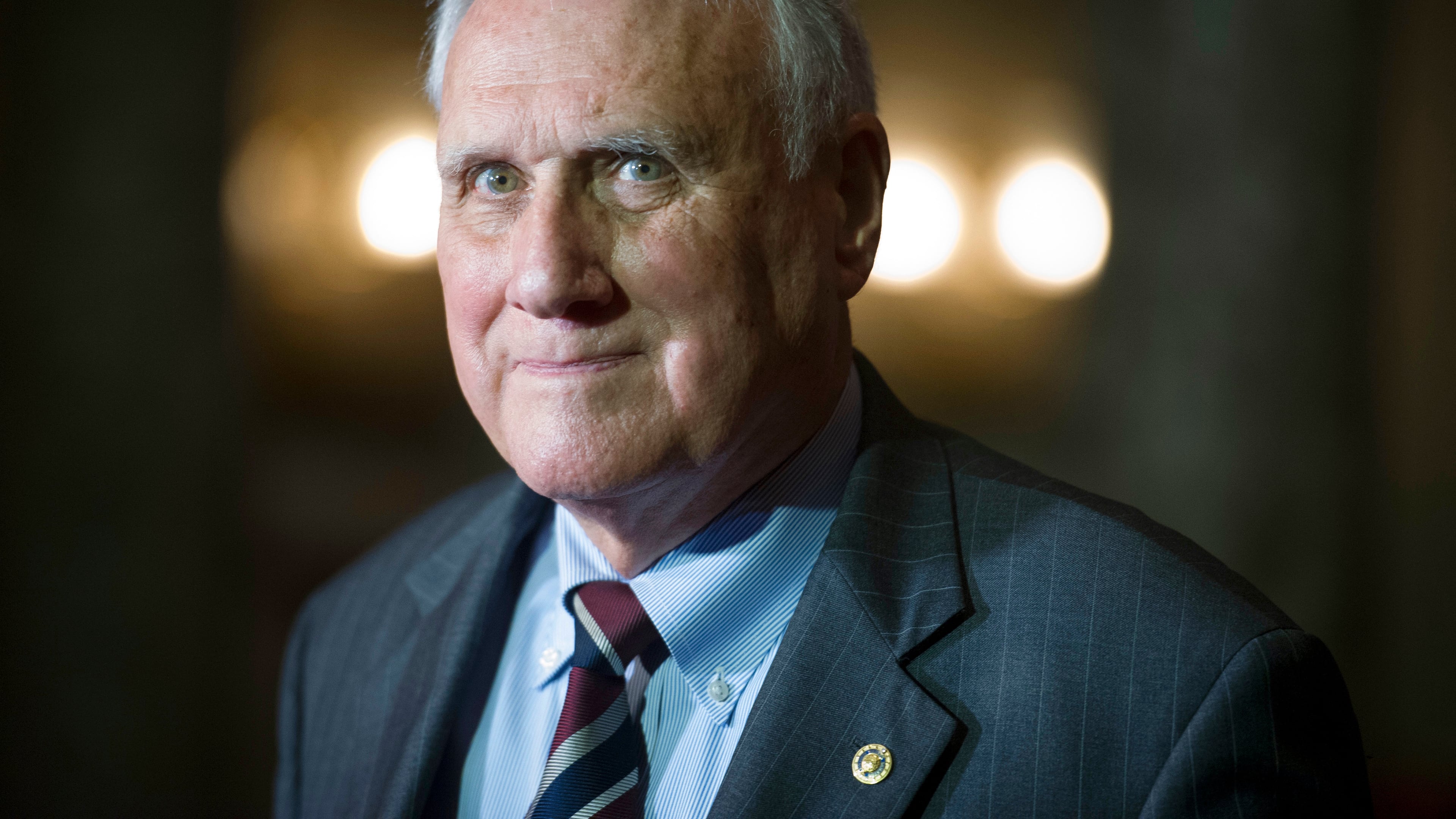
PHOENIX (AP) — Former U.S. Sen. Jon Kyl, a longtime Republican lawmaker from Arizona who shaped landmark water policies in the U.S. West and guided the confirmation of Supreme Court Justice Brett Kavanaugh, has died. He was 84.
Kyl died Wednesday night from a neurological disorder, said Gordon James, a communications professional who is a longtime friend of the Kyl family. Kyl had withdrawn from public life in December 2025 after announcing he had been diagnosed with dementia.
Kyl spent almost three decades in Congress, serving in both chambers, and watched his party undergo a drastic transformation, with his career spanning Ronald Reagan’s presidency to President Donald Trump’s first term.
“Arizonans are mourning the loss of former U.S. Senator Jon Kyl,” Democratic Gov. Katie Hobbs said in a post. “Throughout his decades of public service in the House and Senate, he was a dedicated statesman who always cared deeply for our state.”
Former Republican Arizona Gov. Doug Ducey, who considered Kyl a mentor, described the former senator in a February 2025 interview with The Associated Press as a true statesman and a “workhorse” among Washington, D.C.’s “showhorses.”
“If you saw him on the plane, he was sitting in the aisle, in coach, and he was reading,” Ducey said. “And he was reading potential bills or Senate business.”
Kyl returns briefly to Senate to fill McCain seat
Kyl rose to a leadership position during his last full term in the Senate, when his Republican colleagues selected him as minority whip. After retiring from politics in 2013 and becoming a lobbyist, Kyl returned to Congress briefly in 2018, when Ducey appointed him to fill the vacancy left by the late U.S. Sen. John McCain.
His appointment drew high praise from Trump, who said he was looking forward to working with “the extraordinary senator.” Kyl stayed for less than four months before rejoining lobbying firm Covington and Burling.
“At the federal level, and I regret to say that this is the case, but probably a lot of my better achievements were in preventing bad things from happening (rather) than forcing good things to happen,” Kyl said in a 2012 conversation with former U.S. Supreme Court Justice Sandra Day O’Connor.
Lawyer with expertise in water gets elected
Kyl was born in Oakland, Nebraska, on April 25, 1942, and grew up in a rural farming district in Iowa that his father represented in the U.S. House. At 18, he headed southwest to attend the University of Arizona, where he met his wife, Caryll, and earned a law degree.
Before being elected for the first of his four terms in the House in 1987, Kyl was a key participant in shaping Arizona’s 1980 groundwater code as a lawyer representing a large water utility. The first-of-its-kind code created a regulatory framework for managing groundwater in the drought-stricken state, largely centering on the state’s population centers, including Phoenix and Tucson.
In 2004, Kyl authored legislation that provided one of the largest tribal water rights settlements, which, after a decades-long battle, gave the Gila River Indian Community enough water to fill nearly 313,500 Olympic-sized swimming pools annually. Republican U.S. Sen. Mitch McConnell of Kentucky, who later served as majority leader, called Kyl's work ethic “legendary” in a 2012 floor speech and said Kyl had labored mostly behind the scenes for 15 years to advance the settlement.
Former Arizona Sen. Jeff Flake said he had long admired Kyl and appreciated the advice he offered when Flake started his political career. “The government needs people who are willing to serve a cause greater than their own self-interest, and that personified Jon,” Flake said. “He was a true public servant.”
Arizona State University’s Kyl Center for Water Policy takes its name from him. Its director, Sarah Porter, said Kyl was generous with his time and an effective member of the state’s congressional delegation who took a practical approach to water policy. “He’s always sort of cared about the public good and been able to think about, ‘What will this mean for the generations to come?’” Porter said, adding that Kyl remained “quite a dynamo” until recent years, as his wife battled health problems.
‘Giant’ in the Senate kept Republican caucus together
Ducey said Kyl was a “giant” in the Senate, further describing him as serious, engaging, forthright and thoughtful. His biggest impacts, Ducey said, came from the way he kept the Republican caucus together in opposition to Obamacare and his staunch support of Israel.
Kyl also backed legislation to authorize construction of a fence stretching hundreds of miles along the U.S.-Mexico border. He later joined with Democrats to support a bill that would provide a path to citizenship and temporary guest-worker status for those in the U.S. without authorization. The proposal ultimately failed.
As a lobbyist, Kyl helped guide the confirmation of Trump-picked U.S. Supreme Court Justice Brett Kavanaugh. When Kyl returned to the halls of Congress in 2018, he was known as Kavanaugh’s chief Sherpa — an informal but widely known term for a nominee’s guide to the political tundra in the Senate.
In a statement disclosing his dementia diagnosis, Kyl harkened back to the words of Reagan, when the former president revealed his own Alzheimer’s diagnosis and said he was starting a journey that would lead him to the end of his life.
Kyl said he shared Reagan’s confidence for Arizona and the nation’s future, and that despite his diagnosis, he was a “very fortunate man.”
____ Video journalist Nathan Ellgren in Washington and former Associated Press writer Sejal Govindarao contributed to this report.