The Latest: Supreme Court upholds birthright citizenship, rejecting Trump’s restrictions
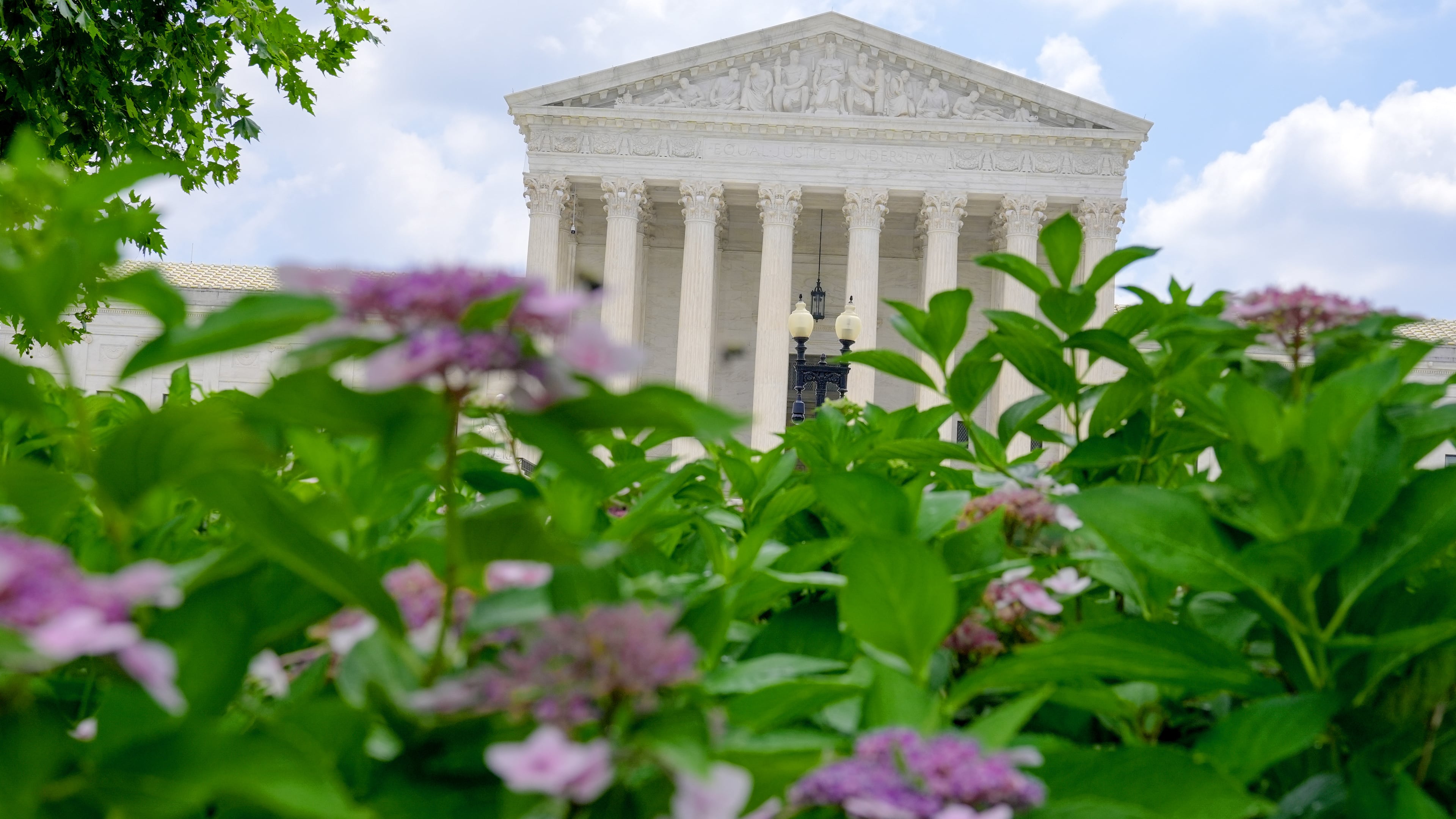
The Supreme Court on Tuesday upheld a broad conception of birthright citizenship, rejecting President Donald Trump’s executive order declaring that children born to parents who are in the United States illegally or temporarily are not American citizens.
The decision, in line with the longstanding judicial interpretation of the 14th Amendment, comes on the final day of a Supreme Court term that has centered on Trump’s expansive claims of presidential power — and largely ruled in his favor.
In its other Tuesday rulings, the court upheld laws in roughly half the states that prohibit transgender girls and women from playing on their public school and college sport teams and struck down limits on party spending in federal elections.
Here's the latest:
Venezuelan asylum seeker, with 2 daughters born in US, relieved by court ruling
Loreana Pachano, a Venezuelan asylum seeker in Lehi, Utah, with two daughters who became U.S. citizens by birth, said the court’s decision was a relief.
Her brother is also a U.S. citizen because he was born in the country while his father was working on a master’s degree with a student visa. She was born in Venezuela.
“It’s good to see there’s some pushback when things don’t make sense,” said Pachano, who has also applied for an employment-based green card. She said her daughters have no legal status in Venezuela.
Justice Thomas: ‘Citizenship Clause was enacted for people who were born in this country and called it home’
Thomas, who wrote the main dissent, disagreed with the majority’s opinion on birthright citizenship.
The basis of his argument, among other things, is that the court ignored evidence from Reconstruction debates that suggested citizenship depended on a deeper relationship to the country.
“The Citizenship Clause was enacted for people who were born in this country and called it home. It was enacted for freed slaves such as Dred Scott, who had ‘a domicile’ here and therefore were entitled to sue as citizens,” Thomas wrote in his dissent, concluding that Reconstruction was a targeted remedy for freed slaves to restore citizenship to a wrongfully excluded group.
Supreme Court chief justice: ‘We break no new ground today’
Much of Chief Justice John Roberts’ opinion was a history lesson on English common law, in which he concluded that birthright citizenship has always depended primarily on birthplace — not on parents’ immigration status or domicile.
“Citizenship, then and now, was the right to have rights — to freely participate in our political community. The Framers of the Fourteenth Amendment extended that promise to ‘every free-born person in this land,’” Roberts wrote for the court, citing congressional debate over the amendment, “We keep that promise today.”
“We break no new ground today,” Roberts said on the bench as he read the court’s majority opinion.
Justice Department instructs prosecutors to crack down on ‘birth tourism’ schemes
In a memo circulated hours after the Supreme Court’s ruling upholding birthright citizenship, the deputy attorney general’s office directed prosecutors to “prioritize the investigation and prosecution” of fraudulent “birth tourism” schemes.
In seeking to end birthright citizenship, the Trump administration pointed to “birth tourism” networks that arrange for non-U.S. citizens to come to the country solely to give birth.
The memo says that while many of such cases are charged as visa fraud, prosecutors should also consider whether other laws apply, including wire fraud, money laundering and aggravated identity theft.
“Together, we will bring illegal birth tourism to an end and those responsible to justice,” the memo says.
‘A very narrow decision’
A lawyer representing trans female athletes in pending litigation in multiple states described the Supreme Court’s ruling that upheld state laws barring transgender girls and women from playing on school athletic teams as “a very narrow decision.”
Susan Cirilli, whose clients include former Swarthmore College cross-country runner Evie Parts, reiterated that there remains no federal law in the country that prohibits transgender women from participating in sports and argues that President Trump’s executive order cannot supersede state law.
Venezuelan woman who is part of another birthright lawsuit received court decision in tears
“I feel a great sense of tranquility,” said the woman, one of the five plaintiffs in the lawsuit at the Maryland district court. “It is a triumph for our children; I fought hard for this day,” said the asylum seeker.
The woman, who asked not to be identified from fear of being detained, said she filed the lawsuit Jan. 21, 2025, the day after President Trump announced his executive order declaring that children born to people who are in the United States illegally or temporarily are not American citizens. She was pregnant with her first child, who was born in August 2025.
As an asylum seeker, she did not believe she could request the Venezuelan citizenship for the baby and wondered what citizenship the child would have.
“There was a lot of uncertainty and fear. I wondered: if my son wasn’t going to be from here, then where would he be from?” said the woman, who was a doctor in her country and arrived to the U.S. in 2019 after receiving death threats in Venezuela.
On Tuesday, she said she felt a “sea of emotions” when she saw the news on TV.
ACLU celebrates the Supreme Court’s birthright citizenship ruling
“This should have been a unanimous decision,” attorney Cody Wofsy, deputy director at the ACLU Immigrants’ Rights Project, told reporters after the decision was announced. “The text of the Constitution is clear, the history is clear, and the precedent is clear.”
“That said, regardless of what the vote count may have been, this is a rejection of the Trump administration’s extreme attempts to rewrite the Constitution and to exclude entire portions of American-born children from our country.”
Birthright could become a powerful wedge issue in US politics, critic of decision says
“The president was never going to win, in the sense that his executive order was going to be overturned,” said Mark Krikorian, the director of the Center for Immigration Studies, a think tank favoring restrictive immigration policies. “The question was if the Supreme Court would accept the ACLU’s interpretation of the 14th Amendment.”
The ruling “constitutionalized the question” of birthright citizenship, he said, requiring changes through a constitutional amendment.
That, he argued, is highly unlikely: “Congress can’t rename post offices, let alone do anything else.”
But, he said, birthright could now become a powerful political wedge issue, similar to the court’s 1973 abortion ruling, which was overturned in 2022.
“It’ll distort our politics the way Roe vs. Wade did in energizing a political movement,” he said.
Could pregnancy now be a question on visa application?
Mark Krikorian, a prominent Washington voice favoring restrictive immigration policies, said he expects the ruling to result in new U.S. visa applications, with potential visitors being asked if they are pregnant.
“It’s something that visa officers are often reluctant to ask about — it’s awkward,” said Krikorian, the director of the Center for Immigration Studies.
“But if it’s on the application then you have the answers, and if you lie you’ve committed a felony,” he said.
The Trump administration says birthright citizenship has created what it calls a birth tourism industry.
“It is unacceptable for foreign parents to use a U.S. tourist visa for the primary purpose of giving birth in the United States to obtain citizenship for the child,” the State Department said in a post on X. “Those who abuse our immigration system through birth tourism may be ineligible for future visas or travel to the United States.”
Justice Thomas says the majority misunderstands the 14th amendment
He insists the majority opinion perpetuates a misunderstanding and misapplication of the 14th amendment.
The citizenship clause and related Reconstruction statutes granted citizenship “to persons born and domiciled in the United States regardless of their race,” he wrote. But “neither guaranteed citizenship to persons who were not domiciled in the United States.”
He continued: “Blacks were entitled to citizenship because they were Americans. They had no other homeland, owed no allegiance to any foreign power, and were subject to no other authority.”
That highlights the argument over what it means to be “subject to the jurisdiction” of the U.S.
The majority holds that, with exceptions like foreign diplomats, being on U.S. soil makes a person subject to U.S. laws. Thomas and dissenters reason that no one who is separately subject to another foreign government should be considered “subject to the jurisdiction” of the U.S., at least when conferring citizenship.
Justice Jackson takes issue with Thomas in citizenship reasoning
Justice Clarence Thomas’ dissent in the birthright case argued the 14th amendment’s citizenship clause applied only to formerly enslaved people and not more broadly.
That prompted Justice Ketanji Brown Jackson to pen a concurrence to Roberts’ majority opinion.
“Despite his longstanding endorsement of a ‘colorblind’ Constitution, Justice Thomas now surprisingly suggests that the Citizenship Clause was a race-conscious remedial measure, relating only to ‘freed slaves such as Dred Scott,’” she wrote, calling that a “narrow vision” of Reconstruction’s intended expansion of democracy.
“This alternative account pitches Black Americans against immigrants when the advocates who promoted the Fourteenth Amendment did no such thing,” Jackson wrote. “Freed Blacks fought for the shared humanity of all people.”
Jackson is the first Black woman to sit on the Supreme Court. Thomas is the second Black man, succeeding Thurgood Marshall, who argued the Brown v. Board case that struck down segregated schools.
Trump says Congress should end birthright citizenship and calls court ruling ‘too bad’
The president said the Supreme Court’s decision upholding that anyone born in the United States automatically becomes an American citizen was “too bad for our Country,” but that Congress could “easily” address it with legislation.
Trump declared that “No long and unwieldy Constitutional Amendment is necessary!”
But the Supreme Court’s ruling Tuesday makes it clear that it would be necessary to amend the Constitution. Chief Justice John Roberts, who wrote the opinion for the court, pointed to the Fourteenth Amendment in the Constitution in ruling that anyone born in the country, with very limited exceptions, is a citizen.
Justice Department reacts to the ruling on birthright citizenship
The Justice Department said in a statement that it’s “committed to tackling illegal birth tourism schemes by working diligently with U.S. Attorneys across the country to uphold the law.”
“Actors seeking to exploit loopholes to obtain automatic citizenship for their children pose a national security threat and will be brought to justice,” the department said in a post on X.
Dred Scott case featured in the justices’ birthright citizenship writings
U.S. Supreme Court justices have long distanced themselves from the pre-Civil War decision that declared Black people — enslaved and free — were not U.S. citizens.
The 1857 Dred Scott case was featured again Tuesday, being mentioned 48 times in 194 pages of the birthright citizenship opinion, concurrences and dissents.
Roberts’ majority opinion explained how U.S. birthright citizenship originates with English common law: Anyone born in the monarch’s realm was considered a “natural-born subject.”
The “odious” Scott case, Roberts said, deviated from that once-accepted understanding and “was met with shock.”
In response, he detailed, the Civil Rights Act of 1866 and the 14th Amendment’s citizenship clause restored common law understanding, with lawmakers making clear they were explicitly rebuking the Scott decision.
Yet, Roberts wrote, “the Government and the principal dissent propose a return to its core tenet,” that “for certain people, being born on American soil will not suffice to confer citizenship.”
Supreme Court denies report that Justice Samuel Alito is retiring
The Supreme Court’s public information office is denying a published report, since retracted, that the court announced Alito’s retirement Tuesday.
The unusual statement followed a story from NPR saying the court had announced that Alito was stepping down. NPR pulled the story a short time later. Chief Justice John Roberts announced the retirement of several court employees Tuesday, as he customarily does after the court’s final opinions are out. Alito was not among them.
Speculation had swirled about the justice’s future plans earlier this year, but Fox News and CBS reported this spring that he planned to remain on the bench.
NPR’s editor-in-chief released a statement saying the story had been incorrectly reported and that correspondent Nina Totenberg would appear on “All Things Considered” Tuesday afternoon to explain what had happened.
Court will consider striking down assault weapons bans in Connecticut and the Chicago-area
A Supreme Court that has expanded gun rights will consider whether bans on semiautomatic rifles, often called assault weapons, violate the Second Amendment.
The justices said Tuesday they will take up appeals asking the court to strike down bans on the AR-15 and similar semiautomatic firearms in the Chicago area and Connecticut.
Similar laws are in place in about a dozen states, covering major cities like New York, Los Angeles and Washington, D.C. Congress allowed a national assault weapons ban to expire in 2004, but Democrats have supported renewing it in response to a series of mass shootings and states have continued to pass their own laws.
The cases are the latest high-profile disputes over guns to reach the court since its conservative majority handed down a landmark ruling in 2022 that expanded Second Amendment rights and spawned challenges to firearm laws around the country.
The case is expected to be heard in the fall.
More reactions to the Supreme Court’s decision on campaign spending
The conservative-leaning Institute for Free Speech hailed the decision as “a landmark victory for the First Amendment.”
“More than half the states have operated for years without restricting coordinated party expenditures, and there is no evidence of the corruption the federal government fears,” institute senior attorney Brett Nolan said. “The Court corrected a two-decade-old mistake.”
Meanwhile, Jacquelyn Lopez and Rachel Jacobs, partners in the Elias Law Group, which represents Democrats in voting rights cases and election contests, said the decision “needlessly” destroyed “a long-standing pillar” of federal campaign finance laws.
However, they also said Republicans have “pushed the boundaries” of the limits to help weak candidates. They said the Elias Law Group had anticipated the outcome for months.
“In the long run, Democratic campaigns will benefit from the level playing field this ruling provides,” they said. “Now, both parties are free to offer unlimited support to their candidates, not just the party willing to ignore the law to do so.”
From a descendant of the man at the center of the 1898 birthright citizenship ruling
Norman Wong, the great-grandson of Wong Kim Ark, the Chinese American cook at the center of the landmark 1898 Supreme Court decision establishing birthright citizenship, applauded Tuesday’s ruling.
“My great grandfather, Wong Kim Ark, never set out to become a symbol. He was one man, only a cook, and yet he stood up for what was right, and I believe that it has made a difference,” Wong said in a statement. “As a result, he stood up for the rights of all of us Americans — it just so happens that I am related to him. Today’s ruling shows that his victory remains as important now as it was in 1898.”
‘By the grace of God, the president does not manage to do everything he wants’
For a Mexican mother with six children born in the United States — ranging in age from 18 years to 18 months — the Supreme Court’s decision brought happiness.
“I am happy for our children,” the 38-year-old woman said in a telephone interview. “I am happy because they don’t face any risk like we do.”
The woman, who asked not to be identified for fear of being detained and deported, crossed the U.S.-Mexico border in 2007 in search of a better life. She has not applied for asylum or any other immigration status.
She works at a plant nursery in South Florida, where her children attend school.
The woman said one of her children called her as soon as he found out about the decision to share his joy with her.
“By the grace of God, the president does not manage to do everything he wants,” the mother said. “I was confident that, with God’s help, he would not succeed.”
Birthright citizenship survived racist eras, and now Trump, Global Refuge leader says
The head of Global Refuge said the Supreme Court averted a catastrophe with its 6-3 opinion upholding the 14th Amendment and rejecting the Trump administration’s attempt to overturn a Reconstruction era amendment.
“Birthright citizenship survived the Chinese Exclusion Act, Jim Crow, and today, it survived an executive order that would have essentially turned the maternity ward into a customs checkpoint,” said Krish O’Mara Vignarajah, President and CEO of Global Refugee.
“The Justices rightly recognized that the U.S. Constitution is clear and unambiguous: if you are born in this country and subject to its jurisdiction, you are a citizen of this country,” she said. Vignarajah said a different outcome would have denied citizenship to more than 250,000 children born in the U.S. each year.
“This was a constitutional stress test.”
Trump says Republicans won ‘big’ on Supreme Court’s party spending ruling
The president applauded a Supreme Court ruling that struck down a federal election law and made it easier for major donors to avoid caps on individual contributions to candidates by going through the party.
“A BIG WIN FOR REPUBLICANS and, more importantly, The First Amendment!” Trump posted on social media.
House Speaker Mike Johnson ‘very disappointed’ over birthright citizenship ruling
The Republican leader’s news conference was interrupted by the ruling as reporters instantly sought a real-time reaction.
“Oh dear,” Johnson said as a reporter read out the decision.
Johnson said he believes it will subject the country to “serious challenges going forward and we’ll have to deal with that.”
Johnson, who has worked as a constitutional lawyer primarily on religious issues, said the 14th Amendment is being abused by people who are coming to the U.S. to have children in a “birthing tourism trend.” It’s not illegal but is a practice the Trump administration has tried to reduce.
__
This story has been corrected to reflect the correct last name of a Venzuelan asylum seeker to Pachano, not Panchana.