Georgia lawmakers leave data center tax breaks intact, punt on energy costs

When the General Assembly convened in January to begin its legislative session, few issues seemed to get more attention from lawmakers than data centers.
A flurry of data center bills emerged in the session’s early days, from moratoriums on new developments to measures aimed at the facilities’ energy infrastructure costs and rolling back the lucrative tax breaks the state offers to lure them to the Peach State.
But as the legislature adjourned in the wee hours of Friday morning, the robust debate that began beneath the Gold Dome earlier this year ended in relative silence, at least as far as data centers are concerned.
In the end, none of the legislation consumer advocates said was needed to protect Georgians from the onslaught of data centers successfully cleared both chambers.
A bill to shield residential electricity customers from data centers’ power infrastructure costs fizzled way back in March. Georgia Power, the state’s largest electric utility, and the Data Center Coalition, a trade group for the data center industry, strongly opposed the measure.
But even scaled-back consumer protection legislation passed by the House or Senate failed to clear the other chamber.
The General Assembly also elected to leave the state’s data center tax breaks intact, even after a state report recently estimated Georgia would miss out on $2.5 billion in tax revenue in 2026 because of the perks.
Khara Boender, the director of state policy for the Data Center Coalition, said data centers are providing jobs and creating tax revenue for Georgia counties. Boender also thanked Gov. Brian Kemp and state legislators “for their efforts to ensure Georgia remains a key market for industry investment.”
“The passage of this legislation would have discouraged future investment and signaled that Georgia is closed for business, eroding the state’s well-earned business reputation in the process,” Boender said in a statement.
But consumer and environmental groups sharply criticized lawmakers for punting on the issues.
“The data center tax breaks are going to the richest people and the richest companies in the history of the world,” said Mark Woodall, a legislative director for the Sierra Club. “It’s disgraceful.”
In a statement, House Speaker Jon Burns said his chamber passed “one of the strongest ratepayer protection acts in the nation, which would have ensured Georgians aren’t footing the bill for large-load users like data centers.” Burns was referring to House Bill 1063, which would have set requirements for power utility contracts with data centers.
“Unfortunately, the measure didn’t make it across the finish line in the Senate, but it’s something the House will continue to work on during the interim,” Burns’ statement said.
A spokesperson for Lt. Gov. Burt Jones, who presides over the Senate, did not respond to a request for comment on the gridlock over these issues.
A spokesperson for Gov. Brian Kemp, who vetoed legislation in 2024 that would have clawed back the tax breaks Georgia offers data centers, did not respond to questions about data center legislation.
Historic power fleet expansion
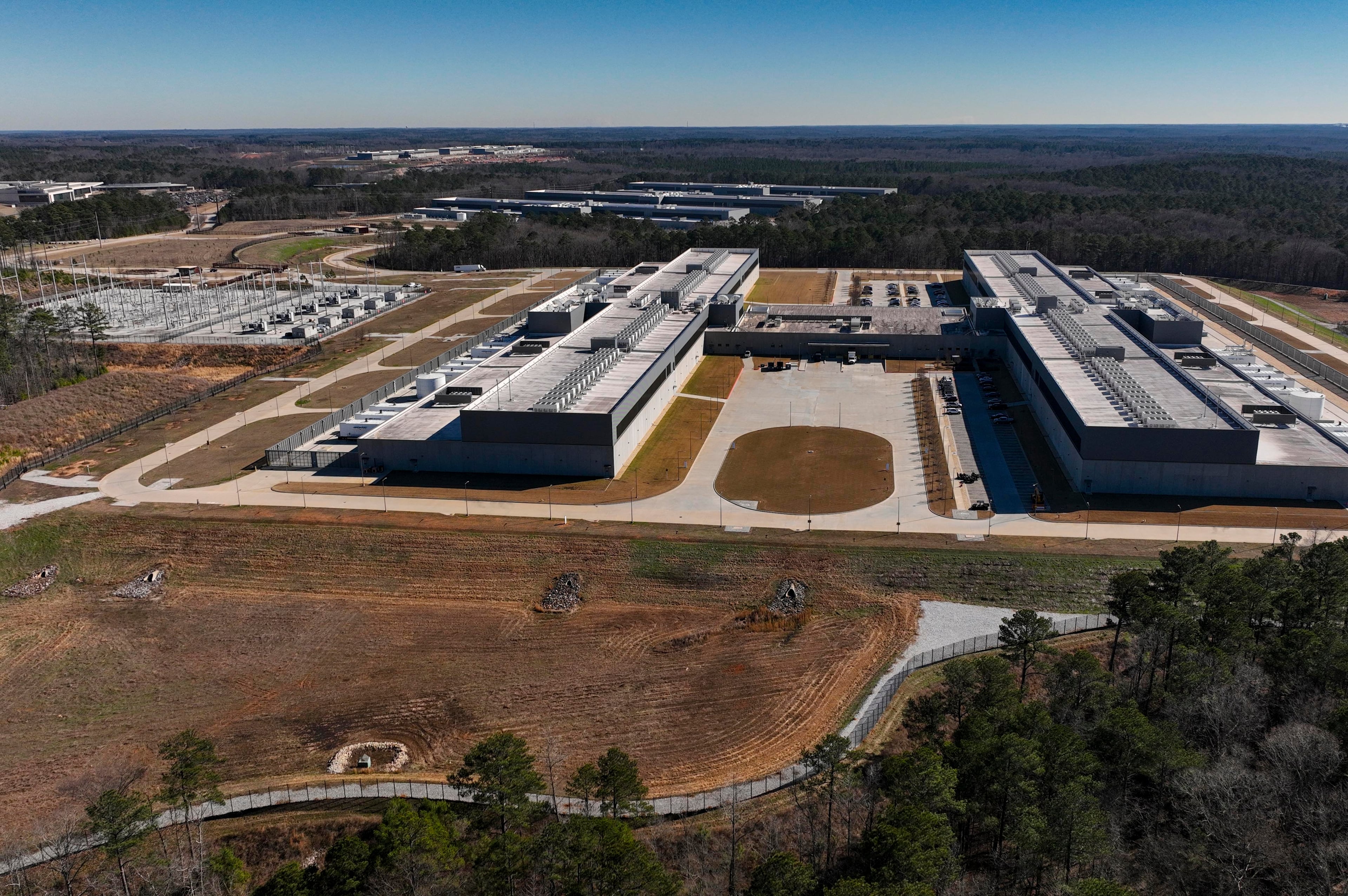
Data centers are the sprawling, computer server-filled warehouses that power artificial intelligence, video streaming services and the digital economy.
Georgia has become one of the most robust data center markets in the country in recent years, led by the white-hot Atlanta area. The amount of data center space under construction in metro Atlanta hit a record high in 2025, according to data from real estate services firm CBRE.
Political and regulatory support have aided the spread of the facilities across Georgia, but residential backlash over impacts to land, water and their own pocketbooks is starting to chip away at that.
What distinguishes them from other warehouses are the gobs of around-the-clock energy required for them to operate. The buildings can use 10 to 50 times as much power as a typical office space that is the same size, according to the federal Environmental Protection Agency.
That’s sparked concerns that Georgians could wind up subsidizing the electricity infrastructure the facilities need.
In response to the AI-driven boom, Georgia Power is adding unprecedented amounts of new power resources.
According to the company’s most recent annual report, Georgia Power is set to add roughly 13 gigawatts of power resources in the coming years, with the lion’s share of the new capacity needed to serve data centers. That will nearly double the company’s generation fleet, and most of the power resources are set to come online in the next five years.
The annual report also sheds light on the buildout’s cost. In it, Georgia Power says it expects to spend more than $52 billion on its grid expansion through 2030.
That steep price has led to heated debates over who will pay for the new electricity and the infrastructure.
The Public Service Commission has already approved changes last year to Georgia Power’s billing rules, which the utility and the PSC say ensure data center operators will pay their fair share of electricity costs.
‘A lot of talk’
Not everyone believes those protections are adequate.
For the second straight session, environmental groups and consumer advocates pushed for what they considered the “gold standard” for residential customer protection, Senate Bill 34.
The original measure, sponsored by Sen. Chuck Hufstetler, R-Rome, would have banned Georgia Power from charging residential customers for any costs tied to serving data centers. But the bill that passed out of committee in February was rewritten with language preferred by Georgia Power and the Data Center Coalition.
On the Senate floor, Hufstetler tried to change the bill to its original form, but the chamber adjourned abruptly, blocking the bill from a vote and essentially stopping it in its tracks.
Other bills that could have protected customers from data centers’ energy costs, like HB 1063, also went nowhere after Crossover Day.
Liz Coyle, the executive director of the consumer advocacy nonprofit Georgia Watch, criticized both chambers’ for their inaction.
“There was a lot of talk at the Capitol about the affordability crisis, but they did nothing to protect Georgians from subsidizing Georgia Power’s massive, speculative buildout to serve large data centers,” Coyle said.
A Georgia Power spokeswoman pointed to the bill relief it says the company’s expansion will provide residential customers.
“Georgia is different than other states,” Georgia Power spokesperson Meredith Stone said. “Under the rules and regulations set by the Georgia Public Service Commission, data center growth in our state means large energy users pay more so you pay less.”
In reality, it will take time for the full impacts of the state’s data center boom to come into focus.
The utility has agreed to freeze its current base electricity rates for the next three years.
With the help of extra revenue from data centers, Georgia Power has also pledged to soften its next rate adjustment, currently scheduled for 2028. The company has promised residential customers using 1,000 kilowatt-hours of power a month — considered the “average” for estimating rate impacts — will see $8.50 in “downward pressure” on their monthly bills starting in 2029.
But “downward pressure” doesn’t necessarily mean lower bills are coming. It just means bills won’t rise as much as they would have without the extra revenue.
About the Authors

Drew Kann is a reporter at The Atlanta Journal-Constitution covering climate change and environmental issues. His passion is for stories that capture how humans are responding to a changing environment. He is a proud graduate of the University of Georgia and Northwestern University, and prior to joining the AJC, he held various roles at CNN.

Kristi Swartz is an AJC contributing writer covering climate change and related matters. She writes about how climate change impacts people’s lives, from extreme weather hitting parts of the state more frequently, to higher electricity bills, insurance premiums and health care expenses.