Antique details and contemporary art mix effortlessly in Charleston home

Tyler Rollins’ Charleston home is a fascinating contradiction. With its quiet elegance, Spanish moss-draped trees, gracious piazza and lush garden, the 1870 house in the Harleston Village neighborhood is exactly what one imagines a Charleston home should be.
The interior of Rollins’ home, however, is a little less expected. A onetime New York gallery owner, Rollins is also an art adviser and collector whose home is filled with the kind of contemporary artwork you’d expect to see in a Manhattan penthouse. His focus is on contemporary Asian art, and his home is filled with sculptures, paintings and photographs by major mid-career artists from Southeast Asia.
“I love antique furniture and wanted to display it in a more contemporary way, less ‘fussy’ and with more emphasis on each piece functioning as a hand-carved sculpture,” he explained. “I wanted to put the main emphasis on my contemporary art collection.”
Rollins is also the founder of the nonprofit Foundation for Spirituality and the Arts (FSA) which fosters connections between contemporary art and spirituality and examines how faith can influence an artist’s process. Each year he hosts several artists in residence as part of the foundation’s work.
In addition to the main house, there are two large buildings beautifully integrated into the backyard landscape — each with its own distinct style. Those wonderfully decorated spaces are occupied by FSA’s resident artists. “I really wanted it to feel like living in a home or a private artist’s retreat, and that’s the special quality of the residency. It’s not an institutional space.”
While the main house is filled with cutting-edge contemporary art, these smaller buildings are dedicated to historic artworks rooted in Charleston’s history. The kitchen house is largely brick and the heavy wood ceiling beams give it the cozy feel of an old English farmhouse. The carriage house, meanwhile, is bright and white, defined by carved painted woodwork that give it the feel of a dollhouse blown up to human size.
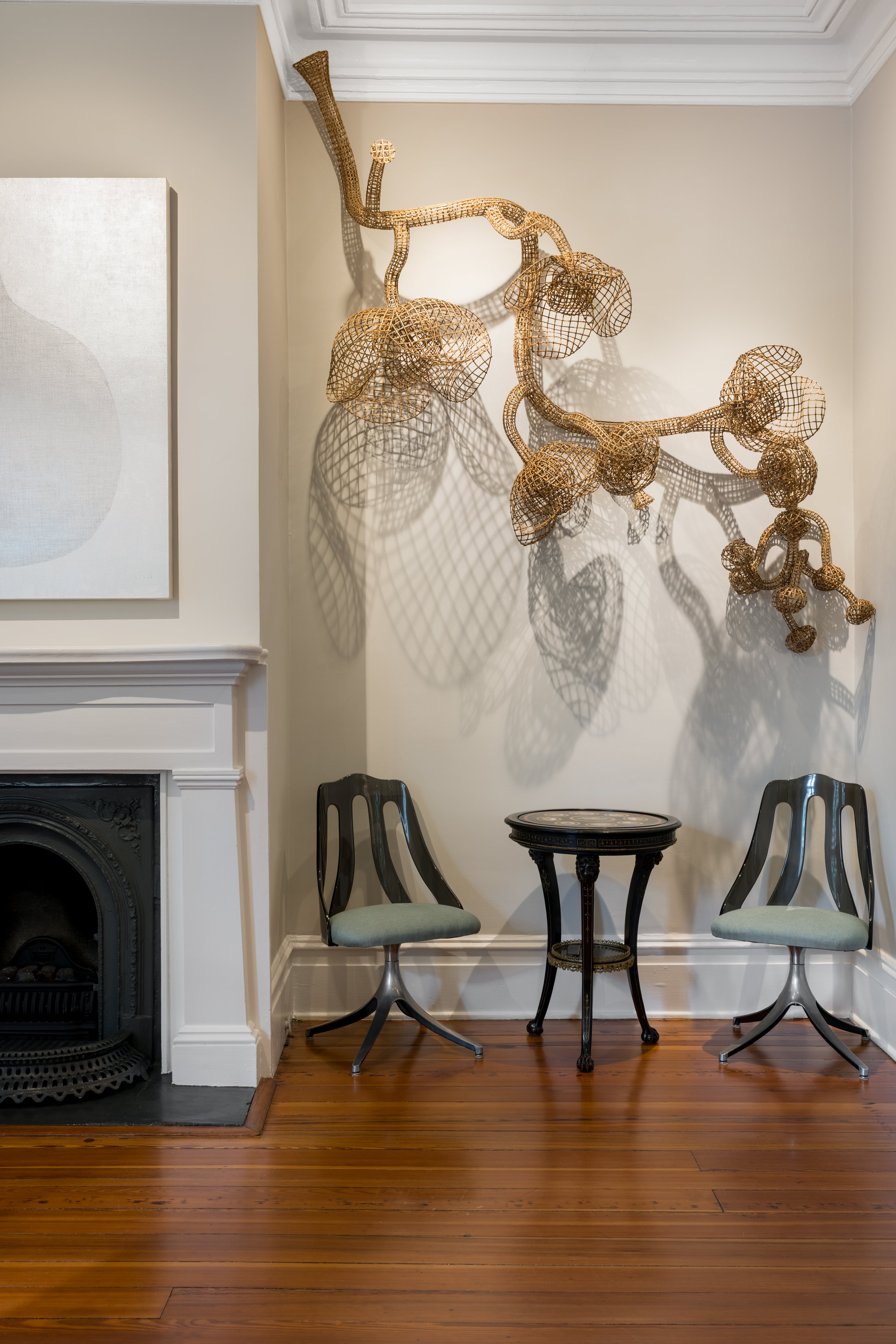
Testifying to the inventive visual mashups of old and new in Rollins’ home, two midcentury modern chairs and a table from the 1870s are flanked by a work in rattan, bamboo and metal wire from one of the most celebrated artists in Southeast Asia, Cambodian artist Sopheap Pich. Pich currently has several sculptures on view on New York’s High Line.

Demonstrating Rollins’ subtle balance of the antique and the contemporary, his dining room features antique furniture and an installation piece “TABLED” by Malaysian artist Yee I-Lann which consists of 50 ceramic plates printed with digital images. The sculptures on the table are works in aluminum, glass and ceramic by Thai artist Pinaree Sanpitak.

Modestly scaled by American standards, the pretty galley-style kitchen off Rollins’ dining room leads to a backdoor and access to the kitchen house and carriage house beyond.

A small powder room is tucked beneath the staircase in the home’s grand entry foyer, one of the many surprises in a home filled with a meticulous sense of detail and whimsy, from the brass toggle switch plates in the home to the small sculptures and miniature windows tucked like Easter eggs throughout the home.

Rollins achieved a more formal look in the home’s front garden with clipped boxwoods. The groundskeepers can sometimes get a little overzealous with the leaf blowers, so he has been know to “re-drape” the Spanish moss in the Japanese evergreen oak trees out front. “It makes a nice contrast to the backyard, which is supposed to look like it had been allowed to overgrow a bit. I don’t keep the palms and hedges pruned too tightly and have added a lot of extra ground cover,” he said of the contrast between the more controlled front garden and the wilder back garden.

A gracious porch runs along the side of the main home. “I wanted the porch — or the piazza as we say in Charleston — to have a lived-in feeling, with old wicker furniture from various periods mixed together, along with old cast iron and marble tables.”

“I was inspired by legendary Charleston landscape architect Loutrel Briggs, particularly his signature style of outdoor ‘rooms’” said Rollins of a backyard garden space he created from scratch, including adding 12 trees. When he bought the home, instead of a garden there was an apron of thick concrete surrounding the home. His garden is composed of three outdoor rooms, each with its own identity. “At night, it’s dimly lit to give a very mysterious and moody effect, whereas during the day it is quite bright with southern exposure.”

A lap pool in the backyard maintains a sense of privacy with a grove of bamboo growing in brick planters to create a screen from the home next door. In warmer months Rollins grows orchids in the trees on his property.

The former carriage house was in such bad shape Rollins had it demolished and built a new one in the Carpenter Gothic style popular in the 1840s-1860s. “I have always loved Gothic Revival architecture and decorative arts, but the Carpenter Gothic has a special appeal in that it is more rustic, more connected to local craftsmanship, and has a quirkiness and whimsy that come from not following the rule book too closely.” He kept the walls and fabrics in the carriage house light to give the room an ethereal quality and salvaged wood beams and antique heart pine floors from the kitchen house. He furnished the carriage house with Gothic Revival furniture from the late 19th century.

The exceedingly aesthetic second-floor bedroom features a peaked roofline and a wedding cake prettiness enhanced by the pure white painted wood details that Rollins said you would often find in rustic churches in the 19th century Carpenter Gothic style.
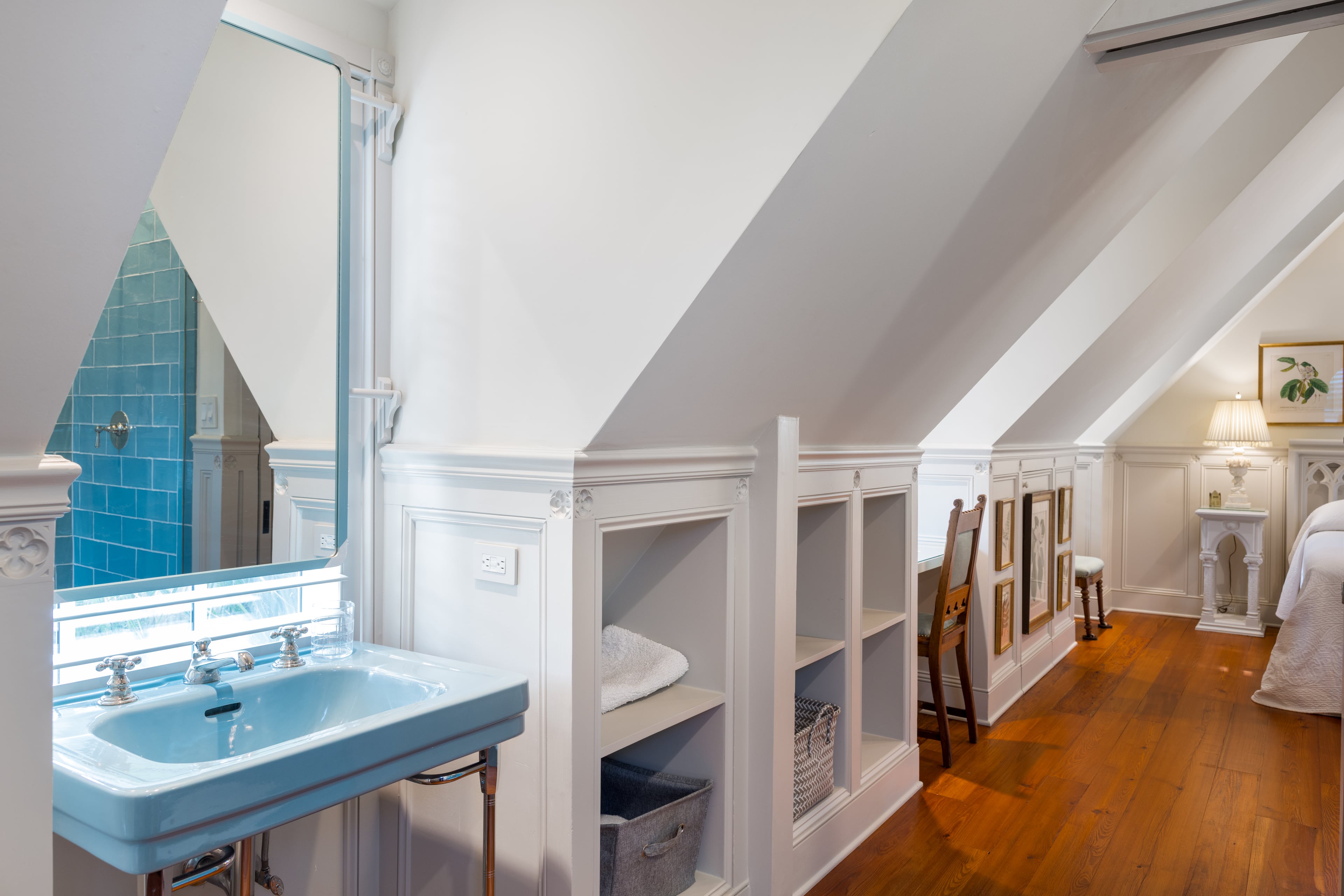
Regional online auction houses are some of Rollins’ favorite places to find antiques and home decor. “They are often a fantastic source for special items at great prices.” He found this vintage ‘30s-‘40s blue sink in the carriage house bathroom on Etsy.

Previously attached to the main house, the kitchen house, where meals were once prepared and cooked, is a historic component of many Charleston homes, built of brick to withstand fires. The house has a more rustic vibe with exposed brickwork and beams. Because of the lower ceiling and more intimate scale of the rooms Rollins said that “everything is a little bit miniaturized” including the compact kitchen with its vintage-style white enamel stove and range hood.
“My two cottages have such different atmospheres, and stepping into each one is like entering a different world altogether,” said Rollins who will occasionally stay in one of these outbuildings for a change of pace.

In decorating the kitchen house, Rollins focused on art by Charleston artists like Merton Simpson and William Halsey from the 1860s through the 1970s.