Georgia has a powerful lieutenant governor. Will it stay that way?


Whoever wins Georgia’s lieutenant governor race in November will lead the state Senate chamber for the next four years ― but the scope of his power will rest in the hands of the likely Republican majority.
Many lieutenant governors across the country have only ceremonial duties, as their only job is to take over if the governor can’t complete the term.
In Georgia, the lieutenant governor wields immense power in the state Senate by presiding over floor debates and making committee assignments that give him control over what bills reach the floor for a vote.
But that power comes from the Senate rules, which can easily be changed.
“The power is all dependent upon the majority caucus allowing you to have it,” said Lt. Gov. Burt Jones, whose term ends in January following his unsuccessful bid for governor.
“If the majority caucus and the lieutenant governor aren’t on the same page on a lot of issues, then it can make for a very dysfunctionally run chamber,” he said.
A weakening of the lieutenant governor’s authority could limit the next officeholder’s ability to deliver on promises made on the campaign trail.
The candidates in the race to replace Jones have both spent two terms in the Senate — but have vastly different politics.
Greg Dolezal casts himself as a hardline Republican with unwavering loyalty to President Donald Trump. Democrat Josh McLaurin is a rising star of his party and looking to become the first Democrat to hold the powerful seat since 2007.
Senate Democrats see this race, along with Keisha Lance Bottoms’ bid for governor, as an opportunity to level up their influence at the state Capitol, where they have had little power for the past two decades.
“If (Bottoms) were to win, and we pick up seats in the Senate and the House, I don’t know what their posture is going to be,” Senate Minority Leader Harold Jones II said of the Republican majority. “Will they just try to shut everything down and wait to win those seats back, or will they say, ‘Let’s work with Democrats’?”
Senate Majority Leader Jason Anavitarte wouldn’t say whether the caucus would explore stripping the lieutenant governor’s powers if a Democrat is elected in November.
“Our caucus is excited to work with one of our own, Greg Dolezal, when he is elected by the people of Georgia this November,” he said in a statement.
Majority rules

Burt Jones, a Republican, couldn’t recall a time when he feuded with the majority party while serving as lieutenant governor.
“I was very fortunate that I had a lot of great relationships and they had a lot of confidence in me,” he said. “So, they didn’t see any need to put any kind of guardrails or restrictions on the lieutenant governor’s role.”
History shows that not all lieutenant governors have been so lucky. A Republican majority has twice changed Senate rules to weaken the position’s powers in recent years.
The first came in 2003 after the GOP won control of the chamber for the first time since Reconstruction. Sonny Perdue, then the incoming Republican governor, convinced four Senate Democrats to switch parties. The Republican chamber moved to strip then Democratic Lt. Gov. Mark Taylor of his authority to make committee assignments and name committee chairs.
And in 2011, within the first two hours of that year’s legislative session ― and while a winter storm blew through Atlanta ― the Republican-led Senate stripped Republican Lt. Gov. Casey Cagle of his assigning powers following a feud over a hospital bed tax the year prior.
“If the chamber stays — and I think it will stay in Republican control — I would be willing to bet that McLaurin would probably not enjoy the same type of power and influence I had,” Burt Jones said.
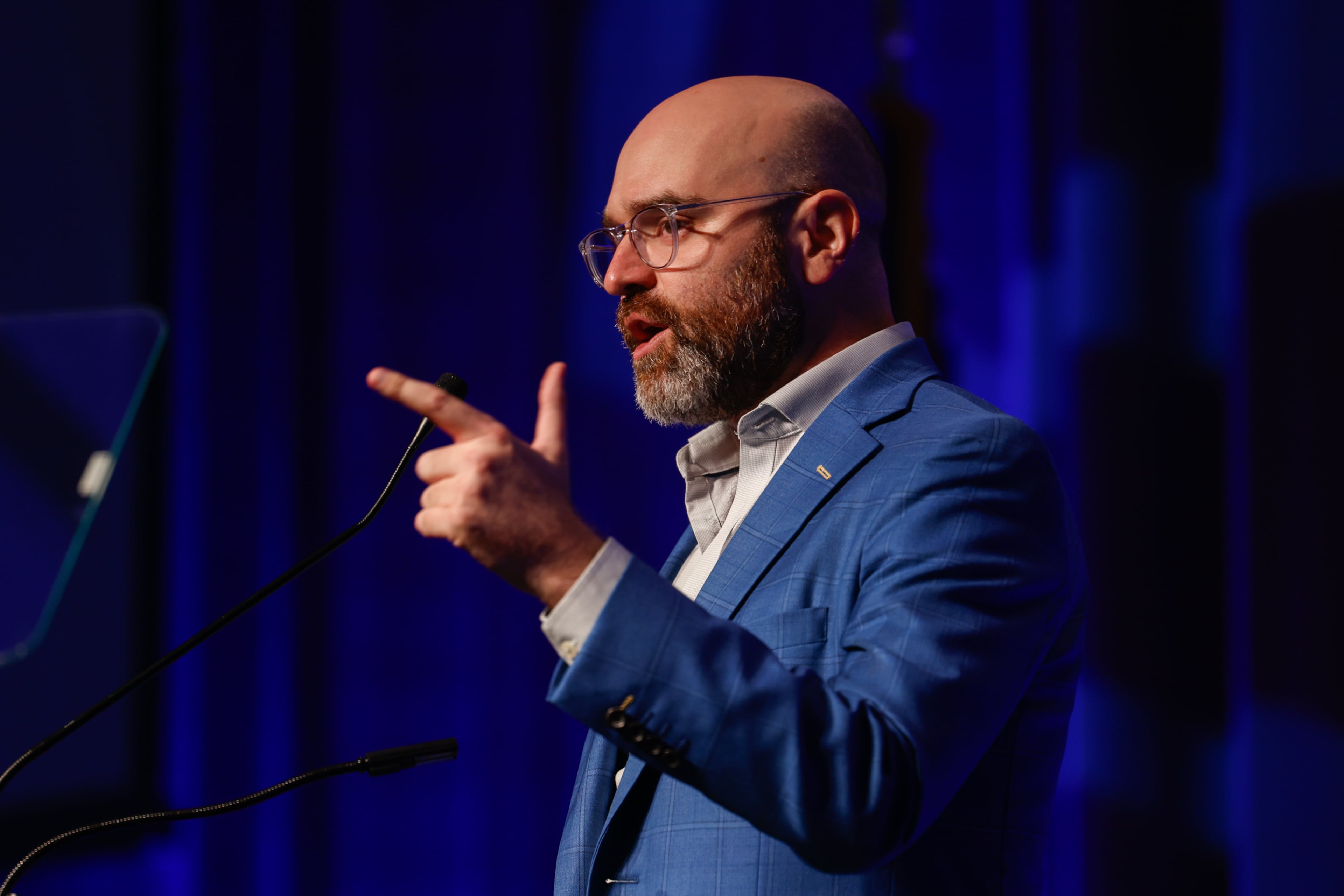
On the campaign trail, McLaurin touts his ability to work across the aisle in the Senate while at the same time lambasting Trump-supporting Republicans.
“It’s a new day in Georgia, folks,” McLaurin said at the Georgia Democratic Convention in Savannah earlier this month. “Millions of voters are waking up to the reality that Democrats are the adults in the room.”
McLaurin told The Atlanta Journal-Constitution there will always be the potential for the majority caucus to weaken the lieutenant governor’s powers.
“They’ve done it to both Democrats and Republicans,” he said. “But rather than store up my treasures in the Senate rules, I’m focused on the ways the office can help build bipartisan consensus and momentum around the main affordability issues facing Georgians, like housing and healthcare.”
Weakening the lieutenant governor’s role is a top concern for Democrats if McLaurin wins, particularly if Bottoms loses the governor’s race and the party fails to pick up additional seats in the Legislature, Harold Jones said.
But even when they share the same party, the lieutenant governor and Senate majority can still butt heads.

Former Lt. Gov. Geoff Duncan ― who ditched the Republican Party to run for governor as a Democrat this year ― boycotted a 2021 Senate vote over sweeping election changes spurred by President Donald Trump’s ire over the 2020 election results.
“It brought attention to the matter,” Duncan said. “It was good attention to some really bad ideas because ultimately that bill failed over in the House and a different version came forward that was slightly improved.”
Party lines aren’t always the only thing that splits the chamber, he said. Often rural and metro-area lawmakers battle over policy; other times it’s a generational divide. And sometimes, more right-leaning Republican members of the body look to pull the chamber further in that direction.
How far right is too far
During Trump’s visit to Cobb County last month, Dolezal dubbed the Peach State “Trump country.”
“Don’t you believe for a second what the fake news will tell you (that) this is a purple state — this is a red state,” he said.
In the Legislature, Dolezal has championed issues aligned with Trump’s positions on transgender athletes and changes to Georgia’s voting system. In 2020, he joined a group of senators who sought to help Trump overturn the results of Georgia’s presidential election.
How Trump-supporting candidates will fare during the midterm elections is a major question among Georgia politicos. Republicans are navigating the challenge of energizing their base without alienating more moderate voters.
“I just don’t sense that there’s a gravitational pull towards the right in Georgia,” Duncan said, who suspects if Dolezal were to win, he’ll face his own challenges navigating the chamber’s power dynamics.
“There’s been some serious incidences of him pulling pins and throwing grenades in public policy, not only on the campaign trail but also at his time as a senator,” he said.

Burt Jones ― who is also a loyal Trump supporter and aligns with Dolezal on red-meat issues ― is more optimistic.
“Dolezal is a very good communicator, and whatever his agenda might be, he’ll be able to communicate that well to the body,” he said. “He has a lot of good working relationships with (senators).”
Anavitarte said the majority party is looking forward to working with Dolezal and called him “a great friend of the caucus.”
But the chamber also faces a high turnover, with 11 of the 56 senators having either resigned to run for higher office or are not seeking reelection. That count includes key members of leadership and the chairs of important committees, including appropriations, judiciary and transportation.
Charles Bullock, political science professor at the University of Georgia, said there’s little way to predict how the Senate will operate before the election results are in.
“So much of the leadership is gone now,” he said. “It’s going to be a very different institution potentially.”